Encounters at Auschwitz-Birkenau
The history of Auschwitz-Birkenau is not only a history of perpetrators and victims. It is also a history of memory, inherited trauma, moral ambiguity and the heavy burden carried by those who survived. The experiences of survivors, their children and those who return to these places of suffering reveal how deeply historical trauma can shape individual lives and collective consciousness. At the same time, these encounters raise broader questions concerning guilt, dissatisfaction, acceptance and the search for meaning in human existence.
Even victims may carry the burden of guilt upon their shoulders. The concentration camps of the Second World War employed complex methods of punishing prisoners who attempted to escape, the purpose of which was to make them understand their own supposed guilt.
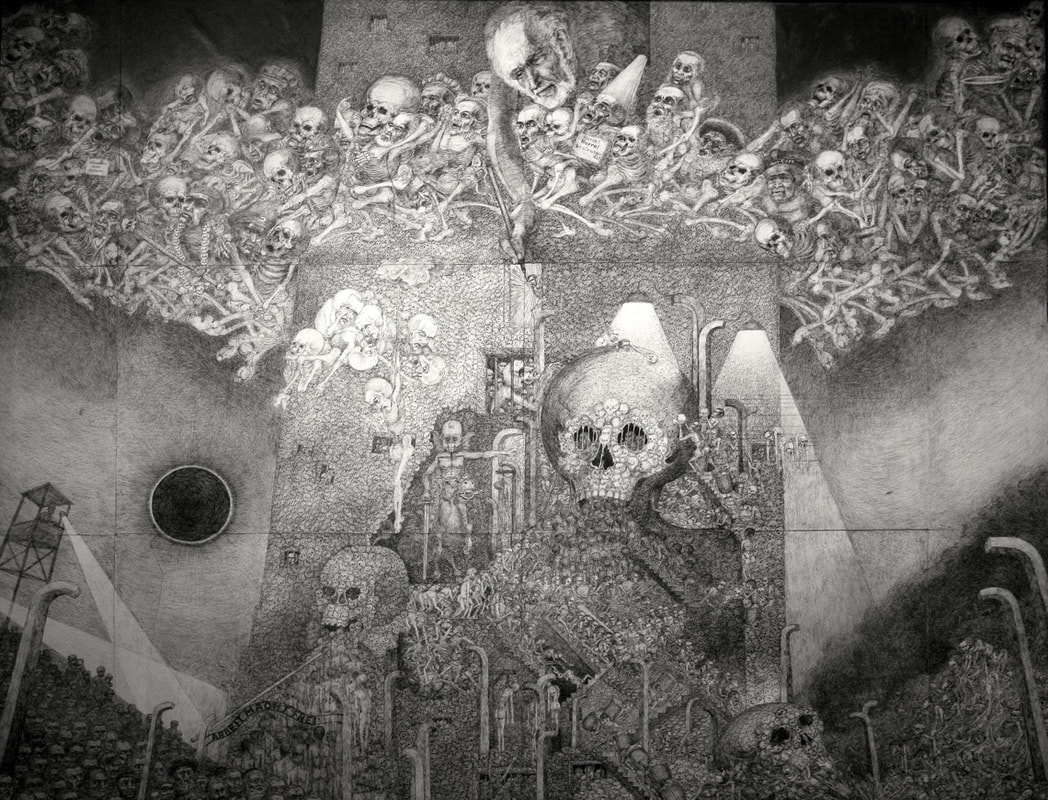
Figure 1. Marian Kolodziej’s drawings of his own experiences at Auschwitz. Immaculate Conception church in Harmęże, Poland.
The Polish survivor August Kowalczyk (1921-2012), who successfully escaped from Auschwitz, spoke about his own feelings of guilt after surviving the camp, knowing that hundreds of prisoners had been executed as punishment for his actions. Kowalczyk participated in a retreat organised by Zen) Peacemakers at Auschwitz during the 1990s. Together, inspired by Kowalczyk and Zen Teacher Bernie Glassman, the Zen Peacemakers succeeded in establishing a hospice for Auschwitz survivors in the town of Oswiecim in the year 2000.
The Burden of Survival and Survivor Guilt
The Polish visual artist and stage designer Marian Kolodziej (1921-2009) also spoke about his own feelings of guilt as an Auschwitz survivor. Kolodziej likewise participated in the Zen Peacemakers retreat until his death in 2009. He was one of the very few prisoners who survived Auschwitz for almost the entire duration of the camp’s existence. He arrived in the first transport of prisoners in 1940 and became prisoner number 432.
Kolodziej (2009) described how, after an escape attempt by another prisoner, they were forced to march in circles for so long that some prisoners collapsed, while others marched over them and crushed them underfoot.
The Machinery of Extermination
Prisoners were also used to perform the most repulsive tasks in the extermination camps, such as forcing people into gas chambers and emptying them before the next transport arrived, cutting the hair of the murdered victims and removing their gold teeth before the bodies were burned in open pits. The prisoners assigned to these duties were known as the Sonderkommando. Kolodziej was one of them.
Kolodziej also participated in the construction of the enormous camp intended for the destruction of human beings that came to be known as Birkenau. Large crematoria were built in the camp in order to dispose of the dead more quickly, yet even these facilities could not always keep pace with the transports and the gassings, and bodies once again had to be burned outdoors. Ultimately, in the summer of 1944, a railway platform was built directly inside Birkenau, making possible the final processing of even greater numbers of people.
During the 1990s, Kolodziej suffered a cerebral haemorrhage, as a result of which his experiences in the Nazi concentration camps resurfaced in his memory. He had never spoken about his past in Auschwitz to anyone, not even to his wife. He rehabilitated his paralysed hand by drawing. The subjects of these drawings became his experiences in Auschwitz.
The drawings of Marian Kolodziej developed into an entire body of work which, according to the artist himself, consists not of art but of words and experiences preserved as images. The works are permanently exhibited in the basement of a Franciscan monastery located near Auschwitz, where they form the space called Labyrinth (Kolodziej, 2009), one of the most significant eyewitness testimonies in the entire history of the concentration camps.
Inherited Trauma and the Search for Closure
Every year, the Zen Peacemakers retreat brings together a diverse group of people of different ages, nationalities and backgrounds.
One such participant, an American man named David Birenbaum had lived a fairly ordinary life as a 1960s hippie in sunny California. Following the deaths of his parents, he wished to establish a new relationship with their Jewish identity and therefore decided to participate the retreat. Both of his parents had been prisoners in the Birkenau extermination camp and had fallen in love there. He remarked that he himself would not even exist without that camp.
Sandwitch to Adolf Eichmann
The American theatre director Anna Smulowitz also participated in the retreat one year. Her parents had likewise met and fallen in love in Birkenau. Her mother’s first task as a prisoner in that camp had been to collect a sandwich from the camp kitchen. There she met the man who would become her husband, who was also a prisoner but worked as a cook in the camp.
Smulowitz was born immediately after the end of the war but described herself as traumatised by the Holocaust. Her mother, consumed by hatred and rage, tormented her throughout her childhood with horrific stories about the concentration camps, the selection ramps, human experimentation, gas chambers, crematoria and burning piles of corpses. One of Smulowitz’s reasons for participating in the retreat was to find some form of closure for her own trauma.
At Smulowitz’s request, I organised a memorial ceremony with her in the SS building next to the selection platform at Birkenau, where her mother had once brought a sandwich to Adolf Eichmann. At the conclusion of the ceremony, I asked Smulowitz for her mother’s name so that the ceremony could be dedicated to her appropriately. She wished the ceremony to be dedicated not only to her mother but also to Adolf Eichmann.
All Paths Led Here
During the retreat, the American man named Marty Yura had the opportunity to examine the documentation concerning his father in the Auschwitz Museum, where all of his father’s work assignments and punishments throughout his imprisonment in Auschwitz had been meticulously recorded. Marty was deeply shaken by what he read, but afterwards he told me that ”all paths led here”.
These paths were neither bad nor good, neither right nor wrong. His father’s path had passed through this camp, and there we stood together on the empty railway platform of Birkenau in the middle of a beautiful day.
Afterword
Throughout these blog posts under the title Zen and the Art of Dissatisfaction I have probably failed to explain to you how one might somehow survive dissatisfaction while remaining reasonably sane. I also do not know if it is possible to get rid of dissatisfaction altogether.
The question therefore becomes: is it possible to free ourselves from dissatisfaction? Could liberation from dissatisfaction merely become another goal, something to achieve and obtain? Would the process of attainment leave us unable to be content until the goal has been achieved? How should we evaluate such an achievement? Should we simply accept our inner dissatisfaction and attempt to live with it already today, right here and right now?
I guess, each of us will find our own answers to these questions. Finding meaning in one’s life is always an individual matter. My intention in these posts has been to present ideas concerning the historical layers and social problems that may give rise to our inner uncertainty.
How should we relate to clearly unjust social constructions such as money, debt or globlisation? Or how should we respond to major global problems such as climate change, the Sixth Extinction, the surveillance industry and ever-developing and more intrusive artificial intelligence?
How to Solve Dissatisfaction
I have also offered several perspectives on addressing inner dissatisfaction, including Indigenous ceremonies and modern research into psychedelic therapy, as well as the simple and elegant practice of sitting quietly and remaining still. Meditation, or zazen, has been found to be an effective means of confronting our inner dissatisfaction and perhaps also of reaching a form of acceptance.
Perhaps this acceptance may even extend to the conservative inner voice within our own minds. It too is merely part of the play of our consciousness. We should not allow it to define our entire existence.
We may become aware of the movements of our own minds by sitting quietly and directing our attention, for example, to our breathing. Such a practice can transform our relationship with the external world in a great many ways. Accepting the unknown and listening to it are steps towards change, and such change may give rise to many positive things.
I have offered the work of the Zen Peacemakers as one example of this process, although it is certainly not the only possible example of activity aimed at addressing dissatisfaction and thereby contributing to social transformation.
Conclusion
The stories of Auschwitz survivors and their descendants demonstrate that suffering does not end with liberation from oppression. Trauma, guilt and dissatisfaction often continue across generations and become woven into personal identity and collective memory. Yet these same stories also suggest that acceptance, attentive presence and compassionate engagement with suffering may open pathways towards healing and transformation. The challenge is not necessarily to eliminate dissatisfaction altogether, but rather to learn how to live with it consciously and to allow it to deepen our understanding of ourselves and of others.
References
Glassman, B. (1998). Bearing witness: A Zen master’s lessons in making peace. Bell Tower.
Kolodziej, M. (2009). Labyrinth. Franciscan Centre of Saint Maximilian, Harmeze, Poland.