The Weight of Debt, the Price of Trust
What is money, really? Is it a tool, a promise, or a shared illusion? This essay dives into the deep and often surprising roots of our monetary systems, far beyond coins and banknotes. Drawing on the anthropological insights of David Graeber and the philosophical debates of Enlightenment thinkers like Rousseau and Hobbes, it explores how concepts of debt, value, trust, and inequality have shaped human civilisation—from the temples of Sumer to the trading ports of colonial empires. It also confronts the uncomfortable legacy of economic systems built on slavery and environmental domination. The aim is not only to trace the history of money, but to ask what this history says about who we are—and who we might become.
Originally published in Substack https://substack.com/home/post/p-162392089
Before Money – The Myth of Barter
Anthropologist David Graeber (2011) argues that debt and credit systems are far older than money or states. In fact, the Sumerians used accounting methods for debt and credit over 5,500 years ago. The Sumerian economy was managed by vast temple and palace complexes employing thousands of priests, officials, craftsmen, farmers, and herders. Temple administrators developed a unified accounting system remarkably similar to what we still use today.
The basic unit of Sumerian currency was the silver shekel, whose weight was standardised to equal one gur, or a bushel of barley. A shekel was divided into 60 portions of barley. Temple workers were given two portions of barley per day—60 per month. This monetary value definition did not emerge from commercial trade. Sumerian bureaucrats set the value to manage resources and transfers between departments. They used silver to calculate various debts—silver that was practically never circulated, remaining in the temple or palace vaults. Farmers indebted to the temple or palace typically repaid their debts in barley, making the fixed silver-to-barley ratio crucial.
Graeber asserts that debt predates money and states. He dismisses the notion of a past barter economy, suggesting it could only exist where people already had familiarity with money. Such scenarios have existed throughout history—for example, after the fall of the Roman Empire, medieval traders continued pricing goods in Roman coinage, even though the coins were no longer in circulation. Similarly, cigarettes have been used as currency in prisons.
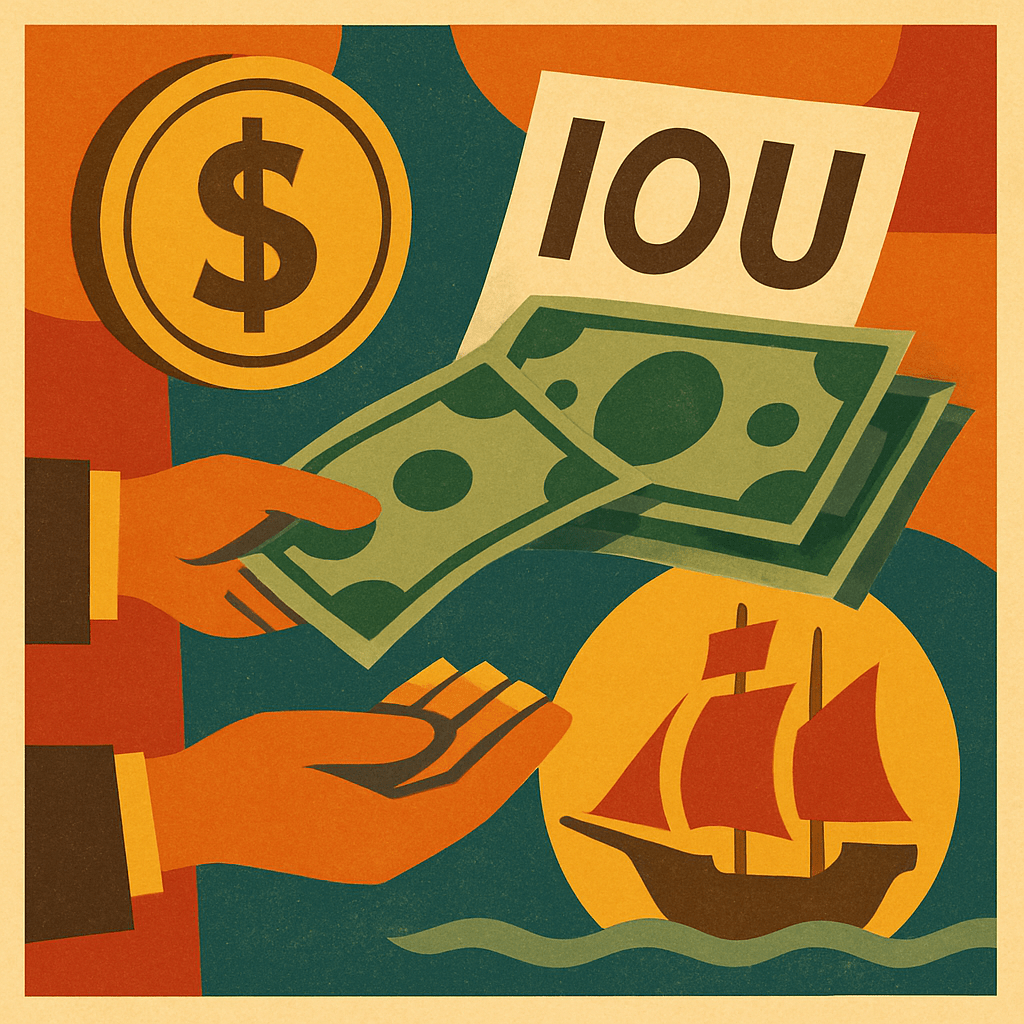
Money, then, is a kind of IOU. For example, Mary buys potatoes from Helena. Mary owes Helena and writes the debt on a slip of paper, stating who owes whom. Helena then needs firewood from Anna and passes the IOU on to her. Now Mary owes Anna. In theory, this IOU could circulate indefinitely, as long as people trust Mary’s ability to pay. Money is essentially a promise to return something of equal value. Ultimately, money has no real intrinsic utility. People accept it only because they believe others will do the same. Money measures trust.
But does everyone trust Mary’s ability to pay? In theory, a whole city or country could operate on such slips stating that Mary owes them—as long as Mary is immensely wealthy. It would not be an issue if Mary were queen of the land and willing to redeem all the debts at once. In a day-to-day practical sense, a contemporary an euro banknote is also a promissory note. But in its legal and traditional financial sense, euro is a fiat currency. Its value is based on the trust and legal framework of the issuing authority, which is the European Central Bank and eurozone countries.
Lending money and usury were taboos in deeply Christian medieval Europe. It was only after the plague eradicated large parts of the population for seemingly no rational reason that papal authority weakened. This enabled a shift in financial norms. Many Western religions prohibit lending money at interest. Only with the weakening of papal dominance could such doctrines be reassessed, allowing banking to grow.
This invention led to growing prosperity and overall wealth. Money was no longer something physical; it became trust between people. This gave rise to the greatest of all monetary inventions—financing. It enabled more ambitious projects that had previously been too risky. It also led to the creation of colonial merchant fleets, as the new banks could finance shipowners who sought vast fortunes in spices, textiles, ivory, tobacco, sugar, coffee, tea, and cocoa from distant lands—reaping enormous profits upon return.
The Bitterness of Luxury
Especially coffee, tea, and cocoa stand out. These three plant-based stimulants are all psychoactive substances that cause physical dependence. For some, they act as stimulants; for others, they soothe and aid concentration. These substances fulfil needs that users may not even have known they had. Once again, the dissatisfied human fell into their own trap. Bitter-tasting, these indulgences increased the demand for sugar.
The growing need for sugar, coffee, tea, cocoa, tobacco, and cotton intensified the African slave trade. It is unfair to call it the African slave trade—as it was a European slave trade conducted on African shores. Europeans even created their own currency for buying people. One human cost one manilla: a horseshoe-shaped ring made of cheap metal with flared ends. Manillas were produced en masse, and many still lie at the bottom of the Atlantic Ocean. So many were made that they continued to function as currency and ornaments until the late 1940s.
Due to the European slave trade, over two million Africans ended up at the bottom of the Atlantic, and entire nations were relocated across the ocean and forced to labour—simply because dissatisfied café customers in London found their coffee bitter and slightly overpriced.
This exploration of human dissatisfaction and its origins touches upon the age-old debate regarding the nature of human goodness and evil. Jean-Jacques Rousseau (1712–1778), the Genevan-French Enlightenment philosopher, composer, and critic of Enlightenment thought, wrote in 1755 the influential Discourse on the Origin and Basis of Inequality Among Men. Rousseau posited that humans once lived as hunter-gatherers in a childlike state of innocence within small groups. This innocence ended when we left our natural paradise and began living in cities. With that came all the evils of civilisation—patriarchy, armies, bureaucrats, and mind-numbing office work.
As a counterpoint to Rousseau’s romantic paradise vision, English philosopher Thomas Hobbes (1588–1679) proposed in Leviathan (1651) that life in a state of nature was not innocent but ”solitary, poor, nasty, brutish, and short.” Progress, if any, resulted only from the repressive mechanisms that Rousseau lamented.
Graeber and David Wengrow (2021) argue that to envision a more accurate and hopeful history, we must abandon this mythical dichotomy of an original Eden and a fall from grace. Rousseau’s ideas didn’t arise in a vacuum, nor were they ignored. Graeber and Wengrow argue that Rousseau captured sentiments already circulating among the French intelligentsia. His 1754 essay responded to a contest question: ”What is the origin of inequality among men, and is it authorised by natural law?”
Such a premise was radical under the absolutist monarchy of Louis XV. Most French people at the time had little experience with equality; society was rigidly stratified with elaborate hierarchies and social rituals that reinforced inequality. This Enlightenment shift, seen even in the essay topic, marked a decisive break from the medieval worldview.
In the Middle Ages, most people around the world who knew of Northern Europe considered it a gloomy and backward place. Europe was rife with plagues and filled with religious fanatics who kept largely to themselves, apart from the occasional violent crusade.
Graeber and Wengrow argue that many Enlightenment thinkers drew inspiration from the ideas of Native Americans, particularly those reported by French Jesuit missionaries. These widely read and popular reports introduced new perspectives on individual liberty and equality—including women’s roles and sexual freedom—that deeply influenced French thought.
Especially influential were the ideas of the Huron people from present-day Canada. They were offended by the French’s harshness, stinginess, and rudeness. The Hurons were shocked to hear there were homeless beggars in France. They believed the French lacked kindness and criticised them for it. They didn’t understand how the French could talk over one another without sound reasoning, which they saw as a sign of poor intellect.
To understand how Indigenous critiques influenced European thought, Graeber and Wengrow focus on two figures: Louis Armand, Baron de Lahontan (1666–1716), a French aristocrat, and the eloquent and intelligent Huron statesman Kandiaronk (1649–1701). Lahontan joined the French army at seventeen and was sent to Canada, where he engaged in military operations and exploration. He eventually became deputy to Governor Frontenac. Fluent in local languages and, according to his own claims, friends with Indigenous leaders such as Kandiaronk, he published several books in the early 1700s. These works—written in a semi-fictional dialogue format—became widely popular and made him a literary celebrity. It remains unclear to what extent Kandiaronk’s views reflect his own or Lahontan’s interpretations.
Graeber and Wengrow suggest it’s plausible Kandiaronk visited France, as the Hurons sent an envoy to Louis XIV’s court in 1691. At the time, Kandiaronk was speaker of the Huron council and thus a logical choice. His views were radically provocative: he suggested Europe should dismantle its religious, social, and economic systems and try true equality. These ideas profoundly shaped European thought and became staples of fashionable literature and theatre.
Mastering Nature, Enslaving Others
Europeans were, by and large, exceptionally ruthless towards the Indigenous peoples of foreign lands. This same hostility, arrogance, and indifference is also reflected in Western attitudes toward natural resources. The English polymath Francis Bacon (1561–1626) was, among other things, a writer, lawyer, and philosopher. Bacon was one of the Enlightenment reformers who advocated for science. For this reason, I have chosen him as an example here, since the triumph of science from the Enlightenment to the present day has shaped both our thinking and our relationship with nature.
There is no doubt that humanity has greatly benefited from Bacon’s achievements. However, in recent times, feminists and environmentalists have highlighted unpleasant and timely justifications for the exploitation of nature in his writings. Naturally, Bacon’s views are also fiercely defended, which makes it difficult to say who is ultimately right. In any case, many have cited the following lines—possibly originally penned by Bacon—as an example:
“My only earthly wish is to stretch man’s lamentably narrow dominion over the universe to its promised bounds… Nature is put into service. She is driven out of her wandering, bound into chains, and her secrets are tortured out of her. Nature and her children are bound into service, and made our slaves… The mechanical inventions of recent times do not merely follow nature’s gentle guidance; they have the power and capacity to conquer and tame her and shake her to her foundations.” (Merchant, 1980; Soble, 1995)
Whether or not these words were written by Bacon himself, they effectively summarise the historical narrative of which we are all victims—especially our children and grandchildren, who are slowly growing up in a dying world marked by escalating natural disasters, famines, and the wars and mass migrations they cause. This kind of mechanistic worldview has also made possible atrocities such as Auschwitz, where human beings were seen merely as enemies or as “others”—somehow separate from ourselves and from how we understand what it means to be human.
Conclusion
The story of money is, at its core, a story of belief—our collective willingness to trust symbols, systems, and each other. But this trust has often been weaponised, tied to exploitation, inequality, and ecological destruction. From the philosophical musings of Enlightenment thinkers inspired by Indigenous critiques to the brutal efficiency of modern finance, the evolution of money reveals both the brilliance and the blindness of human societies. As we stand at a global crossroads marked by climate crises and economic disparity, revisiting these historical insights is more than an intellectual exercise—it’s a necessary reflection on what we value, and why. The future of money may depend not on innovation alone, but on a renewed commitment to justice, sustainability, and shared humanity.
References
Graeber, D. (2011). Debt: The first 5,000 years. New York: Melville House.
Graeber, D., & Wengrow, D. (2021). The dawn of everything: A new history of humanity. Penguin Books.
Hobbes, T. (1651). Leviathan. Andrew Crooke.
Merchant, C. (1980). The death of nature: Women, ecology, and the scientific revolution. Harper & Row.
Rousseau, J.-J. (1755). Discourse on the origin and basis of inequality among men (G. D. H. Cole, Trans.). Retrieved from https://www.gutenberg.org/ebooks/11136
Soble, A. (1995). The philosophy of sex and love: An introduction. Paragon House.
 Helsinki Zen - Peacemakers Finland