Zen and the Art of Dissatisfaction – Part 35

Losing Myself and My Suitcase

This post explores how the stories our minds create – stories of guilt, inadequacy, or fear – can become far heavier burdens than the events that inspire them. A lost suitcase, a moment of confusion in a foreign railway station, or a lapse in attentiveness can transform into a mental storm. Yet within these storms lies an invitation: to examine who we believe ourselves to be and to recognise our deep entanglement with everything around us. Drawing from personal experience and classical Zen teachings-from Emperor Wu of Liang to Bodhidharma and Shitou Xiqian – this post reflects on illusion of the sense of self, perception, and the inseparable connection between all beings.

At times, the stories and self-accusations created by our own minds are our worst enemies. Anyone who has ever accidentally broken or lost something, or missed an important meeting or means of transport, knows how upsetting such moments can be. Even if nothing significant was ultimately harmed or endangered, the mind may still twist the situation into something impossibly difficult.

Lost Suitcase

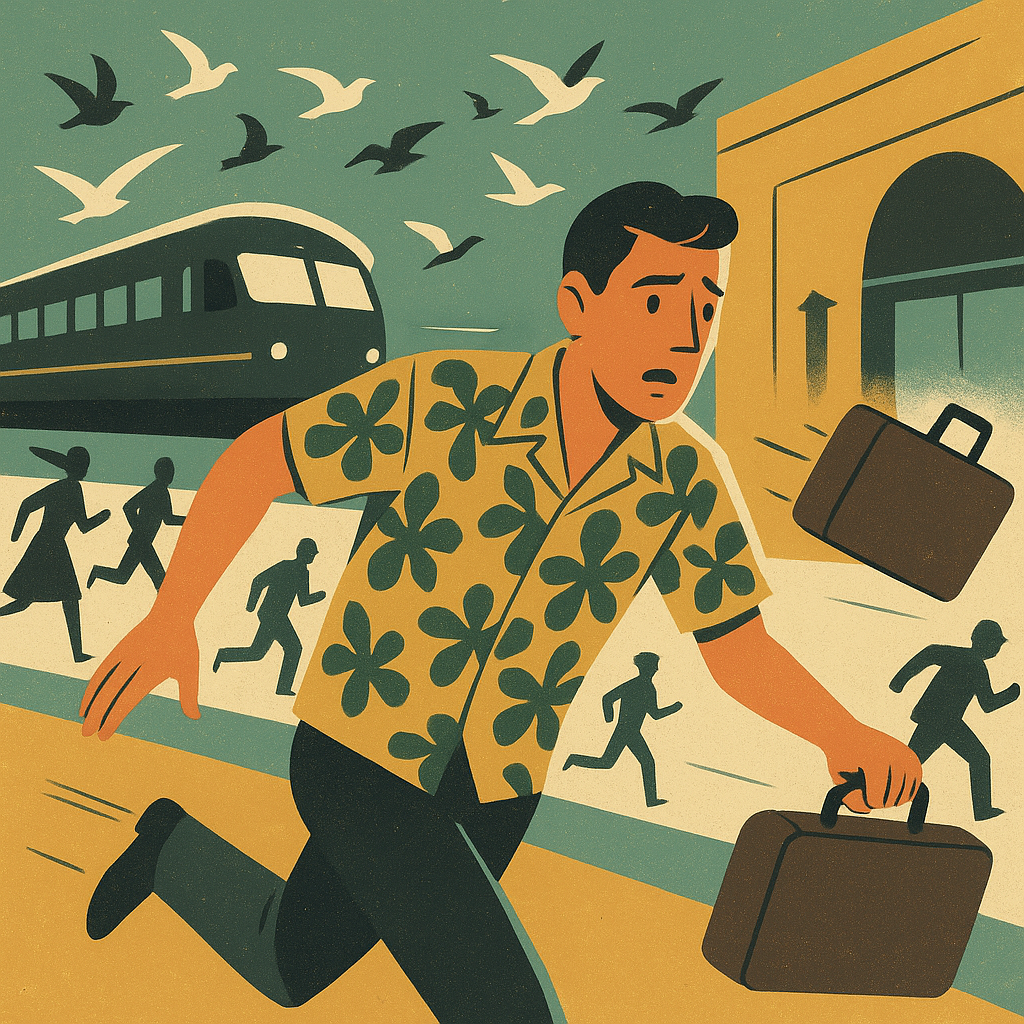
I lost my suitcase in August 2018 while travelling to a week-long silent Zen retreat in the Netherlands. My train stopped at Rotterdam station. I was heading toward a small Dutch town whose name I could not even pronounce. My phone’s internet connection wasn’t working, and I did not know where I was supposed to change trains. I saw a uniformed conductor on the platform and went outside to ask him for help. He told me that I was already running late. My train would leave in minutes, and I would have to switch platforms.

I ran to the new platform, arrived just in time to see the train that had brought me there gliding away. Another train arrived. I stepped in, found myself a seat, and realised that I had not taken my suitcase with me from the previous train. I had only a small shoulder bag and the clothes I was wearing.

My stomach dropped into a deep abyss beneath my feet. It felt as if all the blood in my body fell down with it. I tried to prevent myself from falling into that abyss, but my mind seized control. I began making a plan to retrieve my suitcase. I found the conductor; he gave me the number for the lost-and-found service. I called, but it was no use. No one could tell me where the train I had lost my suitcase on would go after its terminal station. Despite my best efforts, I never saw my suitcase again.

The Longest First Day

When I arrived at the retreat centre, my teacher burst out laughing. It was not mean at all, actually it felt nice. I knew I was safe. ”This is exactly why we practise mindfulness,” he said. His wife promised to bring me a toothbrush and toothpaste. The first day of the retreat felt endless. I noticed how my mind replayed the event again and again from different angles. I sat there in silence, watching how my mind meticulously showed me just how careless, stupid, and thoughtless I had been.

At bedtime my mind was still boiling, replaying the events and insisting on my stupidity and carelessness. Eventually I fell asleep but soon woke up again, my mind still seething with self-accusations. As the days passed, I began to see how utterly unnecessary this whole mental process was. It was merely the torrent of self-blame and fixation on loss. Though at first I had imagined that my suitcase held my entire life, I eventually realised that this was not true. Life is something entirely different.

What Is This Life We Are Living?

But what is this life of ours? Is it even possible to say? I notice that I cannot state with certainty what I mean by my self.

The Emperor Wu of Liang (c. 502-549) is said to have met the semi-mythical ancestor of Zen, the great Bodhidharma (c. 440-528), who arrived in China from somewhere along the Silk Road, presumably from India. During their short encounter, Emperor Wu questioned Bodhidharma about who this man standing before him really was. Bodhidharma replied laconically: ”I don’t know.”

What are we, what am I, truly? It feels irrelevant at first, but when I look deeper, I find it impossible to point to any one specific thing and say that this is me. If I pointed to myself and examined more closely, I would notice that it is not true. If I pointed, for instance, to my shoulder and asked whether that is me – no, it is not. It is only my shoulder, but even that is not so simple. The shoulder is merely a entaglement of various interconnected parts. It is a collection of things: skin, tendons, bone, nerve fibres, blood, and other fluids. The closer I look, the less any of these seem like ”me”. Any one of them could perhaps be replaced without that essential sense of ”I” disappearing. It is like the Ship of Thesius in this regard. Or its Chinese counterpart, the Zen Koan regarding the Cart of Keichu.

Even if my mind insists it is the same ”me” as it was meybe ten years ago, this is not the case. Our minds change, and our memories change with them. The atoms and molecules forming our bodies are replaced as we eat and drink. Food becomes part of us. Old material leaves us when we breathe out, or go to the bathroom, or brush off dry skin.

The skin surrounding the body is not me. It is merely skin. My bones are not me, for they too are merely bones. Yet if I must prove my identity to a police officer or to my computer, I instantly become a unique individual, distinct from all others in some incomprehensible way.

Interbeing: The World Within and Around Us

I sit by the window of our home and listen to the birds singing at the bird feeder. A great spotted woodpecker has given way to squabbling tits. Sound waves carry the birds’ calls to my ears. What separates me from those birds, when even the sound waves travelling through the air connect us? As I listen, the window between us ceases to exist.

The wind rustling the branches of spruces and pines takes shape in the sound it produces as it moves through them. The same play of awareness occurring in my mind is present in everything. It is in the branches of trees, in birdsong, even in the empty space binding us together. I breathe the oxygen these trees have produced. We are all interwoven together. None of us could exist without the other.

And yet, even though we are intertwined with birds, trees, and air, I can also view the same reality from another perspective, where each part becomes sharply distinct. The tit and the woodpecker take on their individual forms, and each of us has our own unique task in this moment. We are separated by our unique ways of being-yet still bound to one another.

The Chinese 8th-century Zen master Shitou Xiqian (700-790), known in Japanese as Sekito Kisen, ends his famous poem Sandokai (The Identity of Relitive and Absolute) with the words: ”Do not waste your time by night or day.” Both darkness and light are two aspects of reality intertwined and, in themselves, the same thing – two dimensions of experience. Everyday dissatisfaction and the bliss of freedom are both right here, right now.

Summary

What begins as a story about a lost suitcase unfolds into a reflection on the self, awareness, and our profound connection with all beings and things. The mind can turn trivial events into overwhelming crises, yet it also possesses the capacity to recognise their emptiness. Through personal experience, ancient Zen teachings, and the simple presence of birds and trees, we are reminded that life is both deeply individual and inseparably shared. In every moment-whether painful or peaceful-there is an invitation to see clearly and live fully.

Zen and the Art of Dissatisfaction – 23

Bullshit Jobs and Smart Machines

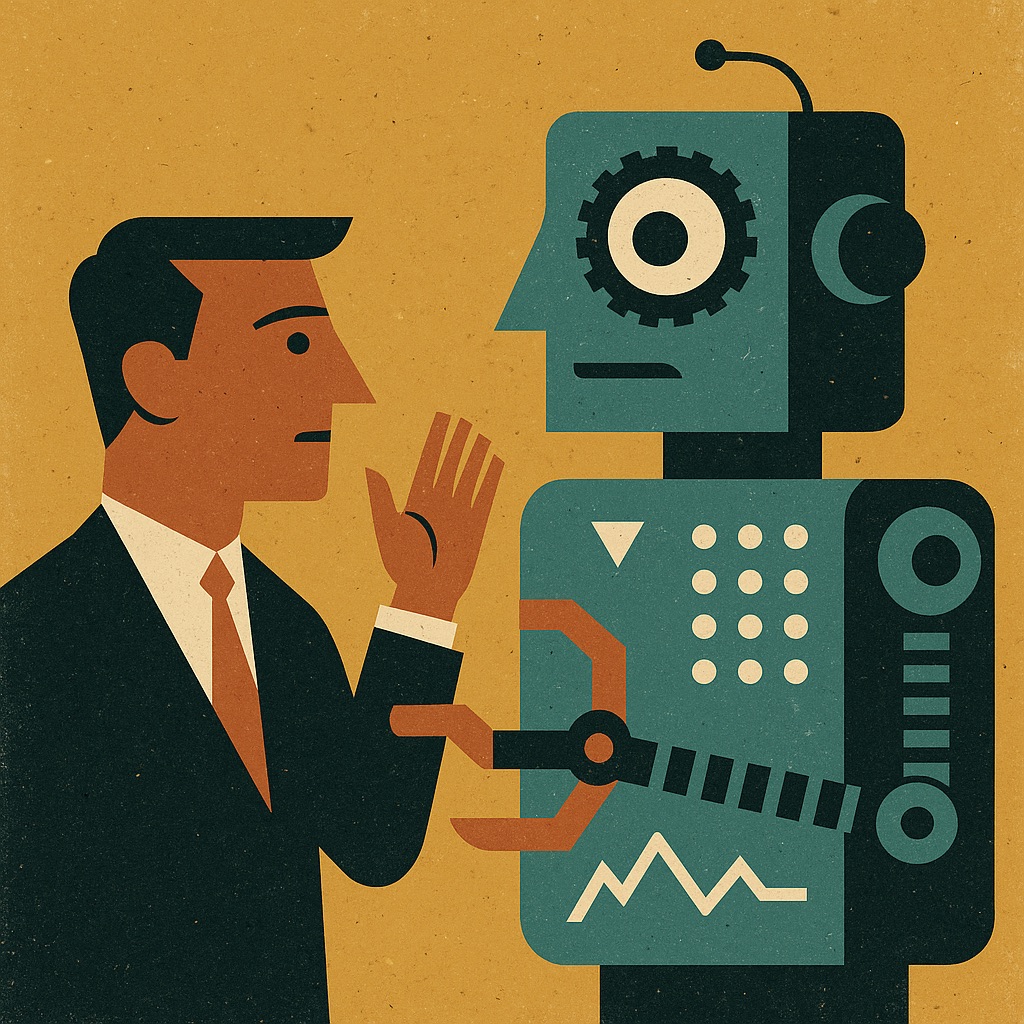
This post explores how many of today’s high‑paid professions depend on collecting and analysing data, and on decisions made on the basis of that process. Drawing on thinkers such as Hannah ArendtGerd Gigerenzer, and others, I examine the paradoxes of complex versus simple algorithms, the ethical dilemmas arising from algorithmic decision‑making, and how automation threatens not only unskilled but increasingly highly skilled work. I also situate these issues in historical context, from the Fordist assembly line to modern AI’s reach into law and medicine.

Originally published in Substack: https://substack.com/inbox/post/170023572

Many contemporary highly paid professions rely on data gathering, its analysis, and decisions based on that process. According to Hannah Arendt (2017 [original 1963]), such a threat already existed in the 1950s when she wrote:

“The explosive population growth of today has coincided frighteningly with technological progress that makes vast segments of the population unnecessary—indeed superfluous as a workforce—due to automation.”

In the words of David Ferrucci, the leader of Watson’s Jeopardy! team, the next phase in AI’s development will evaluate data and causality in parallel. The way data is currently used will change significantly when algorithms can construct data‑based hypotheses, theories and mental models answering the question “why?”

The paradox of complexity: simple versus black‑box algorithms

Paradoxically, one of the biggest problems with complex algorithms such as Watson and Google Flu Trends is their very complexity. Gerd Gigerenzer (2022) argues that simple, transparent algorithms often outperform complex ones. He criticises secret machine‑learning “black‑box” systems that search vast proprietary datasets for hidden correlations without understanding the physical or psychological principles of the world. Such systems can make bizarre errors—mistaking correlation for causation, for instance between Swiss chocolate consumption and number of Nobel Prize winners, or between drowning deaths in American pools and the number of films starring Nicolas Cage. A stronger correlation exists between the age of Miss America and rates of murder: when Miss America is aged twenty or younger, murders committed by hot steam or weapons are fewer. Gigerenzer advocates for open, simple algorithms; for example, the 1981 model The Keys to the White House, developed by historian Allan Lichtman and geophysicist Vladimir Keilis‑Borok, which has correctly predicted every US presidential election since 1984, with the single exception of the result in the Al Gore vs. George W. Bush contest.

Examples where individuals have received long prison sentences illustrate how secret, proprietary algorithms such as COMPAS (“Correctional Offender Management Profiling for Alternative Sanctions”) produce risk assessments that can label defendants as high‑risk recidivists. Such black‑box systems, which may determine citizens’ liberty, pose enormous risks to individual freedom. Similar hidden algorithms are used in credit scoring and insurance. Citizens are unknowingly categorised and subject to prejudices that constrain their opportunities in society.

The industrial revolution, automation, and the meaning of work

Even if transformative technologies like Watson may fail to deliver on all the bold promises made by IBM’s marketing, algorithms are steadily doing tasks once carried out by humans. Just as industrial machines displaced heavy manual labour and beasts of burden—especially in agriculture—today’s algorithms are increasingly supplanting cognitive roles.

Since the Great Depression of the 1930s, warnings have circulated that automation would render millions unemployed. British economist John Maynard Keynes (1883–1946) coined the term “technological unemployment” to describe this risk. As David Graeber (2018) notes, automation did indeed trigger mass unemployment. Political forces on both the right and left share a deep belief that paid employment is essential for moral citizenship; they agree that unemployment in wealthy countries should never exceed around 8 percent. Graeber nonetheless argues that the Great Depression produced a collapse in real need for work—and much contemporary work is “bullshit jobs”. If 37–40 percent of jobs are such meaningless roles, more than 50–60 percent of the population are effectively unemployed.

Karl Marx warned of industrial alienation, where people are uprooted from their villages and placed into factories or mines to do simple, repetitive work requiring no skill, knowledge or training, and easily replaceable. Global corporations have shifted assembly lines and mines to places where workers have few rights, as seen in electronics assembly in Chinese factory towns, garment workshops in Bangladesh, and mineral extraction by enslaved children—all under appalling conditions.

Henry Ford’s Western egalitarian idea of the assembly line—that all workers are equal—became a system where anybody can be replaced. In Charles Chaplin’s 1936 film Modern Times, inspired by his encounter in 1931 with Mahatma Gandhi, he highlighted our dependence on machines. Gandhi argued that Britain had enslaved Indians through its machines; he sought non‑violent resistance and self‑sufficiency to show that Indians did not need British machines or Britain itself.

From industrial jobs to algorithmic threat to professional work

At its origin in Ford’s factory in 1913, the T‑model moved through 45 fixed stations and was completed in 93 minutes, borrowing the idea from Chicago slaughterhouses where carcasses moved past stationary cutters. Though just 8 percent of the American workforce was engaged in manufacturing by the 1940s, automation created jobs in transport, repair, and administration—though these often required only low-skilled labour.

Today, AI algorithms threaten not only blue‑collar but also white‑collar roles. Professions requiring long training—lawyers and doctors, for example—are now at risk. AI systems can assess precedent for legal cases more accurately than humans. While such systems promise reliability, they also bring profound ethical risks. Human judges are fallible: one Israeli study suggested that judges issue harsher sentences before lunch than after—but that finding has been contested due to case‑severity ordering. Yet such results are still invoked to support AI’s superiority.

Summary

This blog post has considered how our economy is increasingly structured around data collection, analysis, and decision‑making by both complex and simple algorithms. It has explored the paradox that simple, transparent systems can outperform opaque ones, and highlighted the grave risks posed by black‑box algorithms in criminal justice and financial systems. Tracing the legacy from Fordist automation to modern AI, I have outlined the existential threats posed to human work and purpose—not only for low‑skilled labour but for highly skilled professions. The text argues that while automation may deliver productivity, it also risks alienation, injustice, and meaninglessness unless we critically examine the design, application, and social framing of these systems.


References

Arendt, H. (2017). The Human Condition (Original work published 1963). University of Chicago Press.
Ferrucci, D. (n.d.). [Various works on IBM Watson]. IBM Research.
Gigerenzer, G. (2022). How to Stay Smart in a Smart World: Why Human Intelligence Still Beats Algorithms. MIT Press.
Graeber, D. (2018). Bullshit Jobs: A Theory. Simon & Schuster.
Keynes, J. M. (1930). Economic Possibilities for our Grandchildren. Macmillan.
Lee, C. J. (2018). The misinterpretation of the Israeli parole study. Nature Human Behaviour, 2(5), 303–304.
Lichtman, A., & Keilis-Borok, V. (1981). The Keys to the White House. Rowman & Littlefield.

Zen and the Art of Dissatisfaction – Part 19

Pandora’s Livestock: How Animal Agriculture Threatens Our Planet and Our Health

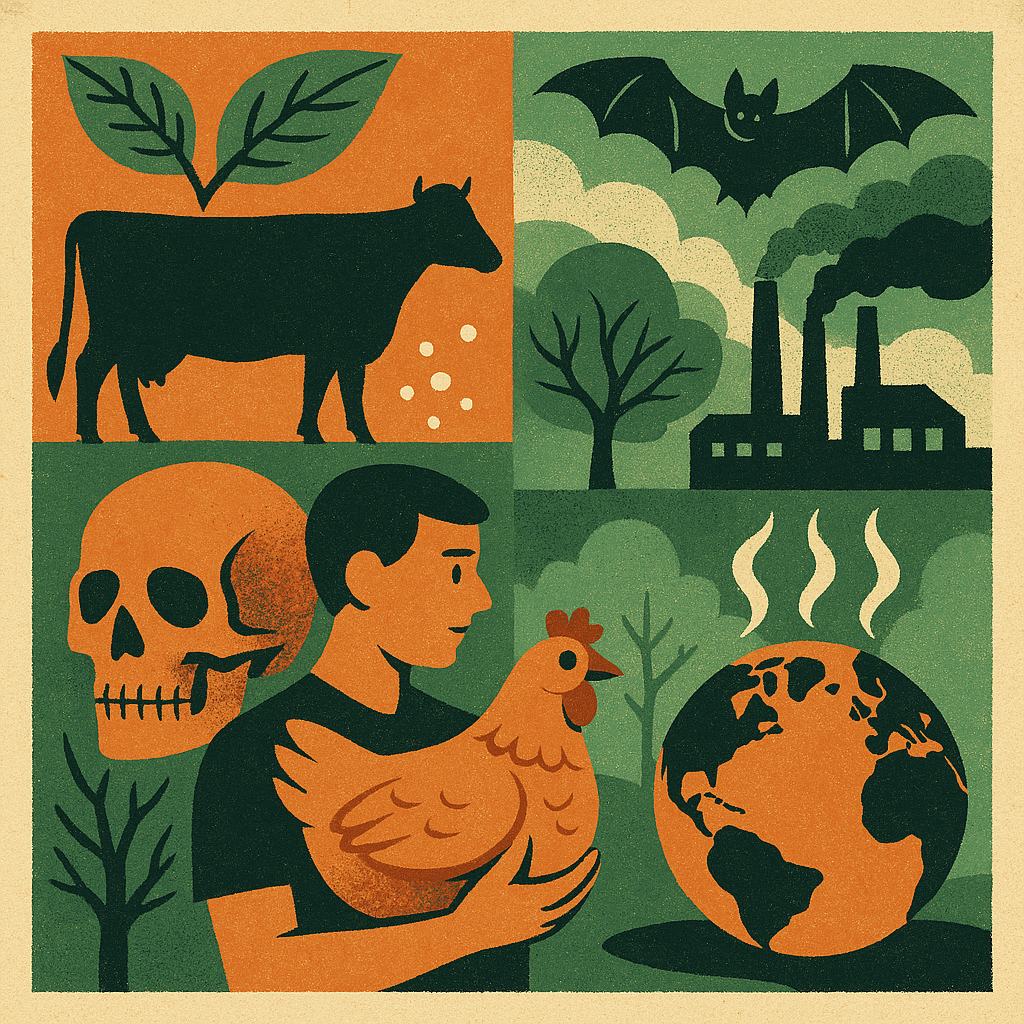
The following post explores the interconnected crises of biodiversity loss, industrial animal agriculture, and climate change, presenting a comprehensive argument about humanity’s complex role in environmental degradation. Drawing from works by Bill Gates, Risto Isomäki, and others, the text combines ecological science, epidemiology, and cultural history to examine both systemic failures and potential paths forward. The post highlights how deeply entangled environmental destruction, pandemics, and human psychology are — while also questioning whether our current cognitive limits allow us to grasp and act upon such intertwined threats.

Originally published in Substack: https://substack.com/home/post/p-166887887

The destruction of ecological diversity, the shrinking habitats of wild animals, and the rise of industrial livestock production represent grave violations against the richness of life — and profound threats to humanity’s own future. These issues go beyond climate change, which is itself just one of many interconnected problems facing nature today.

The Decline of Biodiversity and the Rise of Climate Complexity

In How to Avoid a Climate Disaster (2021), Bill Gates outlines the sources of human-generated greenhouse gas emissions. Although many factors contribute to climate change, carbon dioxide (CO₂) remains the dominant greenhouse gas emitted by humans. Gates also includes emissions of methane, nitrous oxide, and fluorinated gases (F-gases) in his calculations. According to his book, the total annual global emissions amount to 46.2 billion tons of CO₂-equivalent.

These emissions are categorized by sector:

  • Manufacturing (cement, steel, plastics): 31%
  • Electricity generation: 27%
  • Agriculture (plants and animals): 19%
  • Transportation (planes, cars, trucks, ships): 16%
  • Heating and cooling: 7%

This classification is more reader-friendly than the Our World In Data approach, which aggregates emissions into broader categories like ”energy,” comprising 73.2% of total emissions. Agriculture accounts for 18.4%, waste for 3.2%, and industrial processes for 5.2%.

According to Statistics Finland, the country emitted 48.3 million tons of CO₂ in one year, with agriculture accounting for 13.66% — aligning closely with Gates’ method. However, Finnish author and environmentalist Risto Isomäki, in How Finland Can Halt Climate Change (2019) and Food, Climate and Health (2021), argues that the contribution of animal agriculture to greenhouse gases is severely underestimated. He points out its role in eutrophication — nutrient pollution that degrades lake and marine ecosystems, harming both biodiversity and nearby property values.

Animal farming requires vast resources: water, grains, hay, medicines, and space. Isomäki notes that 80% of agricultural land is devoted to livestock, and most of the crops we grow are fed to animals rather than people. Transport, slaughter, and the distribution of perishable meat further exacerbate the emissions. Official estimates put meat and other animal products at causing around 20% of global emissions, but Isomäki warns the real figure could be higher — particularly when emissions from manure-induced eutrophication are misclassified under energy or natural processes rather than livestock.

Antibiotic Resistance and Zoonotic Pandemics: The Hidden Cost of Meat

A more urgent and potentially deadly consequence of animal agriculture is the emergence of antibiotic-resistant bacteria and new viruses. 80% of all antibiotics produced globally are used in livestock — primarily as preventative treatment against diseases caused by overcrowded, unsanitary conditions. Even in Finland, where preventive use is officially banned, antibiotics are still prescribed on dubious grounds, as journalist Eveliina Lundqvist documents in Secret Diary from Animal Farms (2014).

This misuse of antibiotics accelerates antibiotic resistance, a serious global health threat. Simple surgeries have become riskier due to resistant bacterial infections. During the COVID-19 pandemic, roughly half of the deaths were linked not directly to the virus but to secondary bacterial pneumonia that antibiotics failed to treat. Isomäki (2021) emphasises that without resistance, this death toll might have been drastically lower.

Moreover, the close quarters of industrial animal farming create ideal conditions for viruses to mutate and jump species — including to humans. Early humans, living during the Ice Age, didn’t suffer from flu or measles. It was only after the domestication of animals roughly 10,000 years ago that humanity began facing zoonotic diseases — diseases that spread from animals to humans.

Smallpox, Conquest, and the Pandora’s Box of Domestication

This shift had catastrophic consequences. In the late 15th century, European colonizers possessed an unintended biological advantage: exposure to diseases their target populations had never encountered. Among the most devastating was smallpox, thought to have originated in India or Egypt over 3,000 years ago. Spread through close contact among livestock, it left distinct scars on ancient victims like Pharaoh Ramses V, whose mummy still bears signs of the disease.

When Spanish conquistadors reached the Aztec Empire in 1519, smallpox killed over three million people. Similar destruction followed in the Inca Empire. By 1600, the Indigenous population of the Americas had dropped from an estimated 60 million to just 6 million.

Europe began vaccinating against smallpox in 1796 using the cowpox virus. Still, over 300 million people died globally from smallpox in the 20th century. Finland ended smallpox vaccinations in 1980. I personally received the vaccine as an infant before moving to Nigeria in 1978.

From COVID-19 to Fur Farms: How Modern Exploitation Fuels Pandemics

The SARS-CoV-2 virus might have originated in bats, with an unknown intermediate host — maybe a farmed animal used for meat or fur. China is a major fur exporter, and Finnish fur farmers have reportedly played a role in launching raccoon dog (Nyctereutes procyonoides) farming in China, as noted by Isomäki (2021).

COVID-19 has been shown to transmit from humans to animals, including pets (cats, dogs), zoo animals (lions, tigers), farmed minks, and even gorillas. This highlights how human intervention in wildlife and farming practices can turn animals into vectors of global disease.

Are Our Brains Wired to Ignore Global Crises?

Why do humans act against their environment? Perhaps no one intentionally destroys nature out of malice. No one wants polluted oceans or deforested childhood landscapes. But the path toward genuine, large-scale cooperation is elusive.

The post argues that we are mentally unprepared to grasp systemic, large-scale problems. According to Dunbar’s number, humans can effectively maintain social relationships within groups of 150–200 people — a trait inherited from our village-dwelling ancestors. Our brains evolved to understand relationships like kinship, illness, or betrayal within tight-knit communities — not to comprehend or act on behalf of seven billion people.

This cognitive limitation makes it hard to process elections, policy complexity, or global consensus. As a result, people oversimplify problems, react conservatively, and mistrust systems that exceed their brain’s social bandwidth.

Summary: A Call for Compassionate Comprehension

The destruction of biodiversity, the misuse of antibiotics, the threat of pandemics, and climate change are not isolated crises. They are symptoms of a deeper disconnect between human behavior and ecological reality. While no one wants the Earth to perish, the language and actions needed to protect it remain elusive. Perhaps the real challenge is not just technical, but psychological — demanding that we transcend the mental architecture of a tribal species to envision a truly planetary society.


References

Gates, B. (2021). How to Avoid a Climate Disaster: The Solutions We Have and the Breakthroughs We Need. Alfred A. Knopf.

Isomäki, R. (2019). Miten Suomi pysäyttää ilmastonmuutoksen. Into Kustannus.

Isomäki, R. (2021). Ruoka, ilmasto ja terveys. Into Kustannus.

Lundqvist, E. (2014). Salainen päiväkirja eläintiloilta. Into Kustannus.

Our World In Data. (n.d.). Greenhouse gas emissions by sector. Retrieved from https://ourworldindata.org/emissions-by-sector

Statistics Finland. (n.d.). Greenhouse gas emissions. Retrieved from https://www.stat.fi/index_en.html

Zen and the Art of Dissatisfaction – Part 7.

Voices Within – Exploring the Inner Dialogue

Originally published in Substack: https://substack.com/inbox/post/160343816

The Canadian-born British experimental psychologist and philosopher, Bruce Hood, specialises in researching human psychological development in cognitive neuroscience. Hood works at the University of Bristol, and his research focuses on intuitive theories, sense of self, and the cognitive processes underlying adult magical thinking. In his book The Self Illusion: Why There Is No ‘You’ Inside Your Head (2012), Hood argues that our internal dissatisfaction stems from a form of psychological uncertainty. It is still very common to think that some kind of internal self or soul is the core that separates humans from other animals. It is also very common to think that after the human body dies, this core continues to live forever through some form of reincarnation, either here or in another parallel dimension. Our understanding of the internal self does not arise from nothing. It is the result of a long developmental process that takes time to build. According to Bruce Hood, this is an illusion because the sense of self has no permanent anchor or form, yet people experience it as very real and often claim it to be the essence that makes us who we are.

In neurosciences the human consciousness is often divided into various conceptual meanings that together form human consciousness. The first of these meanings is the awareness, referring to whether we are awake or not, such as when we are asleep, we are in a state of mild and temporary form of unconsciousness. The second significant concept related to consciousness is attention, which moves between different activities, depending on what requires our attention at the moment. The third concept of consciousness is experiential consciousness, which defines subjective experiences occurring within ourselves, such as how salt tastes, or what is the sensation a red colour evokes. The fourth meaning of consciousness is reflective consciousness. If something happens to us at the level of experiential consciousness, we begin to consciously ponder how we should act. For instance, if we hammer our finger with a mallet, this experience immediately enters our experiential consciousness as a very intense experience, but almost simultaneously, the same event jumps into our reflective consciousness, where we start weighing the severity of the injury and what we should do to ease pain and prevent further calamity. Should I cry for help? Should I go to the hospital? Or shall I just take a photo and post it on Instagram? Conscious thought flows in this way.

Reflective consciousness speaks of experience, and it leads to conscious thinking, which is characterised by the inability to think about more than one thing at a time. One important form of conscious thought is self-awareness, which also involves the awareness of our own body. The concept of self represents conscious thought and is formed by beliefs and thoughts about an individual’s personal history, identity, and future plans.

Self-awareness is also referred to as the self or sense self, a concept I have and will be using in my writings. However, it’s important to note that this term does not refer to identity. This same issue is often explored in the fields of psychology and sociology.  

The sense of self can be seen as an evolutionary tool or a feature, which helps the organism to stay alive. It makes the organisms feel that they are very important, more important than anyone or anything else. However, this sense of self can also transform over time and through adverse experience into a process that turns against itself. These processes have been seen underlying conditions such as severe depression, in which our sense of self has gone into a deep rut and goes through endless loops of self loathing.  

American journalist and Harvard professor Michael Pollan writes in his book How to Change Your Mind (2019) that modern psychedelic therapies have shown promising results for patients with depression. In his book, Pollan writes about the research conducted by British neuroscientist and psychologist Robin Carhart-Harris (2010) has researched the effect of the brain’s default mode network (DMN) on the formation of the self, ego, or sense of self. The DMN is a neurological process that turns on when the person is not engaged in goal-directed activity. This process has also been linked to the formation of a the sense self.

The human experience of the self is a biographical anchor created by multiple overlapping neural processes of our brain. We get a feeling that everything that happens in my life happens to me. The self is that which experiences all things. That inner center is significant particularly to me. Without our internal awareness and experience of the self, we would never have conceived of the Universal Declaration of Human Rights, drafted by a UN committee chaired by Eleanor Roosevelt. It protects the persons right to physical integrity. We believe that every human being is unique and valuable because we all have an inner sense of self.

However, humans are not the only animals with some form of internal self-awareness. When visiting the London Zoo in 1838, Charles Darwin (1809–1882) saw an orangutang named Jenny becoming upset when a keeper teased her with an apple. This made Darwin reflect on the orangutang’s subjective experience. He noticed Jenny looking into a mirror and wondered if she recognised herself in the reflection.

American psychologist Gordon G. Gallup (1970) experimentally studied self-recognition in two male and two female wild chimpanzees, none of whom had previously seen a mirror. Initially, the chimpanzees made threatening gestures in front of the mirror, perceiving their reflections as threats. Eventually, they began using the mirror for self-directed behaviours, such as grooming parts of their bodies they couldn’t see without it, picking their noses, grinning, and blowing bubbles at their reflections.

Bruce Hood (2012) writes that this process is crucial in human development because, without it, humans would struggle in socially challenging and complex environments. Human children fail the mirror test until around 18 months of age. Before this, they may think the reflection is of another child and look behind the mirror. However, by 18 months, they understand that the person reflected in the mirror is themselves. But humans and chimpanzees are not the only animals to pass the mirror test. Crows, dolphins, and orcas also pass the test. Elephants do too, but cats do not (although my guess is that cats could pass the test if they wanted).

The sensation of self, which the human mind creates, which feels like a concrete structure, and which is referred to as the self, ego, or ”I,” is a process aimed at protecting us from both internal and external threats. When everything functions as it should, our inner narrator keeps the organism on track, helping it achieve its goals and meet its needs, especially eating, seeking shelter, and reproducing. This process works well under normal circumstances, but it is inherently conservative. Our experience of the self is a process, not a fixed entity, though it often feels like one. It emerges as a result of various mental functions and manifests as an internal narrator, or even as an internal dialogue.

The dialogue generated by the self often sounds like someone is explaining things to us, as if to a blind person, about what’s happening around us. We enter a room and might hear someone say inside our mind, “Look, what a nice place this is! Those wallpapers are beautiful, and the furniture is great, but those electrical outlets needs replacing!”

Sometimes, we might hear an internal negotiation, such as whether to run through a red light to catch a tram. Running through traffic might put us in physical danger or cause us to be socially judged. Social shame is one of the worst things a person can experience, and our internal narrator picks up on such details immediately and warns us to at least consider the possibility. At times, our narrator can turn into an internal tyrant, turning its energy against us.

This narrator, or brain talk, sounds very reasonable, but it often shows how our minds are trying to preserve the structures formed earlier, built from previous experiences. Unfortunately, sometimes we’re left with that inner narrator and nothing else, which can leave one feeling out of place. And when this narrator becomes rigid and inflexible, it has the power to push us into states of psychological distress, even driving us into despair.

In cases where brain talk gets stuck in repetitive loops, as is often the case with anxiety, depression, or psychosis, people feel their lives are determined by this narrator, inner force living inside ones head. A stuck self could feel isolated in its inner world and find it impossible to reach outside. The idea of having self-awareness — of being someone in this world — becomes crushed under the weight of these loops. For some, it is as if the voice of our mind becomes detached from the physical person, forcing it into another dimension where everything becomes dark, and disconnected from the social world.

American author David Foster Wallace (1962–2008), who had much experience of this process, reminded us in his commencement speech at Kenyon College in 2005 of the old cliché that the mind is an excellent servant, but a terrible master. However, this cliché expresses a terrible truth. According to Wallace, it is no coincidence that people who commit suicide with firearms almost always shoot themselves in the head. They are shooting that terrible narrator turned into a master — a terrible dark lord. 

Mind out of a Dolmio pasta sauce commercial

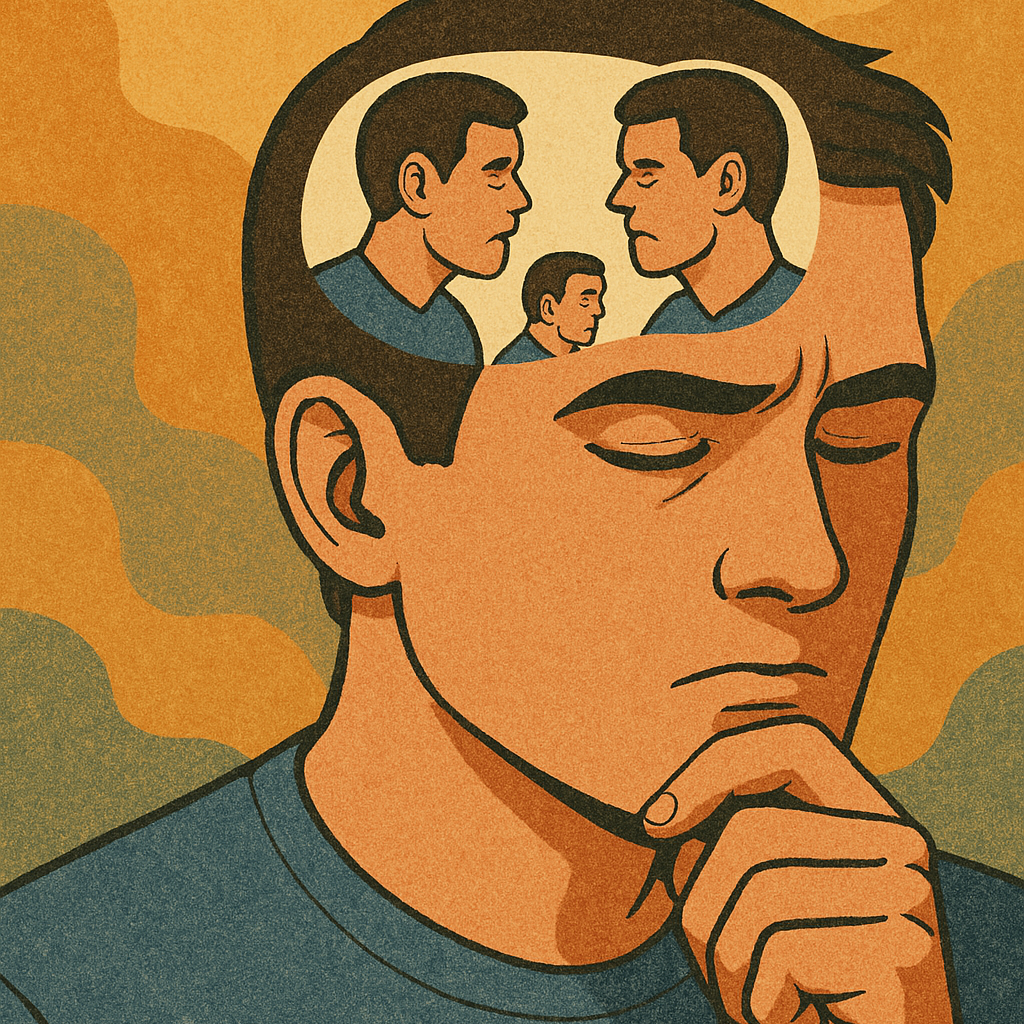
People experience their brain talk in a unique and private way. Most of us have some form of inner voice. A voice that guides, directs, and commands us. A voice that warns “Watch out! Car!” or “Remember to buy toilet paper.” For many of us, this voice sounds like our own, but for some people, their inner narrator is not a straightforward speech that scolds, advises, or reminds them of things. For some, brain talk may take the form of an Italian arguing couple or a calm interviewer. Or it may not be a voice at all, but a taste, feeling, or colour. In some cases, there is no voice at all, only deep and calm silence.

English journalist Sirin Kale (2021) wrote an interesting article on this internal narrator, presenting a few rare examples of different types of inner voices. One of the people interviewed for the article, a 30-year-old English woman named Claudia, hears her inner dialogue in a unique way. Claudia has never been to Italy, nor does she have Italian family or friends. She has no idea why the loud, arguing Italian couple has taken over her inner voice. Claudia says, “I have no idea where this came from. It’s probably offensive to Italians.” The arguing couple in Claudia’s mind sounds like something straight out of a Dolmio pasta sauce commercial. They are expressive and prone to waving their hands and shouting. When Claudia needs to make a decision in her life, this Italian couple takes the reins.

The Italian couple living inside Claudia’s mind argues passionately about almost anything. Claudia finds it very helpful because they do all the work for her. The couple is always in the kitchen and surrounded by food. Claudia has not yet named her Italians, but they have helped her make important decisions, including encouraging her to quit her job and pursue her lifelong dream of going to sea.

Kale writes that the Italian woman in Claudia’s mind supported her resignation, but her husband was more cautious. The Italian man said, “It’s a stable job!” and the woman responded, “Let her enjoy life!” The woman won, and Claudia left for a job on the seas in Greece. Overall, this Italian couple has helped Claudia live a happier life, and they’ve even calmed down a bit. Claudia says, “Less shouting. They just argue now.”

Dr Helene Loevenbruck of Grenoble Alpes University’s, mentioned in the article, claims that the brain talk arises in the same way as our thoughts turn into actions. Our brains predict the consequences of actions. The same principle of predicting actions also applies to human speech. When we speak, our brains create a predictive simulation of speech in our minds to correct any potential mistakes. The inner voice is thought to arise when our minds plan verbalised actions but decide not to send motor commands to the speech muscles. Loevenbruck says this simulated auditory signal is the small voice we hear in our minds. Loevenbruck explains that for the most part, we hear something she refers to as inner language, a more comprehensive term for this phenomenon. This is because, for example, people with hearing impairments do not hear an inner voice but might see sign language or observe moving lips. (Loevenbruck et al., 2018).

In exploring the sense of self and inner voice, we’ve seen how the self emerges as a process rather than a fixed entity. It is shaped by our own evolution, culture, and personal experience. Our brain talk can guide us, deceive us, or even take on unexpected forms and destroy us, yet it remains central to our sense of identity. It feels like the core for which everything happens. But is the self really real? And if not, if the self is an illusion, as neuroscientists and psychologists suggest, what does that mean for how we live? In the next post, I’ll dive into Buddhist perspectives on the self—examining how centuries-old wisdom aligns with modern psychological insights.


Resources:

Carhart-Harris, RL, & Friston, KJ (2010). The default-mode, ego-functions and free-energy: a neurobiological account of Freudian ideas. Brain, 133(4), 1265-1283.

Gallup, GG (1970). Chimpanzees: Self-Recognition. Science. 167 (3914): 86–87.

Hood, B (2012). The self illusion: How the social brain creates identity. HarperCollins Publishers.

Kale, S (2021) The last great mystery of the mind: meet the people who have unusual – or non-existent – inner voices. Guardian 25 Oct 2021 <https://www.theguardian.com/science/2021/oct/25/the-last-great-mystery-of-the-mind-meet-the-people-who-have-unusual-or-non-existent-inner-voices&gt; Link visited 1 April 2025. 

Loevenbruck et al. (2018). A cognitive neuroscience view of inner language: to predict, to hear, to see and to feel. In Inner Speech:  New Voices. Peter Langland-Hassan & Agustín Vicente (eds.), Oxford University Press, 131-167. 

Pollan, M (2019). How to change your mind the new science of psychedelics. Penguin Books.