Zen and the Art of Dissatisfaction – Part 33

From Poverty to Productivity

Across the world, economists, sociologists and policymakers have long debated whether providing people with an unconditional basic income could help lift them out of poverty. Despite numerous pilot projects, there are relatively few long-term studies showing the large-scale social and health impacts of such measures. One striking exception, highlighted by the Dutch historian Rutger Bregman, provides rare empirical evidence of how a sudden, guaranteed flow of money can transform an entire community — not just economically, but psychologically and socially.

In 1997, in the state of North Carolina, the Eastern Band of Cherokee people opened the Harrah’s Cherokee Casino Resort. By 2010, the casino’s annual revenues had reached around 400 million USD, where they have remained relatively stable ever since. The income was used to build a new school, hospital and fire station — but the most significant portion of the profits went directly to the tribe’s members, about 8,000 in total.

The Findings: Money Really Did Change Everything

By 2001, the funds from the casino already accounted for roughly 25–33 per cent of household income for many families. These payments acted, in effect, as an unconditional basic income.

What made this case extraordinary was that, purely by coincidence, a research group led by psychiatrist Jane Costello at Duke University had been tracking the mental health of young people in the area since 1991. This provided a unique opportunity to compare the same community before and after the introduction of this new source of income.

Costello’s long-term data revealed that children who had grown up in poverty were far more likely to suffer from behavioural problems than their better-off peers. Yet after the casino opened — and the Cherokee families’ financial situation improved — behavioural problems among children lifted out of poverty declined by up to 40 per cent, reaching levels comparable to those of children from non-poor households.

The benefits went beyond behaviour. Youth crime, alcohol consumption and drug use all decreased, while school performance improved significantly. Ten years later, researchers found that the earlier a child had been lifted out of poverty, the better their mental health as a teenager.

Bregman (2018) uses this case to make a clear point: poverty is not caused by laziness, stupidity or lack of discipline. It is caused by not having enough money. When poor families finally have the financial means to meet their basic needs, they frequently become more productive citizens and better parents.

In his words, “Poor people don’t make stupid decisions because they are stupid, but because they live in a context where anyone would make stupid decisions.” Scarcity — whether of time or money — narrows focus and drains cognitive resources, leading to short-sighted, survival-driven choices. And as Bregman puts it poignantly:

“There is one crucial difference between the busy and the poor: you can take a holiday from busyness, but you can’t take a holiday from poverty.”

How Poverty Shapes the Developing Brain

The deeper roots of these findings lie in how poverty and stress affect brain development and emotional regulation. The Canadian physician and trauma expert Gábor Maté (2018) explains how adverse childhood experiences — known as ACE scores — are far more common among children raised in poverty. Such children face a higher risk of being exposed to violence or neglect, or of witnessing domestic conflict in their homes and neighbourhoods.

Chronic stress, insecurity and emotional unavailability of caregivers can leave lasting marks on the developing brain. The orbitofrontal cortex — located behind the eyes and crucial for interpreting non-verbal emotional cues such as tone, facial expressions and pupil size — plays a vital role in social bonding and empathy. If parents are emotionally detached due to stress, trauma or substance use, this brain region may develop abnormally.

Maté describes how infants depend on minute non-verbal signals — changes in the caregiver’s pupils or micro-expressions — to determine whether they are safe and loved. Smiling faces and dilated pupils signal joy and security, whereas flat or constricted expressions convey threat or absence. These signals shape how a child’s emotional circuits wire themselves for life.

When children grow up surrounded by tension or neglect, they may turn instead to peers for validation. Yet peer-based attachment, as Maté notes, often fosters riskier behaviour: substance use, early pregnancy, and susceptibility to peer pressure. Such patterns are not signs of inherent cruelty or weakness, but rather of emotional immaturity born of unmet attachment needs.

Not Just a Poverty Problem: The Role of Emotional Availability

Interestingly, these developmental challenges are not confined to low-income families. Children from wealthy but emotionally absent households often face similar struggles. Parents who are chronically busy or glued to their smartphones may be physically present yet emotionally unavailable. The result can be comparable levels of stress and insecurity in their children.

Thus, whether a parent is financially poor or simply time-poor, the emotional outcome for the child can be strikingly similar. In both cases, high ACE scores predict poorer mental and physical health, lower educational attainment, and reduced social mobility.

While Finland is often praised for its high social mobility, countries like the United States show a much stronger intergenerational persistence of poverty. In rigidly stratified societies, the emotional and economic consequences of childhood disadvantage are far harder to escape.

Towards a More Humane Future: Basic Income and the AI Revolution

As artificial intelligence reshapes industries and redefines the meaning of work, society faces a profound question: how do we ensure everyone has the means — and the mental space — to live well?

If parents could earn their income doing the work they truly value, rather than chasing pay cheques for survival, they would likely become more productive, more fulfilled, and more emotionally attuned to their children. In turn, those children would grow into healthier, happier adults, capable of sustaining positive cycles of wellbeing and productivity.

Such an outcome would not only enhance individual happiness but would also reduce public expenditure on health care, policing and welfare. Investing in people’s emotional and economic stability yields returns that compound across generations. A universal basic income (UBI), far from being utopian, could therefore represent one of the wisest and most humane investments a modern society could make.

Conclusion

The story of the Eastern Band of Cherokee people and the Harrah’s Cherokee Casino stands as powerful evidence that unconditional income can transform lives — not through moral exhortation, but through simple material security. Poverty, as Bregman reminds us, is not a character flaw; it is a cash-flow problem. And as Maté shows, the effects of that scarcity extend deep into the wiring of the human brain. When financial stress eases, parents can connect, children can thrive, and communities can flourish. In an age of automation and abundance, perhaps the greatest challenge is no longer how to produce wealth — but how to distribute it in ways that allow everyone the freedom to be fully human.


References

Bregman, R. (2018). Utopia for Realists: The Case for a Universal Basic Income, Open Borders, and a 15-Hour Workweek. Bloomsbury.
Maté, G. (2018). In the Realm of Hungry Ghosts: Close Encounters with Addiction. North Atlantic Books.

Zen and the Art of Dissatisfaction – Part 32

The Impact of Unemployment

In my previous posts I have been writing about Universal Basic Income (UBI). This would solve many issues related to unemployment as it would pretty much make it disappear. Unemployment is a vast problem and it has many has far-reaching effects, not only on an individual’s financial stability but also on their mental health and social identity. In many Western societies, much of an individual’s identity is shaped by their profession. This social construct is so ingrained that in casual interactions, one of the first questions asked is often, ”What do you do for a living?” However, for the unemployed, such questions can evoke a sense of discomfort and even shame. The notion of self-worth becomes deeply entangled with one’s employment status, and unemployment can trigger a series of social and psychological challenges. This post explores how unemployment leads to poverty, mental health issues, and intergenerational trauma, and underscores the need for systemic change to address these social and economic disparities.

In Western societies, people are often defined by their occupation. This identity construction is reinforced in everyday social settings, where one of the most common icebreakers is the question of what someone does for a living. For those without employment, these encounters can be awkward or even painful. Ironically, while people are eager to discuss their professions and often define others by their job titles in social settings, few would want their occupation to be engraved on their tombstone. For example, one does not often see epitaphs reading, ”Here lies Teuvo Virtanen, a knowledgeable and self-directed YEL product manager.” It seems people wish to define themselves through their family, pets, hobbies, and interests, rather than by their job. Despite this, unemployment, and the poverty it brings, are still viewed as deeply shameful in modern society. This societal stigma worsens the experience of being unemployed, reinforcing feelings of worthlessness.

The Psychological and Social Effects of Unemployment

The financial uncertainty caused by unemployment extends beyond the individual; it can also impact relationships, family dynamics, and children’s futures. Unemployed individuals often experience higher rates of mental health disorders, such as depression, anxiety, and substance abuse. It is often impossible to tell whether these mental health issues preceded the unemployment or resulted from it, creating a vicious cycle. The need for mental health treatment is exacerbated by the financial barriers that prevent unemployed individuals from accessing healthcare, further deepening the crisis. Additionally, bureaucratic requirements, such as being forced to sell one’s car to qualify for unemployment benefits, make it even harder for individuals to regain stability.

The strain caused by unemployment extends to more than just financial difficulties. The stress of living in poverty can lead to mental health problems such as depression, and can also increase the likelihood of substance abuse and violent behaviour. While these are real issues that impact society at large, the solution is not to force unemployed people into any job available. Doing so would only exacerbate the problem. Unemployed individuals are found across all social classes and professions, and it would be unfair to compel a highly educated researcher who has lost their job to accept work as a cleaner, especially when they are not eligible for unemployment benefits.

The Impact on Children: Intergenerational Trauma

Children are the most vulnerable in situations where unemployment and poverty are prevalent. Issues within the family can often have lasting effects on children, leading to trauma that manifests in the form of Post-Traumatic Stress Disorder (PTSD). Dutch-born American psychiatrist Bessel van der Kolk has been one of the leading researchers to bring attention to the issue of trauma-based stress disorders in the West. Van der Kolk (2014) references the ACE (Adverse Childhood Experiences) study, led by researchers Robert Anda and Vincent Felitti, which aimed to examine the prevalence and effects of harmful childhood experiences.

The ACE study revealed that traumatic childhood experiences were more common than previously thought. Two-thirds of participants in the ACE study had experienced trauma during childhood, with significant negative impacts on their lives. Around 10% of participants reported frequently being verbally abused by their parents or other household members, while more than 25% had suffered physical violence in their family. Over 28% of female participants and 16% of male participants had been sexually abused. Furthermore, 12.5% had witnessed their mothers being physically assaulted.

The ACE study included a scoring system for traumatic childhood experiences, with participants receiving points based on their responses to various questions about abuse. The study found that 87% of participants scored at least 2 points on the ACE scale, and one in six participants scored 4 or more points. Those who scored 4 or more points reported significant challenges in learning and behaviour, and these traumatic experiences followed them into adulthood. High ACE scores were directly associated with issues in work, family life, and life expectancy.

Van der Kolk notes that women with high ACE scores (4 points or more) were 66% more likely to suffer from chronic depression, and men with similar scores had a 35% chance. As ACE scores increased, so did the likelihood of depression, substance use disorders, and suicidal behaviour. Suicidal attempts increased by 5000% when ACE scores rose from 0 to 6.

Perhaps one of the most shocking findings from the ACE study was the correlation between ACE scores and sexual violence. Only 5% of women with a score of 0 had been victims of rape, while 33% of women with a score of 4 had been raped. Van der Kolk explains that children who witness domestic violence are at significantly greater risk of entering violent relationships themselves later in life.

Addressing the Root Causes: Economic Inequality and Public Health

Economic inequality and poverty are not only detrimental to individual well-being but are also deeply ingrained in society’s broader health challenges. According to Bessel van der Kolk, eliminating child abuse and improving economic conditions could lead to significant public health benefits, including reductions in depression, alcoholism, suicide rates, drug abuse, and family violence. The financial cost of child abuse has been estimated to be higher than that of cancer or heart disease, yet its societal impact remains largely ignored.

In his work When the Body Says No (2011), Hungarian-Canadian doctor Gabor Maté discusses how access to regular and adequate income is one of the most significant health-promoting factors. Wealthier individuals have the means to provide their children with good daycare, access to quality education, and healthier lifestyles. On the other hand, the poor often have few choices and may resort to leaving their children in the care of abusive family members. These socio-economic disparities have a profound impact on mental and physical health. I will continue this topic on my next post.

Conclusion

Addressing poverty and unemployment is not only crucial for the immediate well-being of individuals but is also a smart long-term investment in public health. Reducing poverty would lead to improved mental health outcomes, enhanced safety, and lower crime rates. In particular, reducing childhood trauma and its lifelong effects would be a significant step toward a healthier, more equitable society. The solution does not lie in forcing people into any job, but in addressing the root causes of economic inequality and providing support for those affected by unemployment.


References
Bregman, R. (2017). Utopia for Realists: How We Can Build the Ideal World. The Correspondent.
Kolk, B. van der. (2014). The Body Keeps the Score: Brain, Mind, and Body in the Healing of Trauma. Viking.
Maté, G. (2011). When the Body Says No: Exploring the Stress-Disease Connection. Wiley.
Anda, R., Felitti, V. J., et al. (1998). The Adverse Childhood Experiences (ACE) Study: Implications for Child Health. Pediatrics, 101(3), 573-578.

Zen and the Art of Dissatisfaction – Part 19

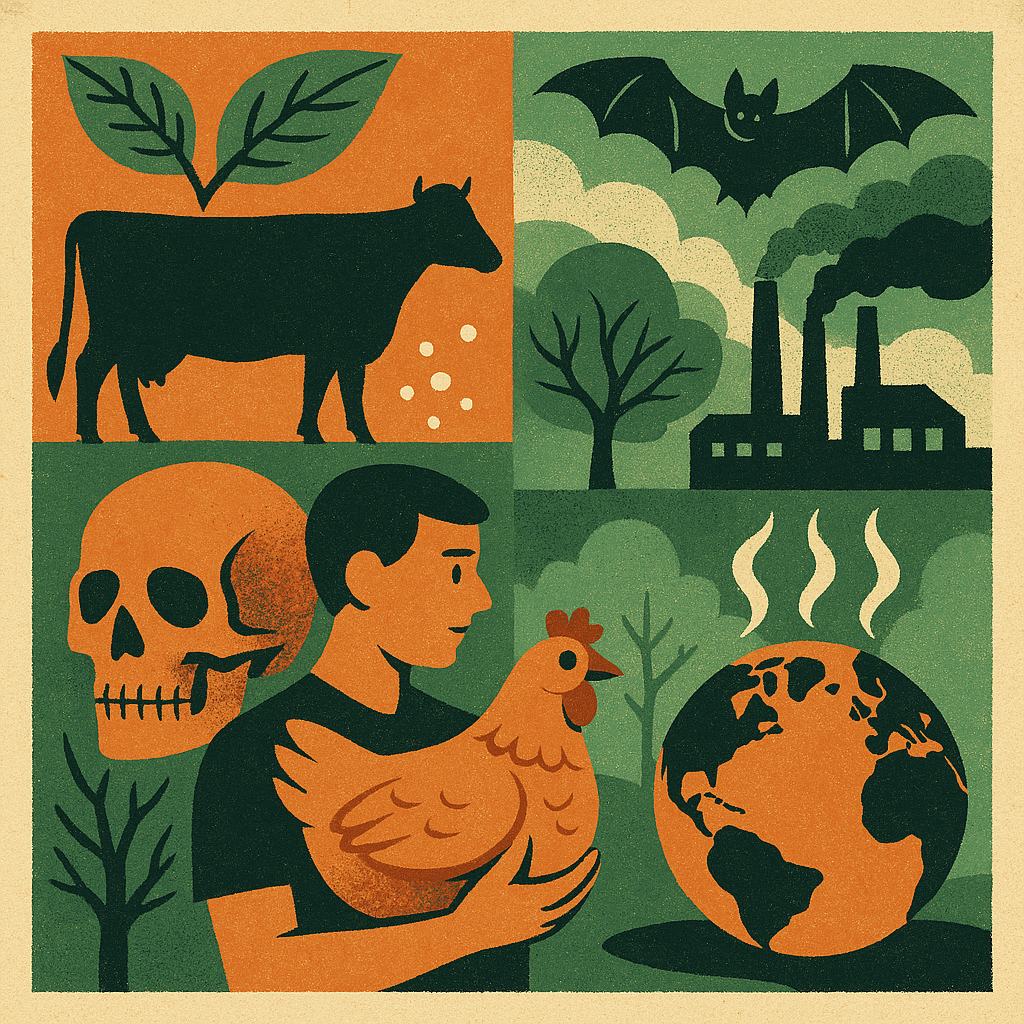
Pandora’s Livestock: How Animal Agriculture Threatens Our Planet and Our Health

The following post explores the interconnected crises of biodiversity loss, industrial animal agriculture, and climate change, presenting a comprehensive argument about humanity’s complex role in environmental degradation. Drawing from works by Bill Gates, Risto Isomäki, and others, the text combines ecological science, epidemiology, and cultural history to examine both systemic failures and potential paths forward. The post highlights how deeply entangled environmental destruction, pandemics, and human psychology are — while also questioning whether our current cognitive limits allow us to grasp and act upon such intertwined threats.

Originally published in Substack: https://substack.com/home/post/p-166887887

The destruction of ecological diversity, the shrinking habitats of wild animals, and the rise of industrial livestock production represent grave violations against the richness of life — and profound threats to humanity’s own future. These issues go beyond climate change, which is itself just one of many interconnected problems facing nature today.

The Decline of Biodiversity and the Rise of Climate Complexity

In How to Avoid a Climate Disaster (2021), Bill Gates outlines the sources of human-generated greenhouse gas emissions. Although many factors contribute to climate change, carbon dioxide (CO₂) remains the dominant greenhouse gas emitted by humans. Gates also includes emissions of methane, nitrous oxide, and fluorinated gases (F-gases) in his calculations. According to his book, the total annual global emissions amount to 46.2 billion tons of CO₂-equivalent.

These emissions are categorized by sector:

  • Manufacturing (cement, steel, plastics): 31%
  • Electricity generation: 27%
  • Agriculture (plants and animals): 19%
  • Transportation (planes, cars, trucks, ships): 16%
  • Heating and cooling: 7%

This classification is more reader-friendly than the Our World In Data approach, which aggregates emissions into broader categories like ”energy,” comprising 73.2% of total emissions. Agriculture accounts for 18.4%, waste for 3.2%, and industrial processes for 5.2%.

According to Statistics Finland, the country emitted 48.3 million tons of CO₂ in one year, with agriculture accounting for 13.66% — aligning closely with Gates’ method. However, Finnish author and environmentalist Risto Isomäki, in How Finland Can Halt Climate Change (2019) and Food, Climate and Health (2021), argues that the contribution of animal agriculture to greenhouse gases is severely underestimated. He points out its role in eutrophication — nutrient pollution that degrades lake and marine ecosystems, harming both biodiversity and nearby property values.

Animal farming requires vast resources: water, grains, hay, medicines, and space. Isomäki notes that 80% of agricultural land is devoted to livestock, and most of the crops we grow are fed to animals rather than people. Transport, slaughter, and the distribution of perishable meat further exacerbate the emissions. Official estimates put meat and other animal products at causing around 20% of global emissions, but Isomäki warns the real figure could be higher — particularly when emissions from manure-induced eutrophication are misclassified under energy or natural processes rather than livestock.

Antibiotic Resistance and Zoonotic Pandemics: The Hidden Cost of Meat

A more urgent and potentially deadly consequence of animal agriculture is the emergence of antibiotic-resistant bacteria and new viruses. 80% of all antibiotics produced globally are used in livestock — primarily as preventative treatment against diseases caused by overcrowded, unsanitary conditions. Even in Finland, where preventive use is officially banned, antibiotics are still prescribed on dubious grounds, as journalist Eveliina Lundqvist documents in Secret Diary from Animal Farms (2014).

This misuse of antibiotics accelerates antibiotic resistance, a serious global health threat. Simple surgeries have become riskier due to resistant bacterial infections. During the COVID-19 pandemic, roughly half of the deaths were linked not directly to the virus but to secondary bacterial pneumonia that antibiotics failed to treat. Isomäki (2021) emphasises that without resistance, this death toll might have been drastically lower.

Moreover, the close quarters of industrial animal farming create ideal conditions for viruses to mutate and jump species — including to humans. Early humans, living during the Ice Age, didn’t suffer from flu or measles. It was only after the domestication of animals roughly 10,000 years ago that humanity began facing zoonotic diseases — diseases that spread from animals to humans.

Smallpox, Conquest, and the Pandora’s Box of Domestication

This shift had catastrophic consequences. In the late 15th century, European colonizers possessed an unintended biological advantage: exposure to diseases their target populations had never encountered. Among the most devastating was smallpox, thought to have originated in India or Egypt over 3,000 years ago. Spread through close contact among livestock, it left distinct scars on ancient victims like Pharaoh Ramses V, whose mummy still bears signs of the disease.

When Spanish conquistadors reached the Aztec Empire in 1519, smallpox killed over three million people. Similar destruction followed in the Inca Empire. By 1600, the Indigenous population of the Americas had dropped from an estimated 60 million to just 6 million.

Europe began vaccinating against smallpox in 1796 using the cowpox virus. Still, over 300 million people died globally from smallpox in the 20th century. Finland ended smallpox vaccinations in 1980. I personally received the vaccine as an infant before moving to Nigeria in 1978.

From COVID-19 to Fur Farms: How Modern Exploitation Fuels Pandemics

The SARS-CoV-2 virus might have originated in bats, with an unknown intermediate host — maybe a farmed animal used for meat or fur. China is a major fur exporter, and Finnish fur farmers have reportedly played a role in launching raccoon dog (Nyctereutes procyonoides) farming in China, as noted by Isomäki (2021).

COVID-19 has been shown to transmit from humans to animals, including pets (cats, dogs), zoo animals (lions, tigers), farmed minks, and even gorillas. This highlights how human intervention in wildlife and farming practices can turn animals into vectors of global disease.

Are Our Brains Wired to Ignore Global Crises?

Why do humans act against their environment? Perhaps no one intentionally destroys nature out of malice. No one wants polluted oceans or deforested childhood landscapes. But the path toward genuine, large-scale cooperation is elusive.

The post argues that we are mentally unprepared to grasp systemic, large-scale problems. According to Dunbar’s number, humans can effectively maintain social relationships within groups of 150–200 people — a trait inherited from our village-dwelling ancestors. Our brains evolved to understand relationships like kinship, illness, or betrayal within tight-knit communities — not to comprehend or act on behalf of seven billion people.

This cognitive limitation makes it hard to process elections, policy complexity, or global consensus. As a result, people oversimplify problems, react conservatively, and mistrust systems that exceed their brain’s social bandwidth.

Summary: A Call for Compassionate Comprehension

The destruction of biodiversity, the misuse of antibiotics, the threat of pandemics, and climate change are not isolated crises. They are symptoms of a deeper disconnect between human behavior and ecological reality. While no one wants the Earth to perish, the language and actions needed to protect it remain elusive. Perhaps the real challenge is not just technical, but psychological — demanding that we transcend the mental architecture of a tribal species to envision a truly planetary society.


References

Gates, B. (2021). How to Avoid a Climate Disaster: The Solutions We Have and the Breakthroughs We Need. Alfred A. Knopf.

Isomäki, R. (2019). Miten Suomi pysäyttää ilmastonmuutoksen. Into Kustannus.

Isomäki, R. (2021). Ruoka, ilmasto ja terveys. Into Kustannus.

Lundqvist, E. (2014). Salainen päiväkirja eläintiloilta. Into Kustannus.

Our World In Data. (n.d.). Greenhouse gas emissions by sector. Retrieved from https://ourworldindata.org/emissions-by-sector

Statistics Finland. (n.d.). Greenhouse gas emissions. Retrieved from https://www.stat.fi/index_en.html