Zen and the Art of Dissatisfaction – Part 35

Losing Myself and My Suitcase

This post explores how the stories our minds create – stories of guilt, inadequacy, or fear – can become far heavier burdens than the events that inspire them. A lost suitcase, a moment of confusion in a foreign railway station, or a lapse in attentiveness can transform into a mental storm. Yet within these storms lies an invitation: to examine who we believe ourselves to be and to recognise our deep entanglement with everything around us. Drawing from personal experience and classical Zen teachings-from Emperor Wu of Liang to Bodhidharma and Shitou Xiqian – this post reflects on illusion of the sense of self, perception, and the inseparable connection between all beings.

At times, the stories and self-accusations created by our own minds are our worst enemies. Anyone who has ever accidentally broken or lost something, or missed an important meeting or means of transport, knows how upsetting such moments can be. Even if nothing significant was ultimately harmed or endangered, the mind may still twist the situation into something impossibly difficult.

Lost Suitcase

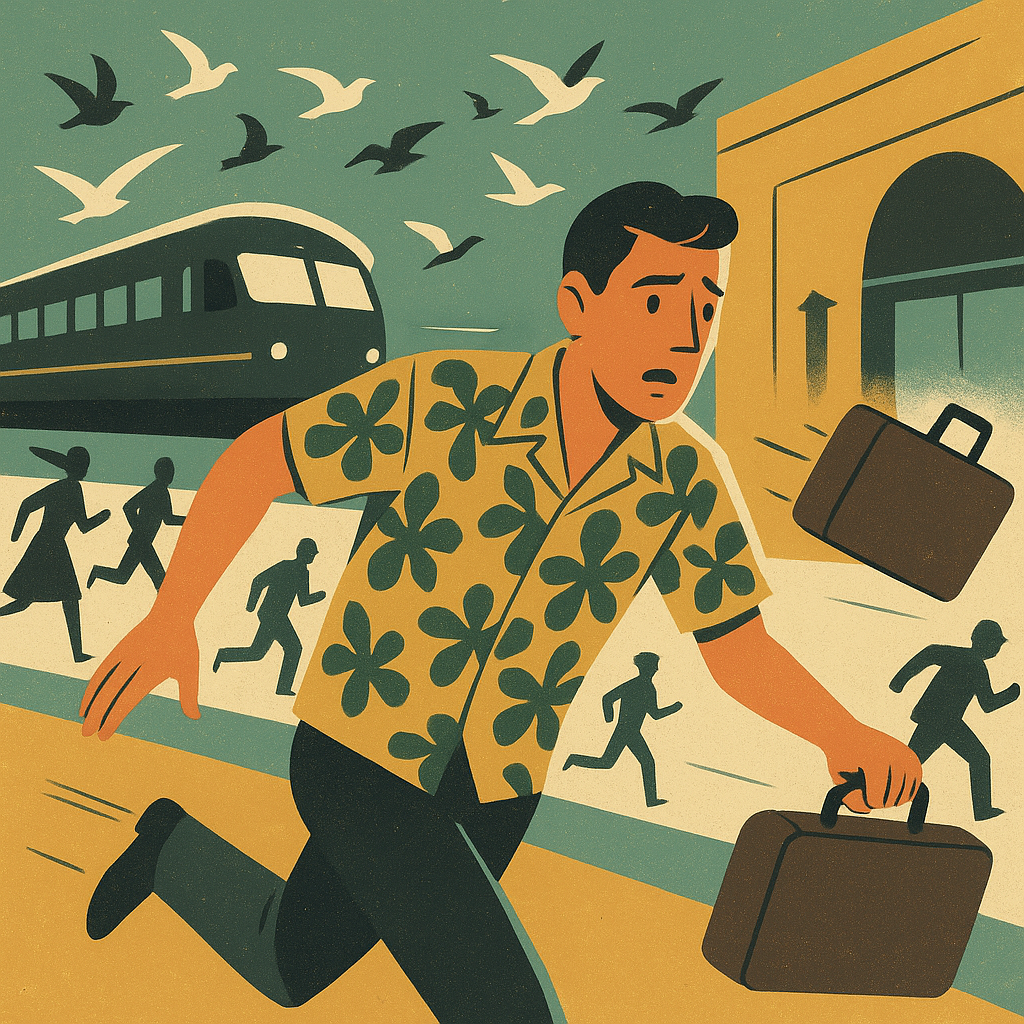
I lost my suitcase in August 2018 while travelling to a week-long silent Zen retreat in the Netherlands. My train stopped at Rotterdam station. I was heading toward a small Dutch town whose name I could not even pronounce. My phone’s internet connection wasn’t working, and I did not know where I was supposed to change trains. I saw a uniformed conductor on the platform and went outside to ask him for help. He told me that I was already running late. My train would leave in minutes, and I would have to switch platforms.

I ran to the new platform, arrived just in time to see the train that had brought me there gliding away. Another train arrived. I stepped in, found myself a seat, and realised that I had not taken my suitcase with me from the previous train. I had only a small shoulder bag and the clothes I was wearing.

My stomach dropped into a deep abyss beneath my feet. It felt as if all the blood in my body fell down with it. I tried to prevent myself from falling into that abyss, but my mind seized control. I began making a plan to retrieve my suitcase. I found the conductor; he gave me the number for the lost-and-found service. I called, but it was no use. No one could tell me where the train I had lost my suitcase on would go after its terminal station. Despite my best efforts, I never saw my suitcase again.

The Longest First Day

When I arrived at the retreat centre, my teacher burst out laughing. It was not mean at all, actually it felt nice. I knew I was safe. ”This is exactly why we practise mindfulness,” he said. His wife promised to bring me a toothbrush and toothpaste. The first day of the retreat felt endless. I noticed how my mind replayed the event again and again from different angles. I sat there in silence, watching how my mind meticulously showed me just how careless, stupid, and thoughtless I had been.

At bedtime my mind was still boiling, replaying the events and insisting on my stupidity and carelessness. Eventually I fell asleep but soon woke up again, my mind still seething with self-accusations. As the days passed, I began to see how utterly unnecessary this whole mental process was. It was merely the torrent of self-blame and fixation on loss. Though at first I had imagined that my suitcase held my entire life, I eventually realised that this was not true. Life is something entirely different.

What Is This Life We Are Living?

But what is this life of ours? Is it even possible to say? I notice that I cannot state with certainty what I mean by my self.

The Emperor Wu of Liang (c. 502-549) is said to have met the semi-mythical ancestor of Zen, the great Bodhidharma (c. 440-528), who arrived in China from somewhere along the Silk Road, presumably from India. During their short encounter, Emperor Wu questioned Bodhidharma about who this man standing before him really was. Bodhidharma replied laconically: ”I don’t know.”

What are we, what am I, truly? It feels irrelevant at first, but when I look deeper, I find it impossible to point to any one specific thing and say that this is me. If I pointed to myself and examined more closely, I would notice that it is not true. If I pointed, for instance, to my shoulder and asked whether that is me – no, it is not. It is only my shoulder, but even that is not so simple. The shoulder is merely a entaglement of various interconnected parts. It is a collection of things: skin, tendons, bone, nerve fibres, blood, and other fluids. The closer I look, the less any of these seem like ”me”. Any one of them could perhaps be replaced without that essential sense of ”I” disappearing. It is like the Ship of Thesius in this regard. Or its Chinese counterpart, the Zen Koan regarding the Cart of Keichu.

Even if my mind insists it is the same ”me” as it was meybe ten years ago, this is not the case. Our minds change, and our memories change with them. The atoms and molecules forming our bodies are replaced as we eat and drink. Food becomes part of us. Old material leaves us when we breathe out, or go to the bathroom, or brush off dry skin.

The skin surrounding the body is not me. It is merely skin. My bones are not me, for they too are merely bones. Yet if I must prove my identity to a police officer or to my computer, I instantly become a unique individual, distinct from all others in some incomprehensible way.

Interbeing: The World Within and Around Us

I sit by the window of our home and listen to the birds singing at the bird feeder. A great spotted woodpecker has given way to squabbling tits. Sound waves carry the birds’ calls to my ears. What separates me from those birds, when even the sound waves travelling through the air connect us? As I listen, the window between us ceases to exist.

The wind rustling the branches of spruces and pines takes shape in the sound it produces as it moves through them. The same play of awareness occurring in my mind is present in everything. It is in the branches of trees, in birdsong, even in the empty space binding us together. I breathe the oxygen these trees have produced. We are all interwoven together. None of us could exist without the other.

And yet, even though we are intertwined with birds, trees, and air, I can also view the same reality from another perspective, where each part becomes sharply distinct. The tit and the woodpecker take on their individual forms, and each of us has our own unique task in this moment. We are separated by our unique ways of being-yet still bound to one another.

The Chinese 8th-century Zen master Shitou Xiqian (700-790), known in Japanese as Sekito Kisen, ends his famous poem Sandokai (The Identity of Relitive and Absolute) with the words: ”Do not waste your time by night or day.” Both darkness and light are two aspects of reality intertwined and, in themselves, the same thing – two dimensions of experience. Everyday dissatisfaction and the bliss of freedom are both right here, right now.

Summary

What begins as a story about a lost suitcase unfolds into a reflection on the self, awareness, and our profound connection with all beings and things. The mind can turn trivial events into overwhelming crises, yet it also possesses the capacity to recognise their emptiness. Through personal experience, ancient Zen teachings, and the simple presence of birds and trees, we are reminded that life is both deeply individual and inseparably shared. In every moment-whether painful or peaceful-there is an invitation to see clearly and live fully.

Zen and the Art of Dissatisfaction – Part 29

Wealth, Work and the AI Paradox

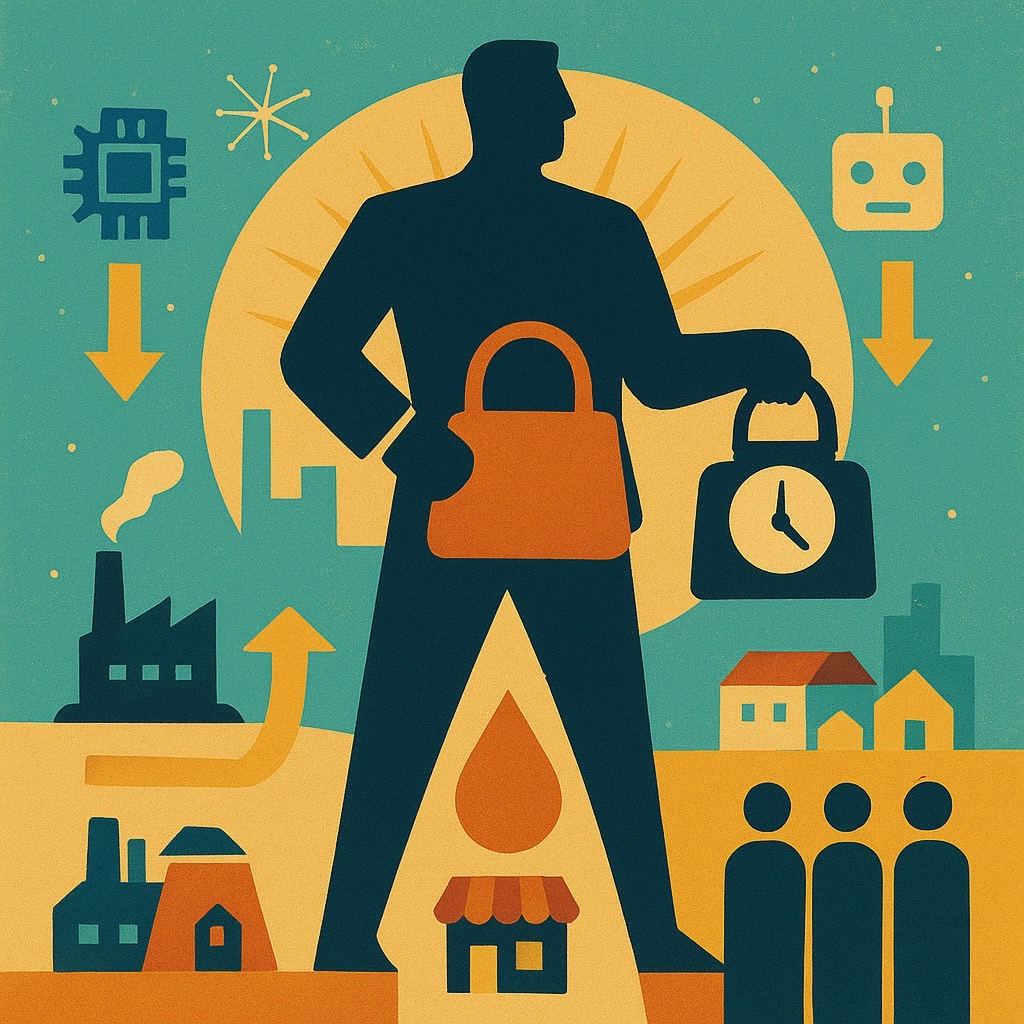
The concentration of wealth among the world’s richest individuals is being driven far more by entrenched, non‑AI industries—luxury goods, energy, retail and related sectors—than by the flashier artificial‑intelligence ventures that dominate today’s headlines. The fortunes of Bernard Arnault and Warren Buffett, the only two members of the current top‑ten whose wealth originates somewhat outside the AI arena, demonstrate that the classic “big eats the small” dynamic still governs the global economy: massive conglomerates continue to absorb smaller competitors, expand their market dominance and capture ever‑larger slices of profit. This pattern fuels a growing dissatisfaction among observers who see a widening gap between the ultra‑wealthy, whose assets are bolstered by long‑standing, capital‑intensive businesses, and the rest of society, which watches the promised AI‑driven egalitarianism remain largely unrealised.

Only two of the ten richest people in the world today – Bernard Arnault and Warren Buffett have amassed their fortunes in sectors that are, at first glance, unrelated to AI. Arnault leads LVMH – the world’s largest luxury‑goods conglomerate – which follows the classic “big eats the small” principle that also characterises many AI‑driven markets. Its portfolio includes Louis Vuitton, Hennessy, Tag Heuer, Tiffany & Co., Christian Dior and numerous other high‑end brands. Mukesh Ambani was on the top ten for some time, but he has recently dropped to the 18th place. Ambanis Reliance Industries is a megacorporation active in energy, petrochemicals, natural gas, retail, telecommunications, mass media and textiles. Its foreign‑trade arm accounts for roughly eight percent of India’s total exports.

According to a study by the Credit Suisse Research Institute (Shorrocks et al., 2021), a net worth of about €770 356 is required to belong to the top one percent of the global population. Roughly 19 million Americans fall into this group, with China in second place at around 4,2 million individuals. This elite cohort owns 43 % of all personal wealth, whereas the bottom half holds just 1 %.

Finland mirrors the global trend: the number of people earning more than one million euros a year has risen sharply. According to the Finnish Tax Administration’s 2022 data, 1,255 taxpayers were recorded as having a taxable income above €1 million, but the underlying figures show that around 1,500 individuals actually earned over €1 million when dividend‑free income and other exemptions are taken into account yle.fi. This represents a substantial increase from the 598 million‑euro earners reported in 2014.

The COVID‑19 Boost to the Ultra‑Rich

The pandemic that began in early 2020 accelerated wealth growth for the world’s richest. Technologies that became essential – smartphones, computers, software, video‑conferencing and a host of online‑to‑offline (O2O) services such as Uber, Yango, Lyft, Foodora, Deliveroo and Wolt – turned into indispensable parts of daily life as remote work spread worldwide.

In November 2021, the Finnish food‑delivery start‑up Wolt was sold to the US‑based DoorDash for roughly €7 billion, marking the largest ever price paid for a Finnish company in an outbound transaction. Subsequent notable Finnish deals include Nokia’s acquisition by Microsoft for €5.4 billion and Sampo Bank’s sale to Danske Bank for €4.05 billion.

AI, Unemployment and the Question of “Useful” Work

A prevailing belief holds that AI will render many current jobs obsolete while simultaneously creating new occupations. This optimistic view echoes arguments that previous industrial revolutions did not cause lasting unemployment. Yet, the reality may be more nuanced.

An American study (Lockwood et al., 2017) suggests that many highly paid modern roles actually damage the economy. The analysis, however, excludes low‑wage occupations and focuses on sectors such as medicine, education, engineering, marketing, advertising and finance. According to the study:

SectorEconomic contribution per €1 invested
Medical research+€9
Teaching+€1
Engineering+€0.2
Marketing/advertising‑€0.3
Finance‑€1.5

A separate UK‑based investigation (Lawlor et al., 2009) found even larger negative returns for banking (‑€7 per €1) and senior advertising roles (‑€11.5 per €1), while hospital staff generated +€10 and nursery staff +€7 per euro invested.

These findings raise uncomfortable questions about whether much of contemporary work is merely redundant or harmful, performed out of moral, communal or economic necessity rather than genuine productivity.

Retraining Professionals in an AI‑Dominated Landscape

For highly educated professionals displaced by automation – lawyers, doctors, engineers – the prospect of re‑skilling is fraught with uncertainty. Possible pathways include:

  1. Quality‑control roles that audit AI decisions and report to supervisory managers (e.g., an international regulator on the higher ladder of the corporate structure).
  2. Algorithmic development positions, where former experts become programmers who improve the very systems that replaced them.

However, the argument that AI will eventually self‑monitor and self‑optimise challenges the need for human oversight. Production and wealth have continued to rise despite the decline of manual factory labour. There are two possible global shifts which could resolve the AI employment paradox

  1. Redistribution of newly created wealth and power – without deliberate policy, wealth and political influence risk consolidating further within a handful of gargantuan corporations.
  2. Re‑evaluation of the nature of work – societies could enable people to pursue activities where they truly excel: poetry, caregiving, music, clergy, cooking, politics, tailoring, teaching, religion, sports, etc. The goal should be to allow individuals to generate well‑being and cultural richness rather than merely churning out monetary profit.

Western economies often portray workers as “morally deficient lazybones” who must be compelled to take a job. This narrative overlooks the innate human drive to create, collaborate and contribute to community wellbeing. Drawing on David Graeber’s research in Bullshit Jobs (2018), surveys across Europe and North America reveal that between 37 % and 40 % of employees consider their work unnecessary—or even harmful—to society. Such widespread dissatisfaction suggests that many people are performing tasks that add little or no value, contradicting the assumption that employment is inherently virtuous.

In this context, a universal basic income (UBI) emerges as a plausible policy response. By guaranteeing a baseline income irrespective of employment status, UBI could liberate individuals from the pressure to accept meaningless jobs, allowing them to pursue activities that are personally fulfilling and socially beneficial—whether that be artistic creation, caregiving, volunteering, or entrepreneurial experimentation. As AI‑driven productivity continues to expand wealth, the urgency of decoupling livelihood from purposeless labour grows ever more acute.

Growing Inequality and the Threat of AI‑Generated Waste

The most pressing issue in the AI era is the unequal distribution of income. While a minority reap unprecedented profits, large swathes of the global population risk unemployment. Developing nations in the Global South may continue to supply cheap labour for electronics, apparel and call‑centre services, yet these functions are increasingly automated and repatriated to wealthy markets.

Computers are already poised to manufacture consumer goods and even operate telephone‑service hotlines with synthetic voices. The cliché that AI will spare only artists is questionable. Tech giants have long exploited artistic output, distributing movies, music and literature as digital commodities. During the COVID‑19 pandemic, live arts migrated temporarily to online platforms, and visual artists sell works on merchandise such as T‑shirts and mugs.

Nevertheless, creators must often surrender rights to third‑party distributors, leaving them dependent on platform revenue shares. Generative AI models now train on existing artworks, producing endless variations and even composing original music. While AI can mimic styles, it also diverts earnings from creators. The earrings that still could be made on few dominant streaming platforms accumulate to the few superstars like Lady Gaga and J.K. Rowling.

Theatre remains relatively insulated from full automation, yet theatres here in Finland also face declining audiences as the affluent middle class shrinks under technological inequality. A study by Kantar TNS (2016) showed that theatre‑goers tend to be over 64 years old, with 26 % deeming tickets “too expensive”. Streaming services (Netflix, Amazon Prime Video, HBO, Apple TV+, Disney+, Paramount+) dominate story based entertainment consumption, but the financial benefits accrue mainly to corporate executives rather than the content creators at the bottom of the production chain.

Corporate Automation and Tax evasion

Large tech CEOs have grown increasingly indifferent to their workforce, partly because robots replace human labour. Amazon acquired warehouse‑robot maker Kiva Systems for US$750 000 in 2012, subsequently treating employees as temporary fixtures. Elon Musk has leveraged production robots to sustain Tesla’s U.S. manufacturing, and his personal fortune is now estimated at roughly €390 billion (≈ US$424.7 billion) as of May 2025 (Wikipedia). Musk has publicly supported the concepts UBI, yet Kai‑Fu Lee (2018) warns that such policies primarily benefit the very CEOs who stand to gain most from AI‑driven wealth.

Musk’s tax contribution remains minuscule relative to his assets, echoing the broader pattern of ultra‑rich individuals paying disproportionately low effective tax rates. Investigative outlet ProPublica reported that Jeff Bezos paid 0.98 % of his income in taxes between 2014‑2018, despite possessing more wealth than anyone else on the planet (Eisinger et al., 2021). At the same time, Elon Musk’s tax rate was 3.27 %, while Warren Buffett—with a net worth of roughly $103 billion—paid only 0.1 %. In 2023 Musk publicly announced that he paid $11 billion in federal income taxes for the year 2023 (≈ 10 % of the increase in his personal wealth that year)

U.S. Senator Bernie Sanders tweeted on 13 Nov 2021: “We must demand that the truly rich pay their fair share. 👍”, to which Musk replied, “I always forget you’re still alive.” This exchange epitomises the ongoing debate over wealth inequality.

Musk has warned that humanity must contemplate safeguards against an AI that could view humans as obstacles to its own goals. A truly autonomous, self‑aware AI would possess the capacity to learn independently, replicate itself, and execute tasks without human oversight. Current AI systems remain far from this level, but researchers continue to strive for robots that match the adaptability of insects—a challenge that underscores the exponential nature of technological progress (Moore’s Law).

Summary

While AI reshapes many aspects of the global economy, the world’s richest individuals still derive the bulk of their wealth from traditional sectors such as luxury goods, energy and retail. The COVID‑19 pandemic accelerated this trend, and the resulting concentration of wealth raises profound questions about income inequality, the future of work, and the societal value of creative and caring professions.

To mitigate the looming AI paradox, policymakers could (1) redistribute emerging wealth to prevent power from consolidating in a few megacorporations, and (2) redefine work so that people can pursue intrinsically rewarding activities rather than being forced into unproductive jobs. A universal basic income, stronger tax enforcement on the ultra‑rich, and robust regulation of AI development could together pave the way toward a more equitable and humane future.


References

Eisinger, P., et al. (2021). Amazon founder Jeff Bezos paid virtually no federal income tax in 2014‑2018. ProPublica. https://www.propublica.org/article/jeff-bezos-tax Graeber, D. (2018). Bullshit jobs: A theory. Simon & Schuster. Kantar TNS. (2016). Finnish theatre audience study. Lawlor, D., et al. (2009). Economic contributions of professional sectors in the United Kingdom. Journal of Economic Perspectives, 23(4), 45‑62. Lockwood, R., et al. (2017). The hidden costs of high‑paying jobs. American Economic Review, 107(5), 123‑138. Shorrocks, A., et al. (2021). Global wealth distribution and the top 1 percent. Credit Suisse Research Institute.