Zen and the Art of Dissatisfaction – Part 34

Navigating the Times of Crisis

In a rapidly changing world, where the climate crisis, technological advancements, and social inequality loom large, many may feel overwhelmed by the forces shaping our future. Yet, in the face of such challenges, simple spiritual practices can offer us ways to navigate uncertainty and find meaning. Drawing on Eastern philosophy, we are reminded that the pursuit of peace, both within ourselves and in the world, is a path we can all walk.

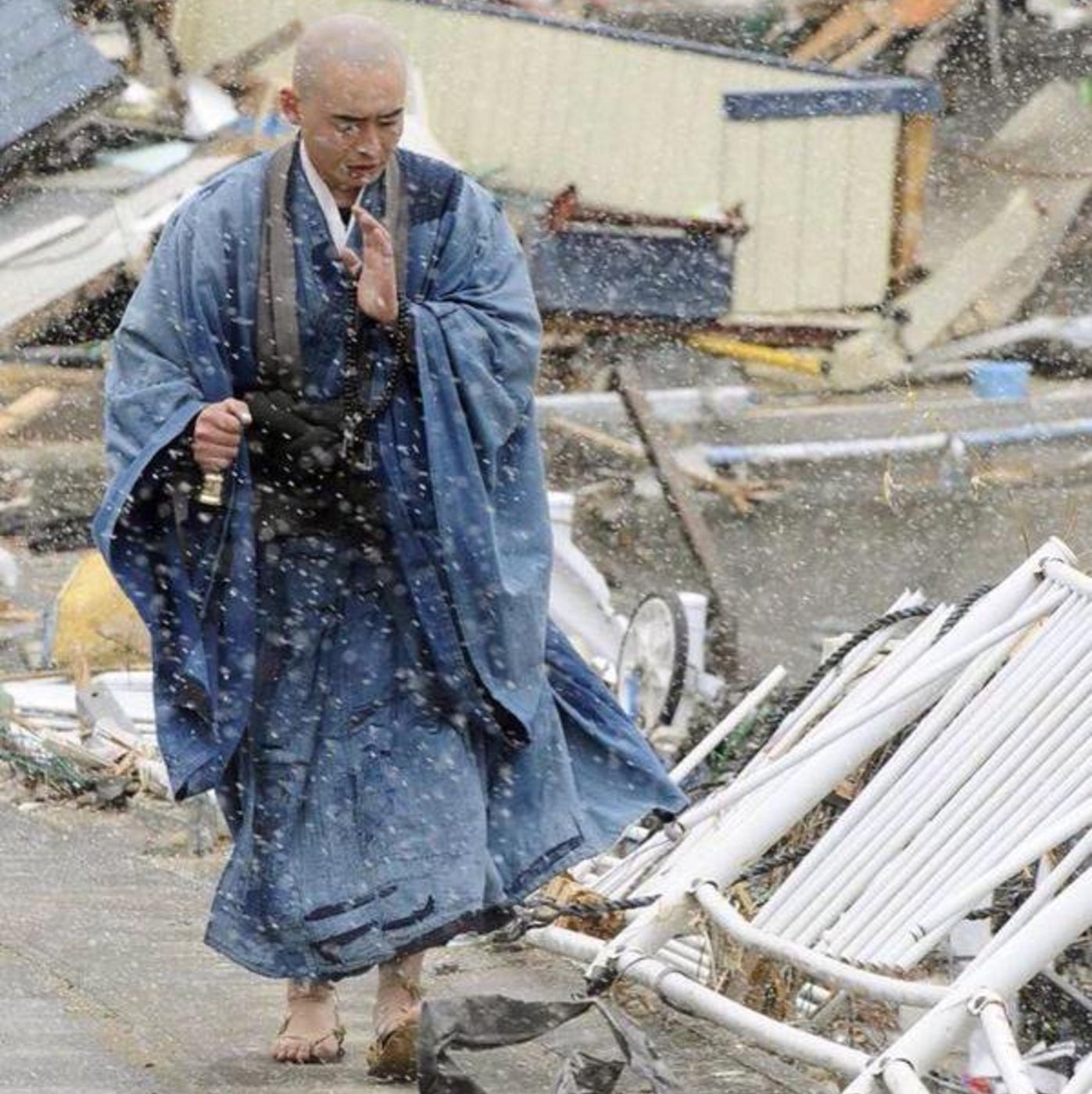
Photo: Buddhist monk Sokan Obara, 28, from Morioka, Iwate prefecture, prays for the victims in an area devastated by the earthquake and tsunami, in Ofunato, Iwate prefecture, April 7. Unknown photographer.

According to some estimates, our planet is heading towards a hothouse Earth scenario, where runaway climate change threatens the future of human civilisation (Steffen et al., 2018). This process will particularly affect the global South, countries that continue to bear the brunt of colonialism’s harmful legacy, yet have contributed the least to global warming, rising sea levels, and environmental degradation.

The Challenge of Our Time: Climate Crisis and Technology

The rise of artificial intelligence (AI) and its reliance on algorithms may also lead to large tech companies becoming the global decision-makers, shaping the economy and politics of the world. This shift could pose an existential challenge to the global South, as demand for human manual labour diminishes, further exacerbating social inequities.

But should we panic and give up hope? Is a hedonistic ”live for today” attitude the only remaining solution?

Philosopher David Loy (2019) has been exploring for decades the answers Eastern philosophies may offer to help us navigate these challenges. One such concept is the bodhisattva ideal, which originates from Sanskrit and refers to an awakened being who recognises the interconnectedness of all life. The bodhisattva understands that their well-being is intricately linked to the well-being of the world as a whole.

An embodiment of this ideal is Kanzeon (also known as Avalokiteśvara in Sanskrit and Guanyin in Chinese), a figure often depicted with a thousand arms, symbolising the countless ways in which this figure reaches out to help those in need. Another popular figure embodying the bodhisattva’s compassion is Hotei (also known as Budai in Chinese), a joyful, portly monk carrying a large bag, from which he pulls out healing remedies for the world’s suffering—whether it be a bandage for a fallen child or a new kidney for the ill.

Embracing Sorrow: The First Step Towards Action

The destruction of biodiversity and the decline of democracy are deeply sorrowful realities. Accepting this sorrow is the first step toward constructive action. As the great Joanna Macy (2021) reminded us, we are saddened by the loss of ecological diversity because we care. Our hearts break, and yet it is precisely our hearts that allow us to take action.

Acceptance of sorrow may lead us to take meaningful steps toward creating a better, fairer future. Paradoxically, to help the world, we must first let go and turn inward. The path of the peacemaker has two sides. One must care for their own well-being and strive to awaken to the oneness of life, but one should also aknowledge their own responsibility in the oneness of life and act accordingly.

The most basic spiritual practice that can help us on this path is mindfulness, which can begin with simply sitting in silence and staying aware of the open nature of our own mind. Through this practice, we can observe not just the sensations of our body, but also the nature of our mind. While suffering and dissatisfaction may not disappear, we can examine our relationship with them. Over time, our relationship with our innate dissatisfaction may change.

This process can also unveil the awareness that the nature of our mind is unknown to us. All the thoughts and emotions that arise in our mind come from someplace we cannot know – from the unknown. This insight may lead us to consider that the same interplay of consciousness occurs across all life forms. All beings have thoughts, ideas, and feelings, yet we cannot know exactly what another experiences.

American Zen teacher Bernie Glassman (1998) reminded that we need to let go of our preconceived notions and ideas and trust the Not-Knowing. The next step in the peacemaker’s path is listening or Bearing Witness. We must pause for a moment and pay attention to what is happening around us, to what others are trying to communicate. Stopping to listen to others’ perspectives may challenge our previous assumptions, attitudes, and beliefs. The third step is action – Loving Action that arises from this process of not-knowing and deep listening.

The Peacemaker’s Responsibility

A peacemaker responds to each situation in a way that is appropriate. When one realises they are interconnected with everything, one feels that they also have personal responsibility. If we are tired, we must rest. If we are hungry, we must eat. We care for our children, ensuring they are picked up from daycare, fed, and put to bed on time. We help those who fall.

Every day, we can ask ourselves: what can we do for others – since others are ourselves.

A peacemaker may also come to see that the systems in place often work for the benefit of few and to cause harm the oneness of life. They may feel compelled to influence these unjust systems, helping others realise, through their own example, that the current system damages life and its interconnectedness. The peacemaker does not demand change forcefully nor does they try to impose their will on everyone else. The peacemaker listens to all perspectives and seeks to show, through their own actions, the interconnectedness and oneness of life.

The Struggle for Change

But how do we act in a world full of injustice and suffering? We often try to force others to change their minds and behave differently. But will that lead to the outcome we desire? The peacemaker’s ideal involves helping others through not-knowing, listening, and taking loving action. Through this process, they hope to find the best solutions for the wholeness of life. The peacemaker is not just hoping for change, but becomes the change themselves.

This kind of action is exceedingly difficult. The easiest solution may be to demand change, but would that help anyone realise the harm their actions cause? Mahatma Gandhi’s concept of civil disobedience and nonviolent resistance aimed to make the opposition recognise the wrongness of their violent actions. Nonviolent resistance has brought about significant change in the world when enough people collectively stand behind a cause.

However, we do not need to start by changing everything. We do not need to be Gandhi today. First, we must learn to know ourselves. Despite knowing much about the workings of the human brain and mind, we often fail to understand our own mind. We think of ourselves as the rulers of our own mind and consciousness, but we are barely gatekeepers. Even as gatekeepers, we often wander aimlessly through our minds like Snufkin in the Moomin stories.

The first appropriate step on the peacemaker’s path may simply be to sit down and be quiet for a moment.

Conclusion

The journey of a peacemaker is not easy, nor it is straight forward. It requires us to embrace sorrow, realise our interconnectedness, and take action in small and large ways. But ultimately, it is through open awareness of the nature of our mind, and compassion that we can navigate the complexities of the diversity of the world and contribute to a more peaceful and just future for all life.

References

Glassman, Bernie (1998). Bearing Witness: A Zen Master’s Lessons in Making Peace. Bell Tower.
Loy, D. R. (2019). Ecodharma: Buddhist Teachings for the Ecological Crisis. Wisdom Publications.
Macy, J. (2021). Active Hope: How to Face the Mess We’re in without Going Crazy. New World Library.
Steffen, W., Rockström, J., Richardson, K., Lenton, T. M., Folke, C., Liverman, D., … & Schellnhuber, H. J. (2018). Trajectories of the Earth System in the Anthropocene. Proceedings of the National Academy of Sciences, 115(33), 8252-8259. https://doi.org/10.1073/pnas.1810141115

Zen and the Art of Dissatisfaction – Part 33

From Poverty to Productivity

Across the world, economists, sociologists and policymakers have long debated whether providing people with an unconditional basic income could help lift them out of poverty. Despite numerous pilot projects, there are relatively few long-term studies showing the large-scale social and health impacts of such measures. One striking exception, highlighted by the Dutch historian Rutger Bregman, provides rare empirical evidence of how a sudden, guaranteed flow of money can transform an entire community — not just economically, but psychologically and socially.

In 1997, in the state of North Carolina, the Eastern Band of Cherokee people opened the Harrah’s Cherokee Casino Resort. By 2010, the casino’s annual revenues had reached around 400 million USD, where they have remained relatively stable ever since. The income was used to build a new school, hospital and fire station — but the most significant portion of the profits went directly to the tribe’s members, about 8,000 in total.

The Findings: Money Really Did Change Everything

By 2001, the funds from the casino already accounted for roughly 25–33 per cent of household income for many families. These payments acted, in effect, as an unconditional basic income.

What made this case extraordinary was that, purely by coincidence, a research group led by psychiatrist Jane Costello at Duke University had been tracking the mental health of young people in the area since 1991. This provided a unique opportunity to compare the same community before and after the introduction of this new source of income.

Costello’s long-term data revealed that children who had grown up in poverty were far more likely to suffer from behavioural problems than their better-off peers. Yet after the casino opened — and the Cherokee families’ financial situation improved — behavioural problems among children lifted out of poverty declined by up to 40 per cent, reaching levels comparable to those of children from non-poor households.

The benefits went beyond behaviour. Youth crime, alcohol consumption and drug use all decreased, while school performance improved significantly. Ten years later, researchers found that the earlier a child had been lifted out of poverty, the better their mental health as a teenager.

Bregman (2018) uses this case to make a clear point: poverty is not caused by laziness, stupidity or lack of discipline. It is caused by not having enough money. When poor families finally have the financial means to meet their basic needs, they frequently become more productive citizens and better parents.

In his words, “Poor people don’t make stupid decisions because they are stupid, but because they live in a context where anyone would make stupid decisions.” Scarcity — whether of time or money — narrows focus and drains cognitive resources, leading to short-sighted, survival-driven choices. And as Bregman puts it poignantly:

“There is one crucial difference between the busy and the poor: you can take a holiday from busyness, but you can’t take a holiday from poverty.”

How Poverty Shapes the Developing Brain

The deeper roots of these findings lie in how poverty and stress affect brain development and emotional regulation. The Canadian physician and trauma expert Gábor Maté (2018) explains how adverse childhood experiences — known as ACE scores — are far more common among children raised in poverty. Such children face a higher risk of being exposed to violence or neglect, or of witnessing domestic conflict in their homes and neighbourhoods.

Chronic stress, insecurity and emotional unavailability of caregivers can leave lasting marks on the developing brain. The orbitofrontal cortex — located behind the eyes and crucial for interpreting non-verbal emotional cues such as tone, facial expressions and pupil size — plays a vital role in social bonding and empathy. If parents are emotionally detached due to stress, trauma or substance use, this brain region may develop abnormally.

Maté describes how infants depend on minute non-verbal signals — changes in the caregiver’s pupils or micro-expressions — to determine whether they are safe and loved. Smiling faces and dilated pupils signal joy and security, whereas flat or constricted expressions convey threat or absence. These signals shape how a child’s emotional circuits wire themselves for life.

When children grow up surrounded by tension or neglect, they may turn instead to peers for validation. Yet peer-based attachment, as Maté notes, often fosters riskier behaviour: substance use, early pregnancy, and susceptibility to peer pressure. Such patterns are not signs of inherent cruelty or weakness, but rather of emotional immaturity born of unmet attachment needs.

Not Just a Poverty Problem: The Role of Emotional Availability

Interestingly, these developmental challenges are not confined to low-income families. Children from wealthy but emotionally absent households often face similar struggles. Parents who are chronically busy or glued to their smartphones may be physically present yet emotionally unavailable. The result can be comparable levels of stress and insecurity in their children.

Thus, whether a parent is financially poor or simply time-poor, the emotional outcome for the child can be strikingly similar. In both cases, high ACE scores predict poorer mental and physical health, lower educational attainment, and reduced social mobility.

While Finland is often praised for its high social mobility, countries like the United States show a much stronger intergenerational persistence of poverty. In rigidly stratified societies, the emotional and economic consequences of childhood disadvantage are far harder to escape.

Towards a More Humane Future: Basic Income and the AI Revolution

As artificial intelligence reshapes industries and redefines the meaning of work, society faces a profound question: how do we ensure everyone has the means — and the mental space — to live well?

If parents could earn their income doing the work they truly value, rather than chasing pay cheques for survival, they would likely become more productive, more fulfilled, and more emotionally attuned to their children. In turn, those children would grow into healthier, happier adults, capable of sustaining positive cycles of wellbeing and productivity.

Such an outcome would not only enhance individual happiness but would also reduce public expenditure on health care, policing and welfare. Investing in people’s emotional and economic stability yields returns that compound across generations. A universal basic income (UBI), far from being utopian, could therefore represent one of the wisest and most humane investments a modern society could make.

Conclusion

The story of the Eastern Band of Cherokee people and the Harrah’s Cherokee Casino stands as powerful evidence that unconditional income can transform lives — not through moral exhortation, but through simple material security. Poverty, as Bregman reminds us, is not a character flaw; it is a cash-flow problem. And as Maté shows, the effects of that scarcity extend deep into the wiring of the human brain. When financial stress eases, parents can connect, children can thrive, and communities can flourish. In an age of automation and abundance, perhaps the greatest challenge is no longer how to produce wealth — but how to distribute it in ways that allow everyone the freedom to be fully human.


References

Bregman, R. (2018). Utopia for Realists: The Case for a Universal Basic Income, Open Borders, and a 15-Hour Workweek. Bloomsbury.
Maté, G. (2018). In the Realm of Hungry Ghosts: Close Encounters with Addiction. North Atlantic Books.