Zen and the Art of Dissatisfaction – Part 30

The Case for Universal Basic Income

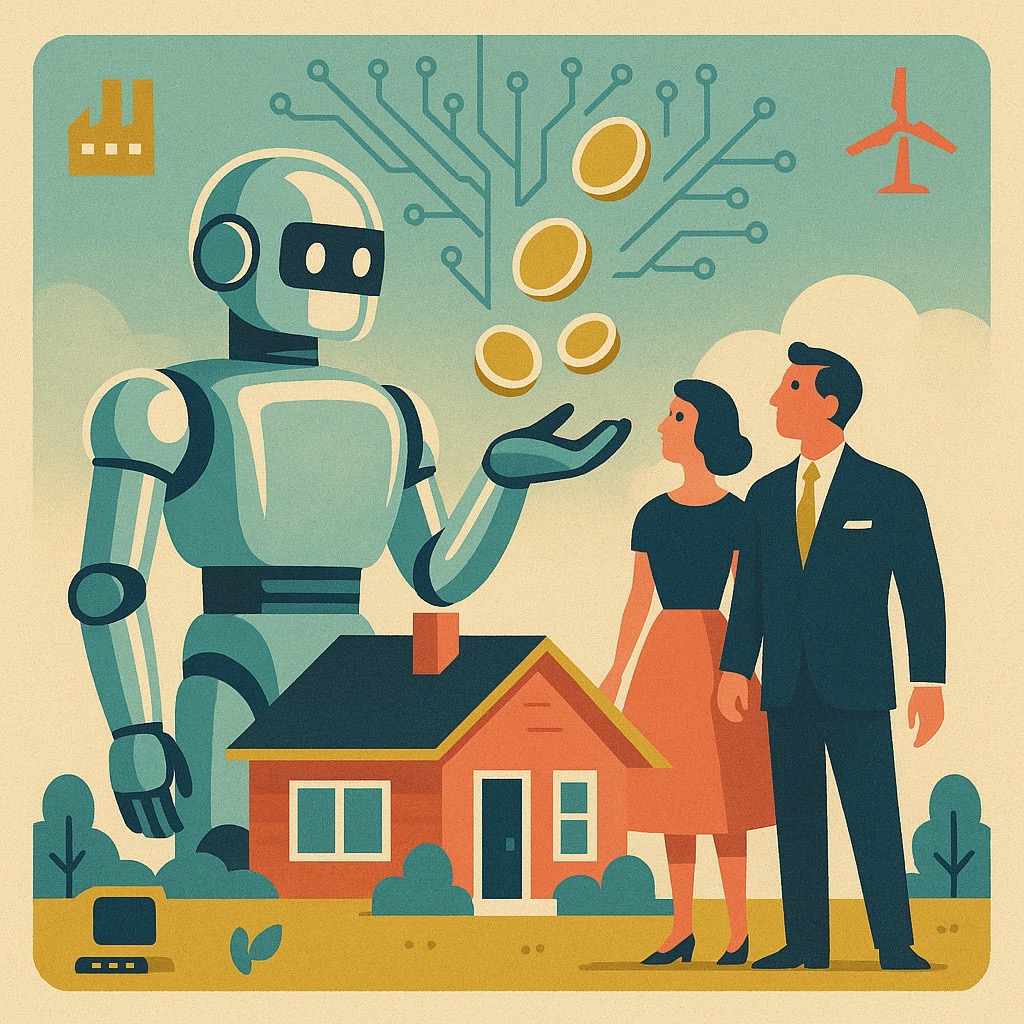
Universal Basic Income (UBI) is a concept that was originally conceived as a solution to poverty, ensuring that markets could continue to grow during normal economic times. The growing interest in UBI in Silicon Valley reflects a future vision driven by concerns over mass unemployment caused by artificial intelligence. Key figures like Sam Altman, CEO of OpenAI, and Chris Hughes, co-founder of Facebook, have both funded research into UBI. Hughes also published a book on the subject, Fair Shot (2018). Elon Musk, in his usual bold fashion, has expressed support for UBI in the context of AI-driven economic change. In August 2021, while unveiling the new Tesla Bot, Musk remarked: ”In the future, physical labour will essentially be a choice. For that reason, I think we will need a Universal Basic Income in the long run.” (Sheffey, 2021)

However, the future of UBI largely hinges on the willingness of billionaires like Musk to fund its implementation. Left-wing groups typically oppose the idea that work should be merely a choice, advocating for guaranteed jobs and wages as a means for individuals to support themselves. While it is undeniable that, in the current world, employment is necessary to afford life’s essentials, UBI could potentially redefine work as a matter of personal choice for everyone.

The Historical Roots of Universal Basic Income

Historian Rutger Bregman traces the historical roots of the UBI concept and its potential in the modern world in his book Free Money for All (2018). According to Bregman, UBI could be humanity’s only viable future, but it wouldn’t come without cost. Billionaires like Musk and Jeff Bezos must contribute their share. If the AI industry grows as expected, it could strip individuals of the opportunity for free and meaningful lives, where their work is recognised and properly rewarded. In such a future, people would need financial encouragement to pursue a better life.

The first mentions of UBI can be found in the works of Thomas More (1478–1535), an English lawyer and Catholic saint, who proposed the idea in his book Utopia (1516). Following More, the concept gained attention particularly after World War II, but it was American economist and Nobel laureate Milton Friedman (1912–2006) who gave the idea widespread recognition. Known as one of the most influential economists of the 20th century, Friedman advocated for a ”negative income tax” as a means to implement UBI, where individuals earning below a certain threshold would receive support from the government based on the difference between their income and a national income standard.

Friedman’s ideas were embraced by several American Republican presidents, including Richard Nixon (1913–1994) and Ronald Reagan (1911–2004), as well as the UK’s prime minister Margaret Thatcher (1925–2013), who championed privatization and austerity. Friedman argued that a negative income tax could replace bureaucratic welfare systems, reducing poverty and related social costs while avoiding the need for active job creation policies.

UBI and the Politics of Welfare

Friedman’s position was influenced by his concern with bureaucratic inefficiencies in the welfare system. He argued that citizens should be paid a basic monthly income or negative income tax instead of relying on complex, often intrusive welfare programs. In his view, this approach would allow people to work towards a better future without the stigma or dependency associated with full unemployment.

In Finland, Olli Kangas, research director at the Finnish Centre for Pensions, has been a vocal advocate for negative income tax. Anyone who has been unemployed and had to report their earnings to the Finnish social insurance institution (Kela) will likely agree with Kangas: any alternative would be preferable. Kela provides additional housing and basic income support, but the process is often cumbersome and requires constant surveillance and reporting.

Rutger Bregman (2018) describes the absurdity of a local employment office in Amsterdam, where the unemployed were instructed to separate staples from old paper stacks, count pages, and check their work multiple times. This, according to the office, was a step towards ”dream jobs.” Bregman highlights how this obsession with paid work is deeply ingrained, even in capitalist societies, noting a pathological fixation on employment.

UBI experiments have been conducted worldwide with positive results. In Finland, a 2017-2018 trial involved providing participants with €560 per month with no strings attached. While this was a helpful supplement for part-time workers, it was still less than the unemployment benefits provided by Kela, which, after tax, amounts to just under €600 per month, with the possibility of receiving housing benefits as well.

In Germany, the private initiative Mein Grundeinkommen (My Basic Income) began in 2020, offering 120 participants €1,200 per month for three years. Funded by crowdfunding, this experiment aimed to explore the social and psychological effects of unconditional financial support.

The core idea of UBI is to provide a guaranteed income to all, allowing people to live independently of traditional forms of employment. This could empower individuals by reducing unnecessary bureaucracy, acknowledging the fragmented nature of modern labour markets, and securing human rights. For example, one study conducted in India (Davala et al., 2015) found that UBI led to a reduction in domestic violence, as many of the incidents had been linked to financial disputes. UBI also enabled women in disadvantaged communities to move more freely within society.

The Future of Work in an AI-Driven World

Kai-Fu Lee (2018) argues that the definition of work needs to be reevaluated because many important tasks are currently not compensated. Lee suggests that, if these forms of work were redefined, a fair wage could be paid for activities that benefit society but are not currently monetised. However, Lee notes that this would require governments to implement higher taxes on large corporations and the wealthiest individuals to redistribute the newfound wealth generated by the AI industry.

In Lee’s home city of Taipei, volunteer networks, often made up of retirees or older citizens, provide essential services to their communities, such as helping children cross the street or assisting visitors with information about Taiwan’s indigenous cultures. These individuals, whose pensions meet their basic needs, choose to spend their time giving back to society. Lee believes that UBI is a wasted opportunity and proposes the creation of a ”social investment stipend” instead. This stipend would provide a state salary for individuals who dedicate their time and energy to activities that foster a kinder, more compassionate, and creative society in the age of artificial intelligence. Such activities might include caregiving, community service, and education.

While UBI could reduce state bureaucracy, Lee’s ”social investment stipend” would require the development of a new, innovative form of bureaucracy, or at least an overhaul of existing systems.

Conclusion

Universal Basic Income remains a highly debated concept, with advocates pointing to its potential to reduce poverty, streamline bureaucratic systems, and empower individuals in a rapidly changing world. While experiments have shown promising results, the true success of UBI will depend on global political will, particularly the involvement of the wealthiest individuals and industries in its implementation. The future of work, especially in the context of AI, will likely require a paradigm shift that goes beyond traditional notions of employment, promoting societal well-being and human rights over rigid economic models.


References

Bregman, R. (2018). Free Money for All: A Basic Income Guarantee and How We Can Make It Happen. Hachette UK.
Davala, S., et al. (2015). Basic Income and the Welfare State. A Report on the Indian Pilot Program.
Friedman, M. (1962). Capitalism and Freedom. University of Chicago Press.
Lee, K. F. (2018). AI Superpowers: China, Silicon Valley, and the New World Order. Houghton Mifflin Harcourt.
Sheffey, M. (2021). Elon Musk and the Future of Work: The Role of Automation in the Economy. CNBC.

Zen and the Art of Dissatisfaction – Part 29

Wealth, Work and the AI Paradox

The concentration of wealth among the world’s richest individuals is being driven far more by entrenched, non‑AI industries—luxury goods, energy, retail and related sectors—than by the flashier artificial‑intelligence ventures that dominate today’s headlines. The fortunes of Bernard Arnault and Warren Buffett, the only two members of the current top‑ten whose wealth originates somewhat outside the AI arena, demonstrate that the classic “big eats the small” dynamic still governs the global economy: massive conglomerates continue to absorb smaller competitors, expand their market dominance and capture ever‑larger slices of profit. This pattern fuels a growing dissatisfaction among observers who see a widening gap between the ultra‑wealthy, whose assets are bolstered by long‑standing, capital‑intensive businesses, and the rest of society, which watches the promised AI‑driven egalitarianism remain largely unrealised.

Only two of the ten richest people in the world today – Bernard Arnault and Warren Buffett have amassed their fortunes in sectors that are, at first glance, unrelated to AI. Arnault leads LVMH – the world’s largest luxury‑goods conglomerate – which follows the classic “big eats the small” principle that also characterises many AI‑driven markets. Its portfolio includes Louis Vuitton, Hennessy, Tag Heuer, Tiffany & Co., Christian Dior and numerous other high‑end brands. Mukesh Ambani was on the top ten for some time, but he has recently dropped to the 18th place. Ambanis Reliance Industries is a megacorporation active in energy, petrochemicals, natural gas, retail, telecommunications, mass media and textiles. Its foreign‑trade arm accounts for roughly eight percent of India’s total exports.

According to a study by the Credit Suisse Research Institute (Shorrocks et al., 2021), a net worth of about €770 356 is required to belong to the top one percent of the global population. Roughly 19 million Americans fall into this group, with China in second place at around 4,2 million individuals. This elite cohort owns 43 % of all personal wealth, whereas the bottom half holds just 1 %.

Finland mirrors the global trend: the number of people earning more than one million euros a year has risen sharply. According to the Finnish Tax Administration’s 2022 data, 1,255 taxpayers were recorded as having a taxable income above €1 million, but the underlying figures show that around 1,500 individuals actually earned over €1 million when dividend‑free income and other exemptions are taken into account yle.fi. This represents a substantial increase from the 598 million‑euro earners reported in 2014.

The COVID‑19 Boost to the Ultra‑Rich

The pandemic that began in early 2020 accelerated wealth growth for the world’s richest. Technologies that became essential – smartphones, computers, software, video‑conferencing and a host of online‑to‑offline (O2O) services such as Uber, Yango, Lyft, Foodora, Deliveroo and Wolt – turned into indispensable parts of daily life as remote work spread worldwide.

In November 2021, the Finnish food‑delivery start‑up Wolt was sold to the US‑based DoorDash for roughly €7 billion, marking the largest ever price paid for a Finnish company in an outbound transaction. Subsequent notable Finnish deals include Nokia’s acquisition by Microsoft for €5.4 billion and Sampo Bank’s sale to Danske Bank for €4.05 billion.

AI, Unemployment and the Question of “Useful” Work

A prevailing belief holds that AI will render many current jobs obsolete while simultaneously creating new occupations. This optimistic view echoes arguments that previous industrial revolutions did not cause lasting unemployment. Yet, the reality may be more nuanced.

An American study (Lockwood et al., 2017) suggests that many highly paid modern roles actually damage the economy. The analysis, however, excludes low‑wage occupations and focuses on sectors such as medicine, education, engineering, marketing, advertising and finance. According to the study:

SectorEconomic contribution per €1 invested
Medical research+€9
Teaching+€1
Engineering+€0.2
Marketing/advertising‑€0.3
Finance‑€1.5

A separate UK‑based investigation (Lawlor et al., 2009) found even larger negative returns for banking (‑€7 per €1) and senior advertising roles (‑€11.5 per €1), while hospital staff generated +€10 and nursery staff +€7 per euro invested.

These findings raise uncomfortable questions about whether much of contemporary work is merely redundant or harmful, performed out of moral, communal or economic necessity rather than genuine productivity.

Retraining Professionals in an AI‑Dominated Landscape

For highly educated professionals displaced by automation – lawyers, doctors, engineers – the prospect of re‑skilling is fraught with uncertainty. Possible pathways include:

  1. Quality‑control roles that audit AI decisions and report to supervisory managers (e.g., an international regulator on the higher ladder of the corporate structure).
  2. Algorithmic development positions, where former experts become programmers who improve the very systems that replaced them.

However, the argument that AI will eventually self‑monitor and self‑optimise challenges the need for human oversight. Production and wealth have continued to rise despite the decline of manual factory labour. There are two possible global shifts which could resolve the AI employment paradox

  1. Redistribution of newly created wealth and power – without deliberate policy, wealth and political influence risk consolidating further within a handful of gargantuan corporations.
  2. Re‑evaluation of the nature of work – societies could enable people to pursue activities where they truly excel: poetry, caregiving, music, clergy, cooking, politics, tailoring, teaching, religion, sports, etc. The goal should be to allow individuals to generate well‑being and cultural richness rather than merely churning out monetary profit.

Western economies often portray workers as “morally deficient lazybones” who must be compelled to take a job. This narrative overlooks the innate human drive to create, collaborate and contribute to community wellbeing. Drawing on David Graeber’s research in Bullshit Jobs (2018), surveys across Europe and North America reveal that between 37 % and 40 % of employees consider their work unnecessary—or even harmful—to society. Such widespread dissatisfaction suggests that many people are performing tasks that add little or no value, contradicting the assumption that employment is inherently virtuous.

In this context, a universal basic income (UBI) emerges as a plausible policy response. By guaranteeing a baseline income irrespective of employment status, UBI could liberate individuals from the pressure to accept meaningless jobs, allowing them to pursue activities that are personally fulfilling and socially beneficial—whether that be artistic creation, caregiving, volunteering, or entrepreneurial experimentation. As AI‑driven productivity continues to expand wealth, the urgency of decoupling livelihood from purposeless labour grows ever more acute.

Growing Inequality and the Threat of AI‑Generated Waste

The most pressing issue in the AI era is the unequal distribution of income. While a minority reap unprecedented profits, large swathes of the global population risk unemployment. Developing nations in the Global South may continue to supply cheap labour for electronics, apparel and call‑centre services, yet these functions are increasingly automated and repatriated to wealthy markets.

Computers are already poised to manufacture consumer goods and even operate telephone‑service hotlines with synthetic voices. The cliché that AI will spare only artists is questionable. Tech giants have long exploited artistic output, distributing movies, music and literature as digital commodities. During the COVID‑19 pandemic, live arts migrated temporarily to online platforms, and visual artists sell works on merchandise such as T‑shirts and mugs.

Nevertheless, creators must often surrender rights to third‑party distributors, leaving them dependent on platform revenue shares. Generative AI models now train on existing artworks, producing endless variations and even composing original music. While AI can mimic styles, it also diverts earnings from creators. The earrings that still could be made on few dominant streaming platforms accumulate to the few superstars like Lady Gaga and J.K. Rowling.

Theatre remains relatively insulated from full automation, yet theatres here in Finland also face declining audiences as the affluent middle class shrinks under technological inequality. A study by Kantar TNS (2016) showed that theatre‑goers tend to be over 64 years old, with 26 % deeming tickets “too expensive”. Streaming services (Netflix, Amazon Prime Video, HBO, Apple TV+, Disney+, Paramount+) dominate story based entertainment consumption, but the financial benefits accrue mainly to corporate executives rather than the content creators at the bottom of the production chain.

Corporate Automation and Tax evasion

Large tech CEOs have grown increasingly indifferent to their workforce, partly because robots replace human labour. Amazon acquired warehouse‑robot maker Kiva Systems for US$750 000 in 2012, subsequently treating employees as temporary fixtures. Elon Musk has leveraged production robots to sustain Tesla’s U.S. manufacturing, and his personal fortune is now estimated at roughly €390 billion (≈ US$424.7 billion) as of May 2025 (Wikipedia). Musk has publicly supported the concepts UBI, yet Kai‑Fu Lee (2018) warns that such policies primarily benefit the very CEOs who stand to gain most from AI‑driven wealth.

Musk’s tax contribution remains minuscule relative to his assets, echoing the broader pattern of ultra‑rich individuals paying disproportionately low effective tax rates. Investigative outlet ProPublica reported that Jeff Bezos paid 0.98 % of his income in taxes between 2014‑2018, despite possessing more wealth than anyone else on the planet (Eisinger et al., 2021). At the same time, Elon Musk’s tax rate was 3.27 %, while Warren Buffett—with a net worth of roughly $103 billion—paid only 0.1 %. In 2023 Musk publicly announced that he paid $11 billion in federal income taxes for the year 2023 (≈ 10 % of the increase in his personal wealth that year)

U.S. Senator Bernie Sanders tweeted on 13 Nov 2021: “We must demand that the truly rich pay their fair share. 👍”, to which Musk replied, “I always forget you’re still alive.” This exchange epitomises the ongoing debate over wealth inequality.

Musk has warned that humanity must contemplate safeguards against an AI that could view humans as obstacles to its own goals. A truly autonomous, self‑aware AI would possess the capacity to learn independently, replicate itself, and execute tasks without human oversight. Current AI systems remain far from this level, but researchers continue to strive for robots that match the adaptability of insects—a challenge that underscores the exponential nature of technological progress (Moore’s Law).

Summary

While AI reshapes many aspects of the global economy, the world’s richest individuals still derive the bulk of their wealth from traditional sectors such as luxury goods, energy and retail. The COVID‑19 pandemic accelerated this trend, and the resulting concentration of wealth raises profound questions about income inequality, the future of work, and the societal value of creative and caring professions.

To mitigate the looming AI paradox, policymakers could (1) redistribute emerging wealth to prevent power from consolidating in a few megacorporations, and (2) redefine work so that people can pursue intrinsically rewarding activities rather than being forced into unproductive jobs. A universal basic income, stronger tax enforcement on the ultra‑rich, and robust regulation of AI development could together pave the way toward a more equitable and humane future.


References

Eisinger, P., et al. (2021). Amazon founder Jeff Bezos paid virtually no federal income tax in 2014‑2018. ProPublica. https://www.propublica.org/article/jeff-bezos-tax Graeber, D. (2018). Bullshit jobs: A theory. Simon & Schuster. Kantar TNS. (2016). Finnish theatre audience study. Lawlor, D., et al. (2009). Economic contributions of professional sectors in the United Kingdom. Journal of Economic Perspectives, 23(4), 45‑62. Lockwood, R., et al. (2017). The hidden costs of high‑paying jobs. American Economic Review, 107(5), 123‑138. Shorrocks, A., et al. (2021). Global wealth distribution and the top 1 percent. Credit Suisse Research Institute.

Zen and the Art of Dissatisfaction – Part 25

Exponential Futures

Throughout history, humanity has navigated the interplay between population growth, technological progress, and ethical responsibility. As automation, artificial intelligence, and biotechnology advance at exponential rates, philosophers, scientists, and entrepreneurs have raised profound questions: Are we heading towards liberation from biological limits, or into a new form of dependency on machines? Can we satisfy our dissatisfaction with more intelligent machines and unlimited growth? What would be enough? The following post explores these dilemmas, drawing from historical parables, the logic of Moore’s law, transhumanism, and the latest breakthroughs in artificial intelligence.

“The current explosive growth in population has frighteningly coincided with the development of technology, which, due to automation, makes large parts of the population ‘superfluous’, even as labour. Because of nuclear energy, this double threat can be tackled with means beside which Hitler’s gas chambers look like the malicious child’s play of an evil brat.”
– Hannah Arendt

Originally published in Substack: https://substack.com/inbox/post/171630771

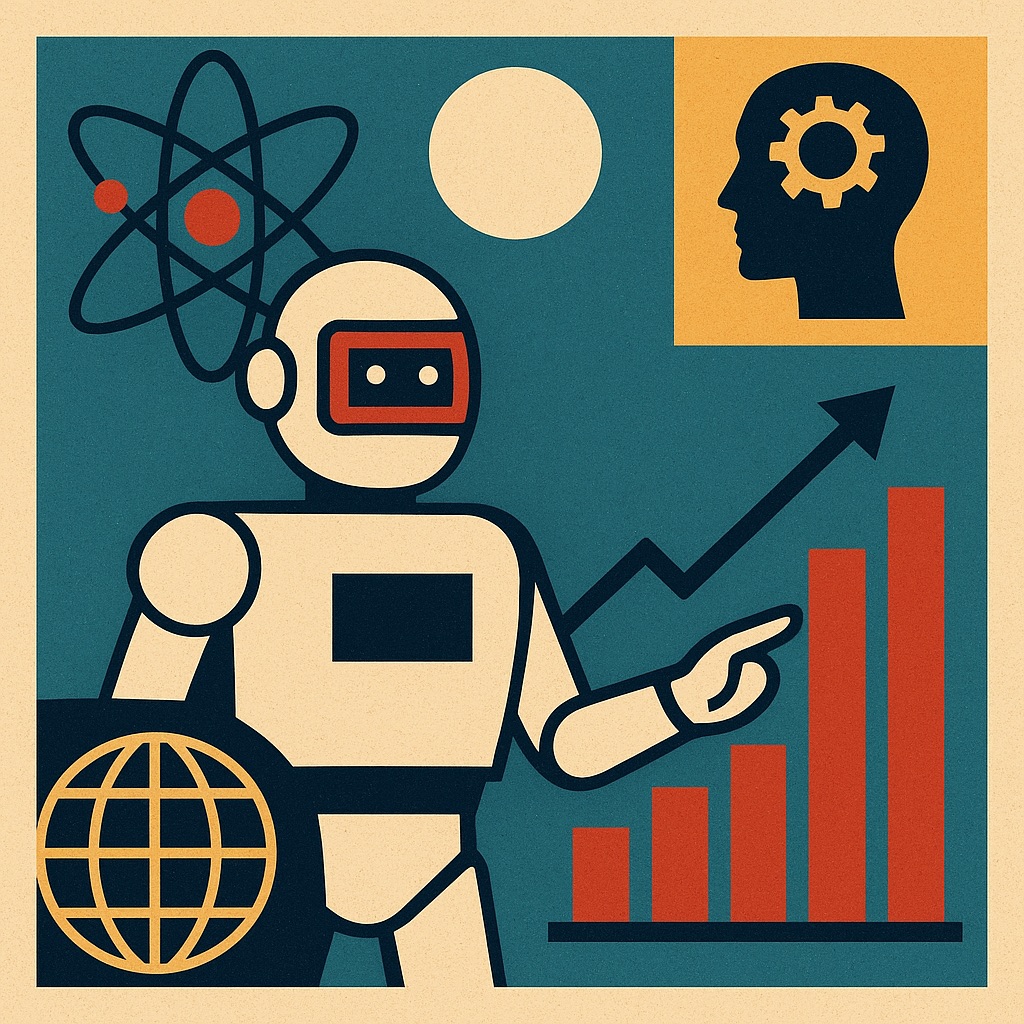
Our technological development has been tied to Moore’s law. Named after Gordon Moore, the founder of Intel, one of the world’s largest semiconductor manufacturers, the law states that the number of transistors on a microchip doubles every 18–24 months. As a result, chips become more powerful while their price falls. Moore’s prediction in 1965 has remained remarkably accurate, as innovation has kept the process alive long past the point when the laws of physics should have slowed it down. This type of growth is called exponential, characterised by slow initial development which suddenly accelerates at an unexpected pace.

A Parable of Exponential Growth

The Islamic scholar Ibn Khallikan described the logic of exponential growth in a tale from 1256. According to the story, chess originated in India during the 6th century. Its inventor travelled to Pataliputra and presented the game to the emperor. Impressed, the ruler offered him any reward. The inventor requested rice, calculated using the chessboard: one grain on the first square, two on the second, four on the third, doubling with each square.

Such exponential growth seems modest at first, but by the 64th square it yields more than 18 quintillion grains of rice, or about 1.4 trillion tonnes. By comparison, the world currently produces about 772 million tonnes of wheat annually. The inventor’s demand thus exceeded yearly wheat production by a factor of over 2,000. The crucial lesson lies not in the quantity but in the speed at which exponential processes accelerate.

The central question remains: at what stage of the chessboard are we today in terms of microchip development? According to Moore’s law, we are heading towards an increasingly technological future. Futurists such as Ray Kurzweil, Chief Engineer at Google, believe that transhumanism is the only viable path for humanity to collaborate with AI. Kurzweil predicts that artificial intelligence will surpass human mental capabilities by 2045.

Transhumanism posits that the limits of the human biological body are a matter of choice. For transhumanists, ageing should be voluntary, and cognitive capacities should lie within individual control. Kurzweil forecasts that by 2035 nanobots will be implanted in our brains to connect with neurons, upgrading both mental and physical abilities. The aim is to prevent humans from becoming inferior to machines, preserving self-determination.

The Intelligence of Machines – Real or Illusion?

Yet artificial intelligence has not, until recently, been very intelligent. Algorithms can process data and make deductions, but image recognition, for example, has long struggled with tasks a child could solve instantly. A child, even after seeing a school bus once, can intuitively identify it; an algorithm, trained on millions of images, may still fail under slightly altered conditions. This gap between human intuition and machine logic underscores the challenge.

Nevertheless, AI is evolving rapidly. Vast financial resources drive competition over the future of intelligence and power.

The South African-born Elon Musk, founder of Neuralink, has already demonstrated an implant that allows a monkey named Pager to play video games using only thought. Musk suggests such implants could treat depressionAlzheimer’s disease, and paralysis, and even restore sight to the blind.

Though such ideas may sound outlandish, history suggests that visionary predictions often materialise sooner than expected.

The Warnings of Tristan Harris

Tristan Harris, who leads the non-profit Centre for Humane Technology, has been at the heart of Silicon Valley’s AI story, from Apple internships to Instagram development and work at Google. In 2023, alongside Aza Raskin, he warned of AI’s dangers. Their presentation demonstrated AI systems capable of cloning a human voice within seconds, or reconstructing mental images using fMRI brain scans.

AI models have begun to exhibit unexpected abilities. A system trained in English suddenly understands PersianChatGPT, launched by OpenAI, has independently learned advanced chemistry, though it was never explicitly trained in the subject. Algorithms now self-improve, rewriting code to double its speed, creating new training data, and exhibiting exponential capability growth. Experts foresee improvements at double-exponential rates, represented on a graph as a near-vertical line surging upwards.

Conclusion

The trajectory of human civilisation now intertwines with exponential technological growth. From the rice-on-the-chessboard parable to Moore’s law and the visions of Kurzweil, Musk, and Harris, the central issue remains: will humanity adapt, or will machines redefine what it means to be human? The pace of change is no longer linear, and as history shows, exponential processes accelerate suddenly, leaving little time to adjust.


References

Arendt, H. (1963). Eichmann in Jerusalem: A report on the banality of evil. Viking Press.
Harris, T., & Raskin, A. (2023). The AI dilemma [Presentation]. Center for Humane Technology.
Kurzweil, R. (2005). The singularity is near: When humans transcend biology. Viking.
Moore, G. E. (1965). Cramming more components onto integrated circuits. Electronics, 38(8).