Zen and the Art of Dissatisfaction – Part 36

The Interconnected Nature of Reality

In this installment of Zen and the Art of Dissatisfaction, I explore how ancient philosophical and religious traditions illuminate the complex interplay between human perception, duality, and the experience of oneness. Drawing on insights from David Loy’s work Nonduality, Stephen Mitchell’s translations, and my own ethnographic research on the San people of the Kalahari, I will investigate the ways in which ordinary and spiritual realities intertwine and how cultural and economic structures shape our sense of dissatisfaction.

Photo by Mikko Ijäs

Philosopher David Loy observes in his book Nonduality (1988) how, in the Daodejing by the Chinese philosopher Laozi, composed approximately 2,500 years ago, the odd-numbered lines – such as 1, 3, 5, and 7 – describe an interconnected nonduality, an indefinable essence known as the Tao. This Tao is said to be the source of heaven and the world, a reality understood as spiritual unity. Experiences that reveal this Taoist nonduality emerge only when a person has no deliberate striving to attain it.

In contrast, the even-numbered lines – 2, 4, 6, and 8 – point to another perspective of the experience of this world, in which we perceive everything as a collection of separate, independent entities that nonetheless interact with one another. These two perspectives and experiences of reality form a web of interactions, ultimately constituting a single, unified whole. Loy argues that this view of the world, also referred to in Buddhism as samsara, is a dualistic world in which the experiencer and the external world are distinguished from each other. A dualistic world is characterised by distinctions and definitions between objects and concepts. It tends to categorise things into opposites – good and bad, right and wrong, evil and just, large and small, black and white, rich and poor, and so on. This perspective enables classifications, lists, and categories.

Language, Metaphor, and the Limits of Duality

Linguist and translator Stephen Mitchell notes (1991) agrees we instinctively interpret language through a dualistic lens. We take metaphors literally because language is itself a dualistic method. Linguistic systems rely on distinctions and categories, which makes it challenging to describe phenomena beyond their reach. Over time, the metaphors of original religious experience may vanish in literary traditions.

For this reason, some religious traditions emphasise the practitioner’s own trust in their personal experience over written knowledge. In such practices, experiential knowledge is transmitted from teacher to student. In esoteric religions, teachings are intended only for the initiated; nothing is revealed to outsiders, to prevent misinterpretation of metaphors.

In Zen Buddhism, the student must personally perceive the true nature of life. Even the teacher cannot grant it. The teacher can only gently guide the student toward their personal insight.

Insight and the Path of Practice

Such insight is not something that can be understood in a conventional sense. There is no book to read that mystically unlocks the gates of the mind so that we understand the astonishing world in which we live. Cognitively, we may grasp the concept, but experiencing it through personal insight is entirely different. This requires humility, dedication, faith, and effort.

The process requires that the individual examines their own understanding of self and the nature of reality. Upon the first glimpse of insight, the practitioner questions everything: mountains are no longer mountains, and waters are no longer waters. As the practice continues, the practitioner gradually realises the true nature of reality and appreciates that it has been present all along; it was simply unseen. Eventually, mountains are once again mountains, and waters are waters. This experience is often described as awakening, or even enlightenment.

This insight does not occur as a sudden, dramatic event where the practitioner is transported to another dimension. Spiritual practices aim for slow, often years- or decades-long cultivation, during which the practitioner gradually comes to a new understanding of reality, often imperceptibly. Occasionally, sudden flashes of insight occur that are difficult to articulate. Each tradition has its own means of framing these experiences so that they can be understood within a coherent context.

For instance, in Zen practice, a student may have sudden, surprising experiences, feeling as though the entire world is shifting or collapsing. The student may exclaim, “Here it is. I understand!” The teacher then reminds them: “It is wonderful that you had this experience, but this is not the end. Experiences come and go. We continue to practise understanding this reality.”

Mitchell also observes that similar insights are accessible in the original texts of Christianity. Even the Christian notion of the Kingdom of Heaven can be understood as a subtle state of being, living with ordinary joys and sorrows. After such realisation, life becomes simple and effortless, like the flight of birds across the sky or lilies growing eternally in the field – ever-present in the present moment.

Social Context, Dissatisfaction, and Economic Change

My doctoral research on the shamanistic cultures of the Kalahari led me to think that human dissatisfaction may arise from distorted perspectives. Axial age transformations between 800 BCE and 600 CE brought not only new religions but also profound economic changes. Previously, people relied on mutual aid and trust in everyday life. The introduction of money disrupted this trust. Slavery, armies, and money altered everything.

This transformation continues to affect us. Money, though in principle democratic and available to anyone, requires individuals to make extreme sacrifices of personal freedom to acquire it. Money disconnects people from social networks of trust – both in relation to others and in relation to their environment – because all resources are reduced to commodities defined by monetary value.

The San people of the Kalahari still live in an economy where everything is shared, and reliability holds meaningful social significance. Social cohesion is paramount in such societies. The trance dance practiced by the San is one method of reinforcing social cohesion. This religious practice aims to engage with the spiritual world so that spirits or ancestors can assist the community in times of hardship, such as illness. The trance dance exemplifies a form of spiritual practice intended to blur the distinctions and limitations of a dualistic world.

I do not claim that humanity has ever lived in a society where individuals constantly felt at one with the universe. Yet I believe that our contemporary market-driven worldview contains elements that disrupt this sense of unity and connection. This worldview – shaped by armies, oppression, and money, originating roughly 2,500 years ago – may prevent us from fully experiencing the beauty and interconnectedness of life. Perhaps it is the root of fundamental dissatisfaction.

Conclusion

The interplay between Taoist, Zen, and Christian insights, along with observations of human societies such as the Kalahari San, illustrates that the perception of duality is deeply ingrained in language, culture, and social structures. Spiritual practices cultivate a gradual awakening to the reality of interconnectedness, which cognitive understanding alone cannot achieve. Human dissatisfaction, whether induced by economic, social, or cultural frameworks, may ultimately reflect a misalignment between our conditioned perceptions and the underlying unity of existence. By exploring these perspectives, we gain a richer understanding of both the limitations of our worldview and the transformative potential of personal insight.


References

Loy, D. (1988). Nonduality: In Buddhism and Beyond. Wisdom Publications.

Mitchell, S. (1991). Tao Te Ching: A new English version. HarperCollins.

Zen and the Art of Dissatisfaction – Part 34

Navigating the Times of Crisis

In a rapidly changing world, where the climate crisis, technological advancements, and social inequality loom large, many may feel overwhelmed by the forces shaping our future. Yet, in the face of such challenges, simple spiritual practices can offer us ways to navigate uncertainty and find meaning. Drawing on Eastern philosophy, we are reminded that the pursuit of peace, both within ourselves and in the world, is a path we can all walk.

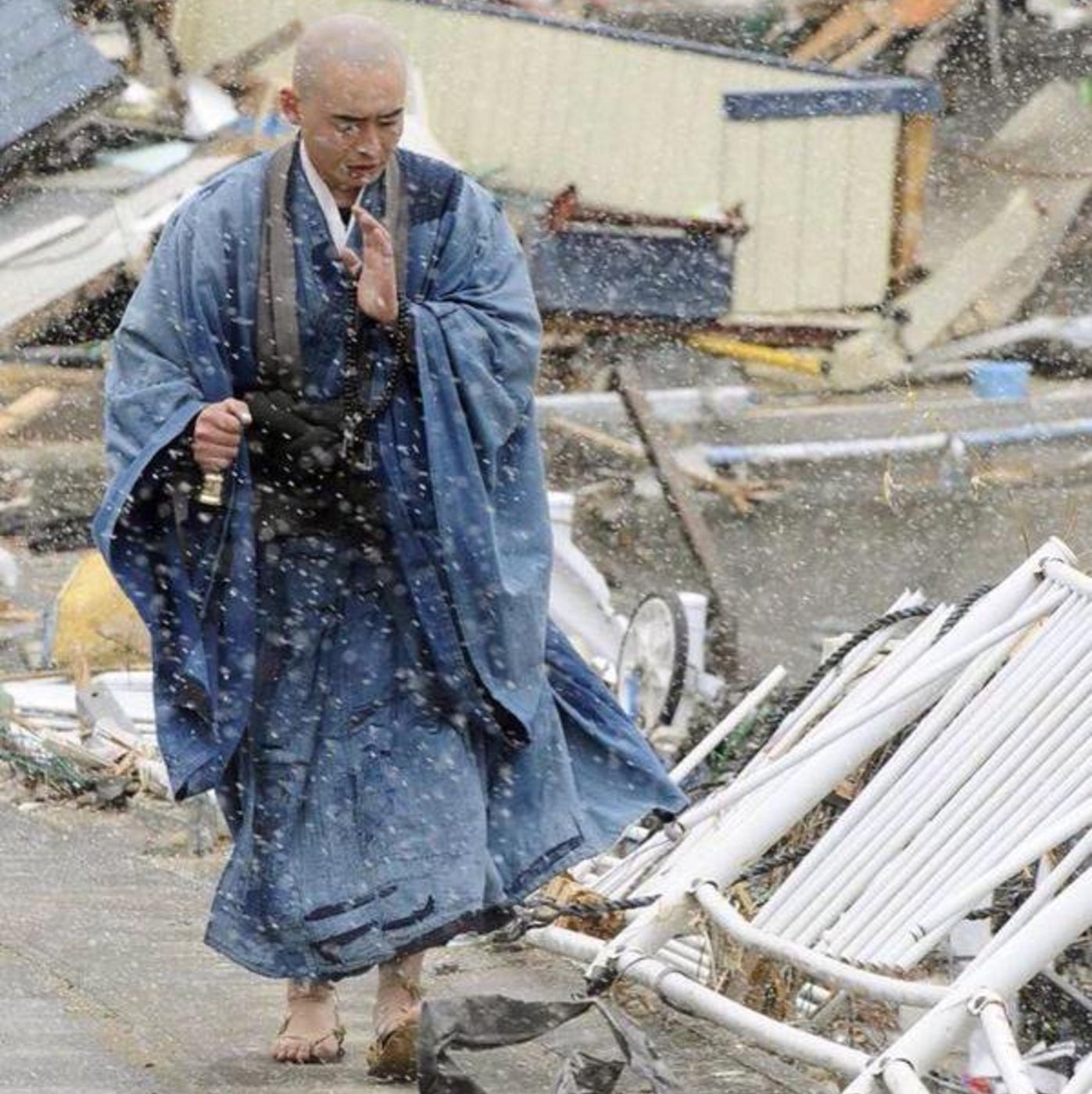
Photo: Buddhist monk Sokan Obara, 28, from Morioka, Iwate prefecture, prays for the victims in an area devastated by the earthquake and tsunami, in Ofunato, Iwate prefecture, April 7. Unknown photographer.

According to some estimates, our planet is heading towards a hothouse Earth scenario, where runaway climate change threatens the future of human civilisation (Steffen et al., 2018). This process will particularly affect the global South, countries that continue to bear the brunt of colonialism’s harmful legacy, yet have contributed the least to global warming, rising sea levels, and environmental degradation.

The Challenge of Our Time: Climate Crisis and Technology

The rise of artificial intelligence (AI) and its reliance on algorithms may also lead to large tech companies becoming the global decision-makers, shaping the economy and politics of the world. This shift could pose an existential challenge to the global South, as demand for human manual labour diminishes, further exacerbating social inequities.

But should we panic and give up hope? Is a hedonistic ”live for today” attitude the only remaining solution?

Philosopher David Loy (2019) has been exploring for decades the answers Eastern philosophies may offer to help us navigate these challenges. One such concept is the bodhisattva ideal, which originates from Sanskrit and refers to an awakened being who recognises the interconnectedness of all life. The bodhisattva understands that their well-being is intricately linked to the well-being of the world as a whole.

An embodiment of this ideal is Kanzeon (also known as Avalokiteśvara in Sanskrit and Guanyin in Chinese), a figure often depicted with a thousand arms, symbolising the countless ways in which this figure reaches out to help those in need. Another popular figure embodying the bodhisattva’s compassion is Hotei (also known as Budai in Chinese), a joyful, portly monk carrying a large bag, from which he pulls out healing remedies for the world’s suffering—whether it be a bandage for a fallen child or a new kidney for the ill.

Embracing Sorrow: The First Step Towards Action

The destruction of biodiversity and the decline of democracy are deeply sorrowful realities. Accepting this sorrow is the first step toward constructive action. As the great Joanna Macy (2021) reminded us, we are saddened by the loss of ecological diversity because we care. Our hearts break, and yet it is precisely our hearts that allow us to take action.

Acceptance of sorrow may lead us to take meaningful steps toward creating a better, fairer future. Paradoxically, to help the world, we must first let go and turn inward. The path of the peacemaker has two sides. One must care for their own well-being and strive to awaken to the oneness of life, but one should also aknowledge their own responsibility in the oneness of life and act accordingly.

The most basic spiritual practice that can help us on this path is mindfulness, which can begin with simply sitting in silence and staying aware of the open nature of our own mind. Through this practice, we can observe not just the sensations of our body, but also the nature of our mind. While suffering and dissatisfaction may not disappear, we can examine our relationship with them. Over time, our relationship with our innate dissatisfaction may change.

This process can also unveil the awareness that the nature of our mind is unknown to us. All the thoughts and emotions that arise in our mind come from someplace we cannot know – from the unknown. This insight may lead us to consider that the same interplay of consciousness occurs across all life forms. All beings have thoughts, ideas, and feelings, yet we cannot know exactly what another experiences.

American Zen teacher Bernie Glassman (1998) reminded that we need to let go of our preconceived notions and ideas and trust the Not-Knowing. The next step in the peacemaker’s path is listening or Bearing Witness. We must pause for a moment and pay attention to what is happening around us, to what others are trying to communicate. Stopping to listen to others’ perspectives may challenge our previous assumptions, attitudes, and beliefs. The third step is action – Loving Action that arises from this process of not-knowing and deep listening.

The Peacemaker’s Responsibility

A peacemaker responds to each situation in a way that is appropriate. When one realises they are interconnected with everything, one feels that they also have personal responsibility. If we are tired, we must rest. If we are hungry, we must eat. We care for our children, ensuring they are picked up from daycare, fed, and put to bed on time. We help those who fall.

Every day, we can ask ourselves: what can we do for others – since others are ourselves.

A peacemaker may also come to see that the systems in place often work for the benefit of few and to cause harm the oneness of life. They may feel compelled to influence these unjust systems, helping others realise, through their own example, that the current system damages life and its interconnectedness. The peacemaker does not demand change forcefully nor does they try to impose their will on everyone else. The peacemaker listens to all perspectives and seeks to show, through their own actions, the interconnectedness and oneness of life.

The Struggle for Change

But how do we act in a world full of injustice and suffering? We often try to force others to change their minds and behave differently. But will that lead to the outcome we desire? The peacemaker’s ideal involves helping others through not-knowing, listening, and taking loving action. Through this process, they hope to find the best solutions for the wholeness of life. The peacemaker is not just hoping for change, but becomes the change themselves.

This kind of action is exceedingly difficult. The easiest solution may be to demand change, but would that help anyone realise the harm their actions cause? Mahatma Gandhi’s concept of civil disobedience and nonviolent resistance aimed to make the opposition recognise the wrongness of their violent actions. Nonviolent resistance has brought about significant change in the world when enough people collectively stand behind a cause.

However, we do not need to start by changing everything. We do not need to be Gandhi today. First, we must learn to know ourselves. Despite knowing much about the workings of the human brain and mind, we often fail to understand our own mind. We think of ourselves as the rulers of our own mind and consciousness, but we are barely gatekeepers. Even as gatekeepers, we often wander aimlessly through our minds like Snufkin in the Moomin stories.

The first appropriate step on the peacemaker’s path may simply be to sit down and be quiet for a moment.

Conclusion

The journey of a peacemaker is not easy, nor it is straight forward. It requires us to embrace sorrow, realise our interconnectedness, and take action in small and large ways. But ultimately, it is through open awareness of the nature of our mind, and compassion that we can navigate the complexities of the diversity of the world and contribute to a more peaceful and just future for all life.

References

Glassman, Bernie (1998). Bearing Witness: A Zen Master’s Lessons in Making Peace. Bell Tower.
Loy, D. R. (2019). Ecodharma: Buddhist Teachings for the Ecological Crisis. Wisdom Publications.
Macy, J. (2021). Active Hope: How to Face the Mess We’re in without Going Crazy. New World Library.
Steffen, W., Rockström, J., Richardson, K., Lenton, T. M., Folke, C., Liverman, D., … & Schellnhuber, H. J. (2018). Trajectories of the Earth System in the Anthropocene. Proceedings of the National Academy of Sciences, 115(33), 8252-8259. https://doi.org/10.1073/pnas.1810141115

Zen and the Art of Dissatisfaction – Part 29

Wealth, Work and the AI Paradox

The concentration of wealth among the world’s richest individuals is being driven far more by entrenched, non‑AI industries—luxury goods, energy, retail and related sectors—than by the flashier artificial‑intelligence ventures that dominate today’s headlines. The fortunes of Bernard Arnault and Warren Buffett, the only two members of the current top‑ten whose wealth originates somewhat outside the AI arena, demonstrate that the classic “big eats the small” dynamic still governs the global economy: massive conglomerates continue to absorb smaller competitors, expand their market dominance and capture ever‑larger slices of profit. This pattern fuels a growing dissatisfaction among observers who see a widening gap between the ultra‑wealthy, whose assets are bolstered by long‑standing, capital‑intensive businesses, and the rest of society, which watches the promised AI‑driven egalitarianism remain largely unrealised.

Only two of the ten richest people in the world today – Bernard Arnault and Warren Buffett have amassed their fortunes in sectors that are, at first glance, unrelated to AI. Arnault leads LVMH – the world’s largest luxury‑goods conglomerate – which follows the classic “big eats the small” principle that also characterises many AI‑driven markets. Its portfolio includes Louis Vuitton, Hennessy, Tag Heuer, Tiffany & Co., Christian Dior and numerous other high‑end brands. Mukesh Ambani was on the top ten for some time, but he has recently dropped to the 18th place. Ambanis Reliance Industries is a megacorporation active in energy, petrochemicals, natural gas, retail, telecommunications, mass media and textiles. Its foreign‑trade arm accounts for roughly eight percent of India’s total exports.

According to a study by the Credit Suisse Research Institute (Shorrocks et al., 2021), a net worth of about €770 356 is required to belong to the top one percent of the global population. Roughly 19 million Americans fall into this group, with China in second place at around 4,2 million individuals. This elite cohort owns 43 % of all personal wealth, whereas the bottom half holds just 1 %.

Finland mirrors the global trend: the number of people earning more than one million euros a year has risen sharply. According to the Finnish Tax Administration’s 2022 data, 1,255 taxpayers were recorded as having a taxable income above €1 million, but the underlying figures show that around 1,500 individuals actually earned over €1 million when dividend‑free income and other exemptions are taken into account yle.fi. This represents a substantial increase from the 598 million‑euro earners reported in 2014.

The COVID‑19 Boost to the Ultra‑Rich

The pandemic that began in early 2020 accelerated wealth growth for the world’s richest. Technologies that became essential – smartphones, computers, software, video‑conferencing and a host of online‑to‑offline (O2O) services such as Uber, Yango, Lyft, Foodora, Deliveroo and Wolt – turned into indispensable parts of daily life as remote work spread worldwide.

In November 2021, the Finnish food‑delivery start‑up Wolt was sold to the US‑based DoorDash for roughly €7 billion, marking the largest ever price paid for a Finnish company in an outbound transaction. Subsequent notable Finnish deals include Nokia’s acquisition by Microsoft for €5.4 billion and Sampo Bank’s sale to Danske Bank for €4.05 billion.

AI, Unemployment and the Question of “Useful” Work

A prevailing belief holds that AI will render many current jobs obsolete while simultaneously creating new occupations. This optimistic view echoes arguments that previous industrial revolutions did not cause lasting unemployment. Yet, the reality may be more nuanced.

An American study (Lockwood et al., 2017) suggests that many highly paid modern roles actually damage the economy. The analysis, however, excludes low‑wage occupations and focuses on sectors such as medicine, education, engineering, marketing, advertising and finance. According to the study:

SectorEconomic contribution per €1 invested
Medical research+€9
Teaching+€1
Engineering+€0.2
Marketing/advertising‑€0.3
Finance‑€1.5

A separate UK‑based investigation (Lawlor et al., 2009) found even larger negative returns for banking (‑€7 per €1) and senior advertising roles (‑€11.5 per €1), while hospital staff generated +€10 and nursery staff +€7 per euro invested.

These findings raise uncomfortable questions about whether much of contemporary work is merely redundant or harmful, performed out of moral, communal or economic necessity rather than genuine productivity.

Retraining Professionals in an AI‑Dominated Landscape

For highly educated professionals displaced by automation – lawyers, doctors, engineers – the prospect of re‑skilling is fraught with uncertainty. Possible pathways include:

  1. Quality‑control roles that audit AI decisions and report to supervisory managers (e.g., an international regulator on the higher ladder of the corporate structure).
  2. Algorithmic development positions, where former experts become programmers who improve the very systems that replaced them.

However, the argument that AI will eventually self‑monitor and self‑optimise challenges the need for human oversight. Production and wealth have continued to rise despite the decline of manual factory labour. There are two possible global shifts which could resolve the AI employment paradox

  1. Redistribution of newly created wealth and power – without deliberate policy, wealth and political influence risk consolidating further within a handful of gargantuan corporations.
  2. Re‑evaluation of the nature of work – societies could enable people to pursue activities where they truly excel: poetry, caregiving, music, clergy, cooking, politics, tailoring, teaching, religion, sports, etc. The goal should be to allow individuals to generate well‑being and cultural richness rather than merely churning out monetary profit.

Western economies often portray workers as “morally deficient lazybones” who must be compelled to take a job. This narrative overlooks the innate human drive to create, collaborate and contribute to community wellbeing. Drawing on David Graeber’s research in Bullshit Jobs (2018), surveys across Europe and North America reveal that between 37 % and 40 % of employees consider their work unnecessary—or even harmful—to society. Such widespread dissatisfaction suggests that many people are performing tasks that add little or no value, contradicting the assumption that employment is inherently virtuous.

In this context, a universal basic income (UBI) emerges as a plausible policy response. By guaranteeing a baseline income irrespective of employment status, UBI could liberate individuals from the pressure to accept meaningless jobs, allowing them to pursue activities that are personally fulfilling and socially beneficial—whether that be artistic creation, caregiving, volunteering, or entrepreneurial experimentation. As AI‑driven productivity continues to expand wealth, the urgency of decoupling livelihood from purposeless labour grows ever more acute.

Growing Inequality and the Threat of AI‑Generated Waste

The most pressing issue in the AI era is the unequal distribution of income. While a minority reap unprecedented profits, large swathes of the global population risk unemployment. Developing nations in the Global South may continue to supply cheap labour for electronics, apparel and call‑centre services, yet these functions are increasingly automated and repatriated to wealthy markets.

Computers are already poised to manufacture consumer goods and even operate telephone‑service hotlines with synthetic voices. The cliché that AI will spare only artists is questionable. Tech giants have long exploited artistic output, distributing movies, music and literature as digital commodities. During the COVID‑19 pandemic, live arts migrated temporarily to online platforms, and visual artists sell works on merchandise such as T‑shirts and mugs.

Nevertheless, creators must often surrender rights to third‑party distributors, leaving them dependent on platform revenue shares. Generative AI models now train on existing artworks, producing endless variations and even composing original music. While AI can mimic styles, it also diverts earnings from creators. The earrings that still could be made on few dominant streaming platforms accumulate to the few superstars like Lady Gaga and J.K. Rowling.

Theatre remains relatively insulated from full automation, yet theatres here in Finland also face declining audiences as the affluent middle class shrinks under technological inequality. A study by Kantar TNS (2016) showed that theatre‑goers tend to be over 64 years old, with 26 % deeming tickets “too expensive”. Streaming services (Netflix, Amazon Prime Video, HBO, Apple TV+, Disney+, Paramount+) dominate story based entertainment consumption, but the financial benefits accrue mainly to corporate executives rather than the content creators at the bottom of the production chain.

Corporate Automation and Tax evasion

Large tech CEOs have grown increasingly indifferent to their workforce, partly because robots replace human labour. Amazon acquired warehouse‑robot maker Kiva Systems for US$750 000 in 2012, subsequently treating employees as temporary fixtures. Elon Musk has leveraged production robots to sustain Tesla’s U.S. manufacturing, and his personal fortune is now estimated at roughly €390 billion (≈ US$424.7 billion) as of May 2025 (Wikipedia). Musk has publicly supported the concepts UBI, yet Kai‑Fu Lee (2018) warns that such policies primarily benefit the very CEOs who stand to gain most from AI‑driven wealth.

Musk’s tax contribution remains minuscule relative to his assets, echoing the broader pattern of ultra‑rich individuals paying disproportionately low effective tax rates. Investigative outlet ProPublica reported that Jeff Bezos paid 0.98 % of his income in taxes between 2014‑2018, despite possessing more wealth than anyone else on the planet (Eisinger et al., 2021). At the same time, Elon Musk’s tax rate was 3.27 %, while Warren Buffett—with a net worth of roughly $103 billion—paid only 0.1 %. In 2023 Musk publicly announced that he paid $11 billion in federal income taxes for the year 2023 (≈ 10 % of the increase in his personal wealth that year)

U.S. Senator Bernie Sanders tweeted on 13 Nov 2021: “We must demand that the truly rich pay their fair share. 👍”, to which Musk replied, “I always forget you’re still alive.” This exchange epitomises the ongoing debate over wealth inequality.

Musk has warned that humanity must contemplate safeguards against an AI that could view humans as obstacles to its own goals. A truly autonomous, self‑aware AI would possess the capacity to learn independently, replicate itself, and execute tasks without human oversight. Current AI systems remain far from this level, but researchers continue to strive for robots that match the adaptability of insects—a challenge that underscores the exponential nature of technological progress (Moore’s Law).

Summary

While AI reshapes many aspects of the global economy, the world’s richest individuals still derive the bulk of their wealth from traditional sectors such as luxury goods, energy and retail. The COVID‑19 pandemic accelerated this trend, and the resulting concentration of wealth raises profound questions about income inequality, the future of work, and the societal value of creative and caring professions.

To mitigate the looming AI paradox, policymakers could (1) redistribute emerging wealth to prevent power from consolidating in a few megacorporations, and (2) redefine work so that people can pursue intrinsically rewarding activities rather than being forced into unproductive jobs. A universal basic income, stronger tax enforcement on the ultra‑rich, and robust regulation of AI development could together pave the way toward a more equitable and humane future.


References

Eisinger, P., et al. (2021). Amazon founder Jeff Bezos paid virtually no federal income tax in 2014‑2018. ProPublica. https://www.propublica.org/article/jeff-bezos-tax Graeber, D. (2018). Bullshit jobs: A theory. Simon & Schuster. Kantar TNS. (2016). Finnish theatre audience study. Lawlor, D., et al. (2009). Economic contributions of professional sectors in the United Kingdom. Journal of Economic Perspectives, 23(4), 45‑62. Lockwood, R., et al. (2017). The hidden costs of high‑paying jobs. American Economic Review, 107(5), 123‑138. Shorrocks, A., et al. (2021). Global wealth distribution and the top 1 percent. Credit Suisse Research Institute.

Zen and the Art of Dissatisfaction – Part 16

Ancient Lessons for Modern Times

“It is horrifying that we have to fight our own government to save the environment.”
— Ansel Adams

In a world increasingly shaped by ecological turmoil and political inaction, a sobering truth has become clear: humanity is at a tipping point. In 2019, a video of Greta Thunberg speaking at the World Economic Forum in Davos struck a global nerve. With calm conviction, Thunberg urged world leaders to heed not her voice, but the scientific community’s dire warnings. What she articulated wasn’t just youthful idealism—it was a synthesis of the environmental truth we can no longer ignore. We are entering a new era—marked by irreversible biodiversity loss, climate destabilisation, and rising seas. But these crises are not random. They are the logical consequences of our disconnection from natural systems forged over millions of years. This post dives into Earth’s deep past, from ancient deserts to ocean floors, to reveal how nature’s patterns hold urgent messages for our present—and our future.

Originally published in Substack https://substack.com/home/post/p-165122353

Today, those in power bear an unprecedented responsibility for the future of humankind. We no longer have time to shift this burden forward. This is not merely about the future of the world—it’s about the future of a world we, as humankind, have come to know. It’s about the future of humanity and the biodiversity we depend on. The Earth itself will endure, but what will happen to the ever-growing list of endangered species?

The Sixth Mass Extinction: A Grim Reality

Climate change is just one problem, but many others stem from it. At its core, our crisis can be summarised in one concept: the sixth mass extinction. The last comparable event occurred 65 million years ago, when dinosaurs and many land and marine species went extinct, and ammonites vanished. Only small reptiles, mammals, and birds survived. The sixth mass extinction is advancing rapidly. According to scientists from the UN Environment Programme, about 150–200 species go extinct every single day.

One analogy described it well: imagine you’re in a plane, and parts begin to fall off. The plane represents the entire biosphere, and the falling bolts, nuts, and metal plates are the species going extinct. The question is: how many parts can fall off before the plane crashes, taking everything else with it?

Each of us can choose how we respond to this reality. Do we continue with business-as-usual, pretending nothing is wrong? Or do we accept that we are in a moment of profound transformation, one that demands our attention and action? Do we consider changes we might make in our own lives to steer this situation toward some form of control—assuming such control is still possible? Or do we resign ourselves to the idea that change has progressed too far for alternatives to remain?

The Carbon Cycle: A System Out of Balance

Currently, humanity emits around 48.3 million tonnes of carbon dioxide annually, which ends up dispersed across the planet. The so-called carbon cycle is a vital natural process that regulates the chemical composition of the Earth, oceans, and atmosphere. However, due to human activity, we have altered this cycle—a remarkable, albeit troubling, achievement. Earth is vast, and it’s hard for any individual to comprehend just how large our atmosphere is, or how much oxygen exists on the planet. This makes it difficult for many to take seriously the consequences of human activity on climate change.

Nature absorbs part of the carbon dioxide we emit through photosynthesis. The most common form is oxygenic photosynthesis used by plants, algae, and cyanobacteria, in which carbon dioxide and water are converted into carbohydrates like sugars and starch, with oxygen as a by-product. Plants absorb carbon dioxide from the air, while aquatic plants absorb it from water.

In this process, some of the carbon becomes stored in the plant and eventually ends up in the soil. Decaying plants release carbon dioxide back into the atmosphere. In lakes and oceans, the process is similar, but the carbon sinks to the bottom of the water instead of into soil. This all sounds simple, and it’s remarkable that such a cycle has created such favourable conditions for life. Yet none of this is accidental, nor is it the result of a supernatural design. It is the product of millions of years of evolution, during which every organism within this system has developed together—everyone needs someone. We should view our planet as one vast organism, with interconnected and co-dependent processes that maintain balance through mutual dependence and benefaction.

A Planet of Mutual Dependence: The Wisdom of Plants

Italian philosopher Emanuele Coccia explores this interdependence beautifully in his book The Life of Plants (2020). Coccia writes that the world is a living planet, its inhabitants immersed in a cosmic fluid. We live—or swim—in air, thanks to plants. The oxygen-rich atmosphere they created is our lifeline and is also connected to the forces of space. The atmosphere is cosmic in nature because it shields life from cosmic radiation. This cosmic fluid “surrounds and penetrates us, yet we are barely aware of it.”

NASA astronauts have popularised the concept of the overview effect—the emotional experience of seeing Earth from space, as a whole. Some describe it as a profound feeling of love for all living things. At first glance, the Sahara Desert and the Amazon rainforest may seem to belong to entirely different worlds. Yet their interaction illustrates the interconnectedness of our planet. Around 66 million years ago, a vast sea stretched from modern-day Algeria to Nigeria, cutting across the Sahara and linking to the Atlantic. The Sahara’s sand still contains the nutrients once present in that ancient sea.

In a 2015 article, NASA scientist Hongbin Yu and colleagues describe how millions of tonnes of nutrient-rich Saharan dust are carried by sandstorms across the Atlantic each year. About 28 million tonnes of phosphorus and other nutrients end up in the Amazon rainforest’s nutrient-poor soils, which are in constant need of replenishment.

In Darren Aronofsky’s 2018 documentary, Canadian astronaut Chris Hadfield describes how this cycle continues: nutrients washed from the rainforest soil travel via the Amazon River to the Atlantic Ocean, feeding microscopic diatoms. These single-celled phytoplankton build new silica-based cell walls from the dissolved minerals and reproduce rapidly through photosynthesis, producing oxygen in the process. Though tiny, diatoms are so numerous that their neon-green blooms can be seen from space. They produce roughly 20% of the oxygen in our atmosphere.

When their nutrients are depleted, many diatoms die and fall to the ocean floor like snow, forming sediment layers that can grow to nearly a kilometre thick. After millions of years, that ocean floor may become arid desert once again—starting the cycle anew, as dust blown from a future desert fertilises some distant forest.

Nature doesn’t always maintain its balance. Sometimes a species overtakes another, or conditions become unliveable for many. Historically, massive volcanic eruptions and asteroid impacts have caused major planetary disruptions. This likely happened 65 million years ago. Ash clouds blocked sunlight, temperatures plummeted, and Earth became uninhabitable for most life—except for four-legged creatures under 25 kilograms. We are descended from them.

Ocean Acidification: A Silent Threat

In her Pulitzer Prize-winning book The Sixth Extinction, American journalist Elizabeth Kolbert writes about researcher Jason Hall-Spencer, who studied how underwater geothermal vents can make local seawater too acidic for marine life. Fish and crustaceans flee these zones. The alarming part is that the world’s oceans are becoming acidic in this same way—but on a global scale. The oceans have already absorbed excess CO₂, making surface waters warmer and lower in oxygen. Ocean acidity is estimated to be 30% higher today than in 1800, and could be 150% higher by 2050.

Acidifying oceans spell disaster. Marine ecosystems are built like pyramids, with tiny organisms like krill at the base. These creatures are essential prey for many larger marine species. If we lose the krill, the pyramid collapses. Krill and other plankton form calcium carbonate shells, but acidic waters dissolve these before they can form properly.

There’s no doubt modern humans are the primary cause of the sixth mass extinction. As humans migrated from Africa around 60,000 years ago to every corner of the globe, they left destruction in their wake. Retired Harvard anthropologist Pat Shipman aptly dubbed Homo sapiens an invasive species in her book Invaders (2015). She suggests humans may have domesticated wolves into proto-dogs as early as 45,000 years ago. On the mammoth steppes of the Ice Age, this would have made humans—accustomed to persistence hunting—unbeatable. Wolves would exhaust the prey, and humans would deliver the fatal blow with spears.

Hunting is easy for wolves, but killing large prey is risky. Getting to a major artery is the most dangerous part. Human tools would have been an asset to the wolves. In return, wolves protected kills from scavengers and were richly rewarded. Since humans couldn’t consume entire megafauna carcasses, there was plenty left for wolves.

Why did some humans leave Africa? Not all did—only part of the population migrated, gradually over generations. One generation might move a few dozen kilometres, the next a few hundred. Over time, human groups drifted far from their origins.

Yet the migration wave seems to reveal something fundamental about our species. Traditionally, it’s been viewed as a bold and heroic expansion. But what if it was driven by internal dissatisfaction? The technological shift from Middle to Upper Palaeolithic cultures may signal not just innovation, but a restless urge for change.

This period saw increasingly complex tools, clothing, ornaments, and cave art. But it may also reflect discontent—where old ways, foods, and homes no longer satisfied. Why did they stop being enough?

As modern humans reached Central Europe, dangerous predators began to vanish. Hyenas, still a threat in the Kalahari today, disappeared from Europe 30,000 years ago. Cave bears, perhaps ritually significant (as suggested by skulls found near Chauvet cave art), vanished 24,000 years ago. Getting rid of them must have been a constant concern in Ice Age cultures.

The woolly mammoth disappeared from Central Europe about 12,000 years ago, with the last surviving population living on Wrangel Island off Siberia—until humans arrived there. The changing Holocene climate may have contributed to their extinction, but humans played a major role. Evidence suggests they were culturally dependent on mammoths. Some structures found in Czechia, Poland, and Ukraine were built from the bones of up to 60 different mammoths. These buildings, not used for permanent living, are considered part of early monumental architecture—similar to Finland’s ancient “giant’s churches.”

Conclusion: Ancient Wisdom, Urgent Choices

The planet is vast, complex, and self-regulating—until it isn’t. Earth’s past is marked by cataclysms and recoveries, extinctions and renaissances. The sixth mass extinction is not a mysterious, uncontrollable natural event—it is driven by us. Yet in this sobering truth lies a sliver of hope: if we are the cause, we can also be the solution.

Whether it’s the dust from the Sahara feeding the Amazon, or ancient diatoms giving us oxygen to breathe, Earth is a system of breathtaking interconnection. But it is also fragile. As Greta Thunberg implores, now is the time not just to listen—but to act.

We need a new kind of courage. Not just the bravery to innovate, but the humility to learn from the planet’s ancient lessons. We need to see the Earth not as a resource to be consumed, but as a living system to which we belong. For our own survival, and for the legacy we leave behind, let us make that choice—while we still can.


References

Coccia, E. (2020). The life of plants: A metaphysics of mixture (D. Wills, Trans.). Polity Press.

Kolbert, E. (2014). The sixth extinction: An unnatural history. Henry Holt and Company.

Shipman, P. (2015). The invaders: How humans and their dogs drove Neanderthals to extinction. Harvard University Press.

Yu, H., et al. (2015). Atmospheric transport of nutrients from the Sahara to the Amazon. NASA Earth Observatory. https://earthobservatory.nasa.gov

Zen and the Art of Dissatisfaction – Part 14

Manufacturing Desire

In an era when technological progress promises freedom and efficiency, many find themselves paradoxically more burdened, less satisfied, and increasingly detached from meaningful work and community. The rise of artificial intelligence and digital optimisation has revolutionised industries and redefined productivity—but not without cost. Beneath the surface lies a complex matrix of invisible control, user profiling, psychological manipulation, and systemic contradictions. Drawing from anthropologists, historians, and data scientists, this post explores how behaviour modification, corporate surveillance, and the proliferation of “bullshit jobs” collectively undermine our autonomy, well-being, and connection to the natural world.

Originally published in Substack https://substack.com/home/post/p-164145621

Manipulation of Desire

Large language models, or AI tools, are designed to optimise production by quantifying employees’ contributions relative to overall output and costs. This logic, however, rarely applies to upper management—those who oversee the operation of these very systems. Anthropologist David Graeber (2018) emphasised that administrative roles have exploded since the late 20th century, especially in institutions like universities where hierarchical roles were once minimal. He noted that science fiction authors can envision robots replacing sports journalists or sociologists, but never the upper-tier roles that uphold the basic functions of capitalism.

In today’s economy, these “basic functions” involve finding the most efficient way to allocate available resources to meet present or future consumer demand—a task Graeber argues could be performed by computers. He contends that the Soviet economy faltered not because of its structure, but because it collapsed before the era of powerful computational coordination. Ironically, even in our data-rich age, not even science fiction dares to imagine an algorithm that replaces executives.

Ironically, the power of computers is not being used to streamline economies for collective benefit, but rather to refine the art of influencing individual behaviour. Instead of coordinating production or replacing bureaucracies, these tools have been repurposed for something far more insidious: shaping human desires, decisions, and actions. From Buddhist perspective manipulation of human desire sounds dangerous. The Buddha said that the cause or suffering and dissatisfaction is tanha, which is usually translates as desire or craving. If human desires or thirst is manipulated and controlled, we can be sure that suffering will not end if we rely on surveillance capitalism. To understand how we arrived at this point, we must revisit the historical roots of behaviour modification and the psychological tools developed in times of geopolitical crisis.

The roots of modern Behaviour modification trace back to mid-20th-century geopolitical conflicts and psychological experimentation. During the Korean War, alarming reports emerged about American prisoners of war allegedly being “brainwashed” by their captors. These fears catalysed the CIA’s MKUltra program—covert mind control experiments carried out at institutions like Harvard, often without subjects’ consent.

Simultaneously, B.F. Skinner’s Behaviourist theories gained traction. Skinner argued that human behaviour could be shaped through reinforcement, laying the groundwork for widespread interest in behaviour modification. Although figures like Noam Chomsky would later challenge Skinner’s reductionist model, the seed had been planted.

What was once a domain of authoritarian concern is now the terrain of corporate power. In the 21st century, the private sector—particularly tech giants—has perfected the tools of psychological manipulation. Surveillance capitalism, a term coined by Harvard professor Shoshana Zuboff, describes how companies now collect and exploit vast quantities of personal data to subtly influence consumer behaviour. It is very possible your local super market is gathering date of your purchases and building a detailed user profile, which in turn is sold to their collaborators.  These practices—once feared as mechanisms of totalitarian control—are now normalised as personalised marketing. Yet, the core objective remains the same: predict and control human action – and turning that into profit. 

Advertising, Children, and the Logic of Exploitation

In the market economy, advertising reigns supreme. It functions as the central nervous system of consumption, seeking out every vulnerability, every secret desire. Jeff Hammerbacher, a data scientist and early Facebook engineer, resigned in disillusionment after realising that some of the smartest minds of his generation were being deployed to optimise ad clicks rather than solve pressing human problems.

Today’s advertising targets children. Their impulsivity and emotional responsiveness make them ideal consumers—and they serve as conduits to their parents’ wallets. Meanwhile, parents, driven by guilt and affection, respond to these emotional cues with purchases, reinforcing a cycle that ties family dynamics to market strategies.

Devices meant to liberate us—smartphones, microwave ovens, robotic vacuum cleaners—have in reality deepened our dependence on the very system that demands we work harder to afford them. Graeber (2018) terms the work that sustains this cycle “bullshit jobs”: roles that exist not out of necessity, but to perpetuate economic structures. These jobs are often mentally exhausting, seemingly pointless, and maintained only out of fear of financial instability.

Such jobs typically require a university degree or social capital and are prevalent at managerial or administrative levels. They differ from “shit jobs,” which are low-paid but societally essential. Bullshit jobs include roles like receptionists employed to project prestige, compliance officers producing paperwork no one reads, and middle managers who invent tasks to justify their existence.

Historian Rutger Bregman (2014) observes that medieval peasants, toiling in the fields, dreamt of a world of leisure and abundance. By many metrics, we have achieved this vision—yet rather than rest, we are consumed by dissatisfaction. Market logic now exploits our insecurities, constantly inventing new desires that hollow out our wallets and our sense of self.

Ecophilosopher Joanna Macy and Dr. Chris Johnstone (2012) give a telling example from Fiji, where eating disorders like bulimia were unknown before the arrival of television in 1995. Within three years, 11% of girls suffered from it. Media does not simply reflect society—it reshapes it, often violently. Advertisements now exist to make us feel inadequate. Only by internalising the belief that we are ugly, fat, or unworthy can the machine continue selling us its artificial solutions.

The Myth of the Self-Made Individual

Western individualism glorifies self-sufficiency, ignoring the fundamental truth that humans are inherently social and ecologically embedded. From birth, we depend on others. As we age, our development hinges on communal education and support.

Moreover, we depend on the natural world: clean air, water, nutrients, and shelter. Indigenous cultures like the Iroquois/Haudenosaunee express gratitude to crops, wind, and sun. They understand what modern society forgets—that survival is not guaranteed, and that gratitude is a form of moral reciprocity.

In Kalahari, the San people question whether they have the right to take an animal’s life for food, especially when its species nears extinction. In contrast, American officials once proposed exterminating prairie dogs on Navajo/Diné land to protect grazing areas. The Navajo elders objected: “If you kill all the prairie dogs, there will be no one to cry for the rain.” The result? The ecosystem collapsed—desertification followed. Nature’s interconnectedness, ignored by policymakers, proved devastatingly real.

Macy and Johnstone argue that the public is dangerously unaware of the scale of ecological and climate crises. Media corporations, reliant on advertising, have little incentive to tell uncomfortable truths. In the U.S., for example, television is designed not to inform, but to retain viewers between ads. News broadcasts instil fear, only to follow up with advertisements for insurance—offering safety in a world made to feel increasingly dangerous.

Unlike in Finland or other nations with public broadcasters, American media is profit-driven and detached from public interest. The result is a population bombarded with fear, yet denied the structural support—like healthcare or education—that would alleviate the very anxieties media stokes.

Conclusions 

The story of modern capitalism is not just one of freedom, but also of entrapment—psychological, economic, and ecological. Surveillance capitalism has privatised control, bullshit jobs sap our energy, and advertising hijacks our insecurities. Yet throughout this dark web, there remain glimmers of alternative wisdom: indigenous respect for the earth, critiques from anthropologists, and growing awareness of the need for systemic change.

The challenge ahead lies not in refining the algorithms, but in reclaiming the meaning and interdependence lost to them. A liveable future demands more than innovation; it requires imagination, gratitude, and a willingness to dismantle the myths we’ve mistaken for progress.


References

Bregman, R. (2014). Utopia for realists: And how we can get there. Bloomsbury Publishing.
Eisenstein, C. (2018). Climate: A new story. North Atlantic Books.
Graeber, D. (2018). Bullshit Jobs: A Theory. New York: Simon & Schuster.
Hammerbacher, J. (n.d.). As cited in interviews on ethical technology, 2013–2016.
Johnstone, C., & Macy, J. (2012). Active hope: How to face the mess we’re in without going crazy. New World Library.
Loy, D. R. (2019). Ecodharma: Buddhist Teachings for the Ecological Crisis. New York: Wisdom Publications.
Skinner, B. F. (1953). Science and human Behaviour. Macmillan.
Zuboff, S. (2019). The age of surveillance capitalism: The fight for a human future at the new frontier of power. London: PublicAffairs.
Chomsky, N. (1959). A review of B. F. Skinner’s Verbal Behaviour. Language, 35(1), 26–58.