Zen and the Art of Dissatisfaction – Part 36

The Interconnected Nature of Reality

In this installment of Zen and the Art of Dissatisfaction, I explore how ancient philosophical and religious traditions illuminate the complex interplay between human perception, duality, and the experience of oneness. Drawing on insights from David Loy’s work Nonduality, Stephen Mitchell’s translations, and my own ethnographic research on the San people of the Kalahari, I will investigate the ways in which ordinary and spiritual realities intertwine and how cultural and economic structures shape our sense of dissatisfaction.

Photo by Mikko Ijäs

Philosopher David Loy observes in his book Nonduality (1988) how, in the Daodejing by the Chinese philosopher Laozi, composed approximately 2,500 years ago, the odd-numbered lines – such as 1, 3, 5, and 7 – describe an interconnected nonduality, an indefinable essence known as the Tao. This Tao is said to be the source of heaven and the world, a reality understood as spiritual unity. Experiences that reveal this Taoist nonduality emerge only when a person has no deliberate striving to attain it.

In contrast, the even-numbered lines – 2, 4, 6, and 8 – point to another perspective of the experience of this world, in which we perceive everything as a collection of separate, independent entities that nonetheless interact with one another. These two perspectives and experiences of reality form a web of interactions, ultimately constituting a single, unified whole. Loy argues that this view of the world, also referred to in Buddhism as samsara, is a dualistic world in which the experiencer and the external world are distinguished from each other. A dualistic world is characterised by distinctions and definitions between objects and concepts. It tends to categorise things into opposites – good and bad, right and wrong, evil and just, large and small, black and white, rich and poor, and so on. This perspective enables classifications, lists, and categories.

Language, Metaphor, and the Limits of Duality

Linguist and translator Stephen Mitchell notes (1991) agrees we instinctively interpret language through a dualistic lens. We take metaphors literally because language is itself a dualistic method. Linguistic systems rely on distinctions and categories, which makes it challenging to describe phenomena beyond their reach. Over time, the metaphors of original religious experience may vanish in literary traditions.

For this reason, some religious traditions emphasise the practitioner’s own trust in their personal experience over written knowledge. In such practices, experiential knowledge is transmitted from teacher to student. In esoteric religions, teachings are intended only for the initiated; nothing is revealed to outsiders, to prevent misinterpretation of metaphors.

In Zen Buddhism, the student must personally perceive the true nature of life. Even the teacher cannot grant it. The teacher can only gently guide the student toward their personal insight.

Insight and the Path of Practice

Such insight is not something that can be understood in a conventional sense. There is no book to read that mystically unlocks the gates of the mind so that we understand the astonishing world in which we live. Cognitively, we may grasp the concept, but experiencing it through personal insight is entirely different. This requires humility, dedication, faith, and effort.

The process requires that the individual examines their own understanding of self and the nature of reality. Upon the first glimpse of insight, the practitioner questions everything: mountains are no longer mountains, and waters are no longer waters. As the practice continues, the practitioner gradually realises the true nature of reality and appreciates that it has been present all along; it was simply unseen. Eventually, mountains are once again mountains, and waters are waters. This experience is often described as awakening, or even enlightenment.

This insight does not occur as a sudden, dramatic event where the practitioner is transported to another dimension. Spiritual practices aim for slow, often years- or decades-long cultivation, during which the practitioner gradually comes to a new understanding of reality, often imperceptibly. Occasionally, sudden flashes of insight occur that are difficult to articulate. Each tradition has its own means of framing these experiences so that they can be understood within a coherent context.

For instance, in Zen practice, a student may have sudden, surprising experiences, feeling as though the entire world is shifting or collapsing. The student may exclaim, “Here it is. I understand!” The teacher then reminds them: “It is wonderful that you had this experience, but this is not the end. Experiences come and go. We continue to practise understanding this reality.”

Mitchell also observes that similar insights are accessible in the original texts of Christianity. Even the Christian notion of the Kingdom of Heaven can be understood as a subtle state of being, living with ordinary joys and sorrows. After such realisation, life becomes simple and effortless, like the flight of birds across the sky or lilies growing eternally in the field – ever-present in the present moment.

Social Context, Dissatisfaction, and Economic Change

My doctoral research on the shamanistic cultures of the Kalahari led me to think that human dissatisfaction may arise from distorted perspectives. Axial age transformations between 800 BCE and 600 CE brought not only new religions but also profound economic changes. Previously, people relied on mutual aid and trust in everyday life. The introduction of money disrupted this trust. Slavery, armies, and money altered everything.

This transformation continues to affect us. Money, though in principle democratic and available to anyone, requires individuals to make extreme sacrifices of personal freedom to acquire it. Money disconnects people from social networks of trust – both in relation to others and in relation to their environment – because all resources are reduced to commodities defined by monetary value.

The San people of the Kalahari still live in an economy where everything is shared, and reliability holds meaningful social significance. Social cohesion is paramount in such societies. The trance dance practiced by the San is one method of reinforcing social cohesion. This religious practice aims to engage with the spiritual world so that spirits or ancestors can assist the community in times of hardship, such as illness. The trance dance exemplifies a form of spiritual practice intended to blur the distinctions and limitations of a dualistic world.

I do not claim that humanity has ever lived in a society where individuals constantly felt at one with the universe. Yet I believe that our contemporary market-driven worldview contains elements that disrupt this sense of unity and connection. This worldview – shaped by armies, oppression, and money, originating roughly 2,500 years ago – may prevent us from fully experiencing the beauty and interconnectedness of life. Perhaps it is the root of fundamental dissatisfaction.

Conclusion

The interplay between Taoist, Zen, and Christian insights, along with observations of human societies such as the Kalahari San, illustrates that the perception of duality is deeply ingrained in language, culture, and social structures. Spiritual practices cultivate a gradual awakening to the reality of interconnectedness, which cognitive understanding alone cannot achieve. Human dissatisfaction, whether induced by economic, social, or cultural frameworks, may ultimately reflect a misalignment between our conditioned perceptions and the underlying unity of existence. By exploring these perspectives, we gain a richer understanding of both the limitations of our worldview and the transformative potential of personal insight.


References

Loy, D. (1988). Nonduality: In Buddhism and Beyond. Wisdom Publications.

Mitchell, S. (1991). Tao Te Ching: A new English version. HarperCollins.

Zen and the Art of Dissatisfaction – Part 34

Navigating the Times of Crisis

In a rapidly changing world, where the climate crisis, technological advancements, and social inequality loom large, many may feel overwhelmed by the forces shaping our future. Yet, in the face of such challenges, simple spiritual practices can offer us ways to navigate uncertainty and find meaning. Drawing on Eastern philosophy, we are reminded that the pursuit of peace, both within ourselves and in the world, is a path we can all walk.

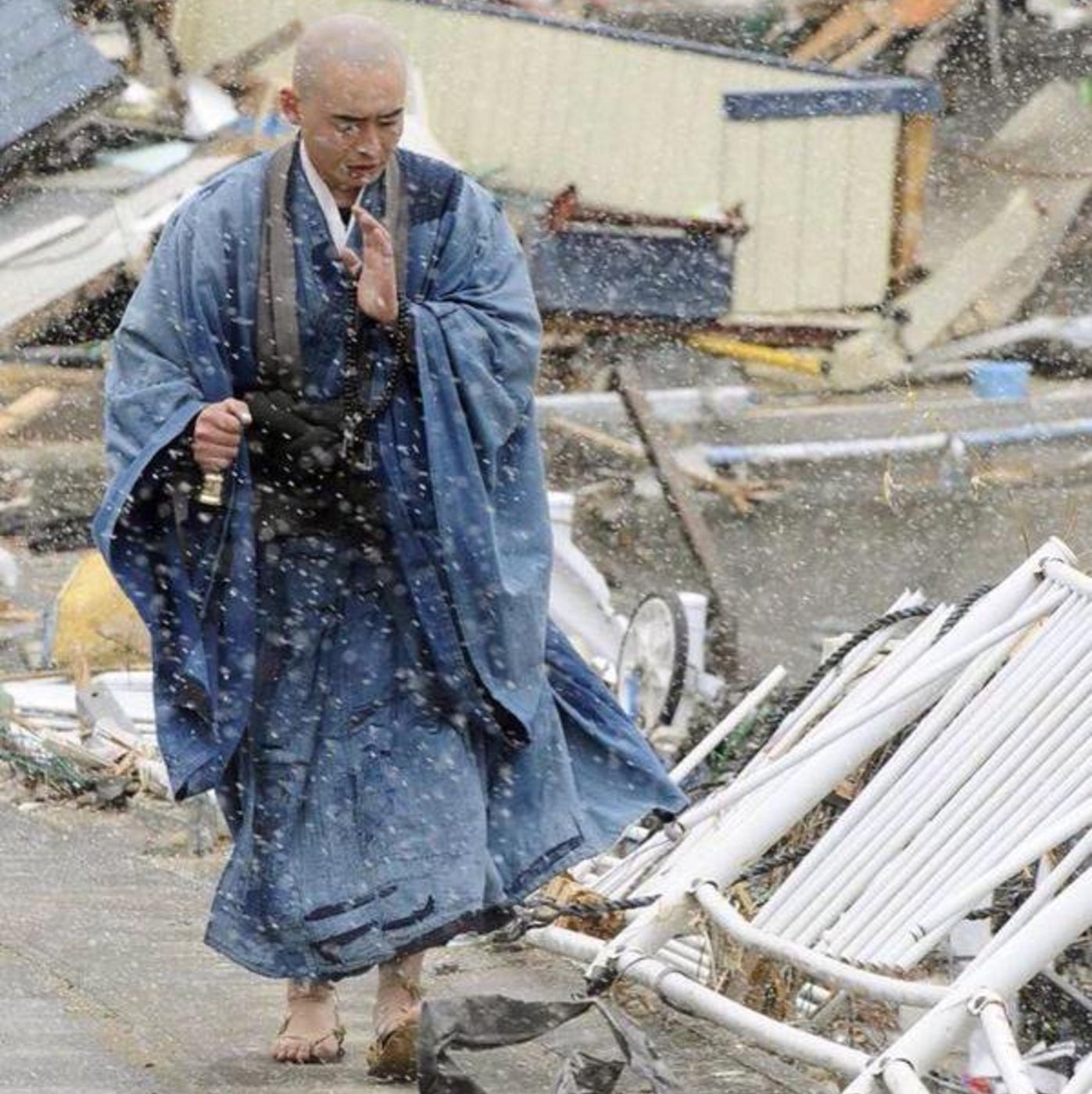
Photo: Buddhist monk Sokan Obara, 28, from Morioka, Iwate prefecture, prays for the victims in an area devastated by the earthquake and tsunami, in Ofunato, Iwate prefecture, April 7. Unknown photographer.

According to some estimates, our planet is heading towards a hothouse Earth scenario, where runaway climate change threatens the future of human civilisation (Steffen et al., 2018). This process will particularly affect the global South, countries that continue to bear the brunt of colonialism’s harmful legacy, yet have contributed the least to global warming, rising sea levels, and environmental degradation.

The Challenge of Our Time: Climate Crisis and Technology

The rise of artificial intelligence (AI) and its reliance on algorithms may also lead to large tech companies becoming the global decision-makers, shaping the economy and politics of the world. This shift could pose an existential challenge to the global South, as demand for human manual labour diminishes, further exacerbating social inequities.

But should we panic and give up hope? Is a hedonistic ”live for today” attitude the only remaining solution?

Philosopher David Loy (2019) has been exploring for decades the answers Eastern philosophies may offer to help us navigate these challenges. One such concept is the bodhisattva ideal, which originates from Sanskrit and refers to an awakened being who recognises the interconnectedness of all life. The bodhisattva understands that their well-being is intricately linked to the well-being of the world as a whole.

An embodiment of this ideal is Kanzeon (also known as Avalokiteśvara in Sanskrit and Guanyin in Chinese), a figure often depicted with a thousand arms, symbolising the countless ways in which this figure reaches out to help those in need. Another popular figure embodying the bodhisattva’s compassion is Hotei (also known as Budai in Chinese), a joyful, portly monk carrying a large bag, from which he pulls out healing remedies for the world’s suffering—whether it be a bandage for a fallen child or a new kidney for the ill.

Embracing Sorrow: The First Step Towards Action

The destruction of biodiversity and the decline of democracy are deeply sorrowful realities. Accepting this sorrow is the first step toward constructive action. As the great Joanna Macy (2021) reminded us, we are saddened by the loss of ecological diversity because we care. Our hearts break, and yet it is precisely our hearts that allow us to take action.

Acceptance of sorrow may lead us to take meaningful steps toward creating a better, fairer future. Paradoxically, to help the world, we must first let go and turn inward. The path of the peacemaker has two sides. One must care for their own well-being and strive to awaken to the oneness of life, but one should also aknowledge their own responsibility in the oneness of life and act accordingly.

The most basic spiritual practice that can help us on this path is mindfulness, which can begin with simply sitting in silence and staying aware of the open nature of our own mind. Through this practice, we can observe not just the sensations of our body, but also the nature of our mind. While suffering and dissatisfaction may not disappear, we can examine our relationship with them. Over time, our relationship with our innate dissatisfaction may change.

This process can also unveil the awareness that the nature of our mind is unknown to us. All the thoughts and emotions that arise in our mind come from someplace we cannot know – from the unknown. This insight may lead us to consider that the same interplay of consciousness occurs across all life forms. All beings have thoughts, ideas, and feelings, yet we cannot know exactly what another experiences.

American Zen teacher Bernie Glassman (1998) reminded that we need to let go of our preconceived notions and ideas and trust the Not-Knowing. The next step in the peacemaker’s path is listening or Bearing Witness. We must pause for a moment and pay attention to what is happening around us, to what others are trying to communicate. Stopping to listen to others’ perspectives may challenge our previous assumptions, attitudes, and beliefs. The third step is action – Loving Action that arises from this process of not-knowing and deep listening.

The Peacemaker’s Responsibility

A peacemaker responds to each situation in a way that is appropriate. When one realises they are interconnected with everything, one feels that they also have personal responsibility. If we are tired, we must rest. If we are hungry, we must eat. We care for our children, ensuring they are picked up from daycare, fed, and put to bed on time. We help those who fall.

Every day, we can ask ourselves: what can we do for others – since others are ourselves.

A peacemaker may also come to see that the systems in place often work for the benefit of few and to cause harm the oneness of life. They may feel compelled to influence these unjust systems, helping others realise, through their own example, that the current system damages life and its interconnectedness. The peacemaker does not demand change forcefully nor does they try to impose their will on everyone else. The peacemaker listens to all perspectives and seeks to show, through their own actions, the interconnectedness and oneness of life.

The Struggle for Change

But how do we act in a world full of injustice and suffering? We often try to force others to change their minds and behave differently. But will that lead to the outcome we desire? The peacemaker’s ideal involves helping others through not-knowing, listening, and taking loving action. Through this process, they hope to find the best solutions for the wholeness of life. The peacemaker is not just hoping for change, but becomes the change themselves.

This kind of action is exceedingly difficult. The easiest solution may be to demand change, but would that help anyone realise the harm their actions cause? Mahatma Gandhi’s concept of civil disobedience and nonviolent resistance aimed to make the opposition recognise the wrongness of their violent actions. Nonviolent resistance has brought about significant change in the world when enough people collectively stand behind a cause.

However, we do not need to start by changing everything. We do not need to be Gandhi today. First, we must learn to know ourselves. Despite knowing much about the workings of the human brain and mind, we often fail to understand our own mind. We think of ourselves as the rulers of our own mind and consciousness, but we are barely gatekeepers. Even as gatekeepers, we often wander aimlessly through our minds like Snufkin in the Moomin stories.

The first appropriate step on the peacemaker’s path may simply be to sit down and be quiet for a moment.

Conclusion

The journey of a peacemaker is not easy, nor it is straight forward. It requires us to embrace sorrow, realise our interconnectedness, and take action in small and large ways. But ultimately, it is through open awareness of the nature of our mind, and compassion that we can navigate the complexities of the diversity of the world and contribute to a more peaceful and just future for all life.

References

Glassman, Bernie (1998). Bearing Witness: A Zen Master’s Lessons in Making Peace. Bell Tower.
Loy, D. R. (2019). Ecodharma: Buddhist Teachings for the Ecological Crisis. Wisdom Publications.
Macy, J. (2021). Active Hope: How to Face the Mess We’re in without Going Crazy. New World Library.
Steffen, W., Rockström, J., Richardson, K., Lenton, T. M., Folke, C., Liverman, D., … & Schellnhuber, H. J. (2018). Trajectories of the Earth System in the Anthropocene. Proceedings of the National Academy of Sciences, 115(33), 8252-8259. https://doi.org/10.1073/pnas.1810141115