Zen and the Art of Dissatisfaction – Part 14

Manufacturing Desire

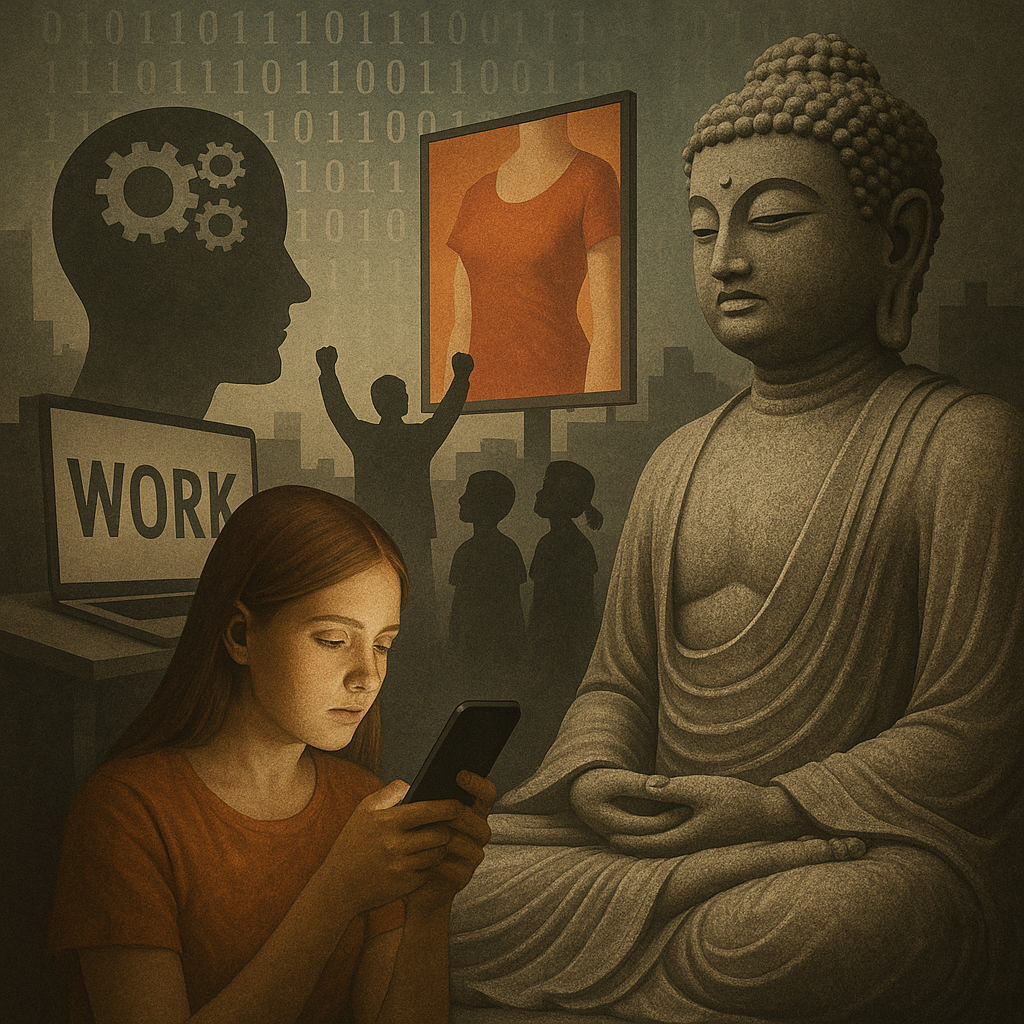
In an era when technological progress promises freedom and efficiency, many find themselves paradoxically more burdened, less satisfied, and increasingly detached from meaningful work and community. The rise of artificial intelligence and digital optimisation has revolutionised industries and redefined productivity—but not without cost. Beneath the surface lies a complex matrix of invisible control, user profiling, psychological manipulation, and systemic contradictions. Drawing from anthropologists, historians, and data scientists, this post explores how behaviour modification, corporate surveillance, and the proliferation of “bullshit jobs” collectively undermine our autonomy, well-being, and connection to the natural world.

Originally published in Substack https://substack.com/home/post/p-164145621

Manipulation of Desire

Large language models, or AI tools, are designed to optimise production by quantifying employees’ contributions relative to overall output and costs. This logic, however, rarely applies to upper management—those who oversee the operation of these very systems. Anthropologist David Graeber (2018) emphasised that administrative roles have exploded since the late 20th century, especially in institutions like universities where hierarchical roles were once minimal. He noted that science fiction authors can envision robots replacing sports journalists or sociologists, but never the upper-tier roles that uphold the basic functions of capitalism.

In today’s economy, these “basic functions” involve finding the most efficient way to allocate available resources to meet present or future consumer demand—a task Graeber argues could be performed by computers. He contends that the Soviet economy faltered not because of its structure, but because it collapsed before the era of powerful computational coordination. Ironically, even in our data-rich age, not even science fiction dares to imagine an algorithm that replaces executives.

Ironically, the power of computers is not being used to streamline economies for collective benefit, but rather to refine the art of influencing individual behaviour. Instead of coordinating production or replacing bureaucracies, these tools have been repurposed for something far more insidious: shaping human desires, decisions, and actions. From Buddhist perspective manipulation of human desire sounds dangerous. The Buddha said that the cause or suffering and dissatisfaction is tanha, which is usually translates as desire or craving. If human desires or thirst is manipulated and controlled, we can be sure that suffering will not end if we rely on surveillance capitalism. To understand how we arrived at this point, we must revisit the historical roots of behaviour modification and the psychological tools developed in times of geopolitical crisis.

The roots of modern Behaviour modification trace back to mid-20th-century geopolitical conflicts and psychological experimentation. During the Korean War, alarming reports emerged about American prisoners of war allegedly being “brainwashed” by their captors. These fears catalysed the CIA’s MKUltra program—covert mind control experiments carried out at institutions like Harvard, often without subjects’ consent.

Simultaneously, B.F. Skinner’s Behaviourist theories gained traction. Skinner argued that human behaviour could be shaped through reinforcement, laying the groundwork for widespread interest in behaviour modification. Although figures like Noam Chomsky would later challenge Skinner’s reductionist model, the seed had been planted.

What was once a domain of authoritarian concern is now the terrain of corporate power. In the 21st century, the private sector—particularly tech giants—has perfected the tools of psychological manipulation. Surveillance capitalism, a term coined by Harvard professor Shoshana Zuboff, describes how companies now collect and exploit vast quantities of personal data to subtly influence consumer behaviour. It is very possible your local super market is gathering date of your purchases and building a detailed user profile, which in turn is sold to their collaborators.  These practices—once feared as mechanisms of totalitarian control—are now normalised as personalised marketing. Yet, the core objective remains the same: predict and control human action – and turning that into profit. 

Advertising, Children, and the Logic of Exploitation

In the market economy, advertising reigns supreme. It functions as the central nervous system of consumption, seeking out every vulnerability, every secret desire. Jeff Hammerbacher, a data scientist and early Facebook engineer, resigned in disillusionment after realising that some of the smartest minds of his generation were being deployed to optimise ad clicks rather than solve pressing human problems.

Today’s advertising targets children. Their impulsivity and emotional responsiveness make them ideal consumers—and they serve as conduits to their parents’ wallets. Meanwhile, parents, driven by guilt and affection, respond to these emotional cues with purchases, reinforcing a cycle that ties family dynamics to market strategies.

Devices meant to liberate us—smartphones, microwave ovens, robotic vacuum cleaners—have in reality deepened our dependence on the very system that demands we work harder to afford them. Graeber (2018) terms the work that sustains this cycle “bullshit jobs”: roles that exist not out of necessity, but to perpetuate economic structures. These jobs are often mentally exhausting, seemingly pointless, and maintained only out of fear of financial instability.

Such jobs typically require a university degree or social capital and are prevalent at managerial or administrative levels. They differ from “shit jobs,” which are low-paid but societally essential. Bullshit jobs include roles like receptionists employed to project prestige, compliance officers producing paperwork no one reads, and middle managers who invent tasks to justify their existence.

Historian Rutger Bregman (2014) observes that medieval peasants, toiling in the fields, dreamt of a world of leisure and abundance. By many metrics, we have achieved this vision—yet rather than rest, we are consumed by dissatisfaction. Market logic now exploits our insecurities, constantly inventing new desires that hollow out our wallets and our sense of self.

Ecophilosopher Joanna Macy and Dr. Chris Johnstone (2012) give a telling example from Fiji, where eating disorders like bulimia were unknown before the arrival of television in 1995. Within three years, 11% of girls suffered from it. Media does not simply reflect society—it reshapes it, often violently. Advertisements now exist to make us feel inadequate. Only by internalising the belief that we are ugly, fat, or unworthy can the machine continue selling us its artificial solutions.

The Myth of the Self-Made Individual

Western individualism glorifies self-sufficiency, ignoring the fundamental truth that humans are inherently social and ecologically embedded. From birth, we depend on others. As we age, our development hinges on communal education and support.

Moreover, we depend on the natural world: clean air, water, nutrients, and shelter. Indigenous cultures like the Iroquois/Haudenosaunee express gratitude to crops, wind, and sun. They understand what modern society forgets—that survival is not guaranteed, and that gratitude is a form of moral reciprocity.

In Kalahari, the San people question whether they have the right to take an animal’s life for food, especially when its species nears extinction. In contrast, American officials once proposed exterminating prairie dogs on Navajo/Diné land to protect grazing areas. The Navajo elders objected: “If you kill all the prairie dogs, there will be no one to cry for the rain.” The result? The ecosystem collapsed—desertification followed. Nature’s interconnectedness, ignored by policymakers, proved devastatingly real.

Macy and Johnstone argue that the public is dangerously unaware of the scale of ecological and climate crises. Media corporations, reliant on advertising, have little incentive to tell uncomfortable truths. In the U.S., for example, television is designed not to inform, but to retain viewers between ads. News broadcasts instil fear, only to follow up with advertisements for insurance—offering safety in a world made to feel increasingly dangerous.

Unlike in Finland or other nations with public broadcasters, American media is profit-driven and detached from public interest. The result is a population bombarded with fear, yet denied the structural support—like healthcare or education—that would alleviate the very anxieties media stokes.

Conclusions 

The story of modern capitalism is not just one of freedom, but also of entrapment—psychological, economic, and ecological. Surveillance capitalism has privatised control, bullshit jobs sap our energy, and advertising hijacks our insecurities. Yet throughout this dark web, there remain glimmers of alternative wisdom: indigenous respect for the earth, critiques from anthropologists, and growing awareness of the need for systemic change.

The challenge ahead lies not in refining the algorithms, but in reclaiming the meaning and interdependence lost to them. A liveable future demands more than innovation; it requires imagination, gratitude, and a willingness to dismantle the myths we’ve mistaken for progress.


References

Bregman, R. (2014). Utopia for realists: And how we can get there. Bloomsbury Publishing.
Eisenstein, C. (2018). Climate: A new story. North Atlantic Books.
Graeber, D. (2018). Bullshit Jobs: A Theory. New York: Simon & Schuster.
Hammerbacher, J. (n.d.). As cited in interviews on ethical technology, 2013–2016.
Johnstone, C., & Macy, J. (2012). Active hope: How to face the mess we’re in without going crazy. New World Library.
Loy, D. R. (2019). Ecodharma: Buddhist Teachings for the Ecological Crisis. New York: Wisdom Publications.
Skinner, B. F. (1953). Science and human Behaviour. Macmillan.
Zuboff, S. (2019). The age of surveillance capitalism: The fight for a human future at the new frontier of power. London: PublicAffairs.
Chomsky, N. (1959). A review of B. F. Skinner’s Verbal Behaviour. Language, 35(1), 26–58.

Zen and the Art of Dissatisfaction – Part 13

Who Do We Owe?

This post delves into the often overlooked complexities of our financial systems and the deep-rooted mechanisms of debt that have shaped our world. In exploring the history of money, state power, and the intricate relationship between banks and citizens, we see how dissatisfaction has long been embedded in the foundations of economic systems. Just as Zen practice challenges the conventional pursuit of constant pleasure and accumulation, our financial history reveals a pattern of never-ending striving, often at the expense of broader social equity. The financial system, much like the pursuit of material satisfaction, is a cycle of continual debt, obligation, and inequality. All of this often equals suffering, or at least dissatisfaction. Understanding this cycle is key to understanding the dissatisfaction that runs through modern society—how it originates from systems that promise wealth and prosperity, yet often deliver nothing more than perpetual indebtedness.

Originally published in Substack https://substack.com/home/post/p-163455665

The Roots of Debt and Power

During the Middle Ages, rulers realised they could manipulate their finances by giving more power to bankers. Anthropologist David Graeber (2011) writes that the history of modern financial instruments and paper money traces back to municipal bond issuance. The Venetian government began this practice in the 12th century when it needed money for military purposes. They collected loans from taxpaying citizens, offering a 5% annual interest rate in return. These bonds were made transferable, creating a market for government debt. Since these bonds had no set maturity date, their market prices fluctuated wildly, as did the probability of repayment.

Similar practices spread quickly across Europe. The state ensured tax compliance by requiring citizens to lend money with interest. But what exactly is this interest? This concept originates from Roman economics, where interest (lat. interesse) was considered compensation for the lender’s loss if repayment was delayed. In practice, the Venetian state agreed to pay this Roman ”interest” — a penalty for late repayment — to citizens who lent money to the state.

Such a system undoubtedly raised questions about the legal and moral relationship between citizens and the state. However, it spread quickly, as it made financing wars and conquests easier for states. By 1650, most Dutch households owned government debt. The true paradox of this system appeared when such bonds were monetised, and citizens started using these promises of repayment as currency for trade.

These government bonds sparked an economic revolution, transforming independent townspeople and villagers into wage labourers, forced to work for those with access to higher forms of credit. Gold bars imported from the Americas were rarely used for daily transactions. Instead, they travelled from Spain’s Seville to Genoese bankers’ vaults, then onward to China, where they were exchanged for silk and other luxury goods.

The Birth of Paper Money: Shifting Trust and Power

Government bonds were, in principle, already paper money, but it wasn’t until the establishment of the Bank of England in 1694 that true paper money emerged. The bank issued notes that were not government debt obligations but were tied directly to the king’s war debts. This money marked a shift in the nature of currency, now determined by speculative forces — interest rates and profits derived from military success and the exploitation of colonial resources.

This development led to a market-based economy, still characterised by a complex relationship between militarism, banking, and exploitation. The value of money shifted from direct human trust and the exchange of precious metals to government bonds, promising profits. This practice of issuing debt extended from government bonds to shares in corporations, suggesting that money could be endlessly created through interest-bearing loans.

The US dollar today is still a form of debt issued by the Federal Reserve, a coalition of banks. This arrangement mirrors the initial loan system introduced by the Bank of England, where the central bank loans money to the US government by purchasing government bonds, which are then turned into money through further lending.

Supporters of market economies claim that such systems have existed for 5,000 years. Yet, when examining the history of monetary economies, we see that the earliest market economies, such as 17th-century Holland and 18th-century England, experienced disastrous speculative crashes, like the tulip mania and the South Sea bubble.

Ultimately, the money we use is an extension of public debt. We engage in trade based on government promises, which are essentially loans from future generations. State debt, as politicians have noted since its inception, is borrowed from future generations. On one hand, this arrangement increases political power in the hands of the state; on the other, it suggests the government owes something to its citizens. The problem lies in the fact that state debt originates from the deprivation of freedom, war, and violence. It is not owed equally to all people but primarily to capital owners. The word ”capitalist” originally referred to someone who owned government bonds.

Debt and Global Ruin?

Enlightenment thinkers feared that state debt could lead to global ruin. The introduction of impersonal debt carried the ever-present risk of bankruptcy. While individual bankruptcy meant losing property, imprisonment, torture, hunger, and death, no one knew what state bankruptcy might entail.

For centuries, capitalism operated in a state of perpetual anxiety, with thinkers like Karl Marx, Max Weber, Joseph Schumpeter, and Ludwig von Mises confident that the system could not last beyond two generations. Graeber describes how, in 1870s Chicago, many wealthy industrialists built homes near military bases, convinced a revolution was imminent.

Debt and interest are significant factors in our world today. Graeber recounts how the International Monetary Fund (IMF) was created when OPEC countries poured vast amounts of oil wealth into Western banks during the 1970s oil crisis. These banks could not find new investment opportunities, so they started persuading global South dictators and politicians to take loans. These loans began with low interest rates but soared to 20% during the tight monetary policies of the 1980s. This aggressive lending process led to a debt crisis in the global South in the 1980s and 1990s. To refinance these loans, the IMF required nations to cut food subsidies, abandon free healthcare and education, and so on.

The tragedy of such loans is that the global South has often repaid them multiple times. The initial loan often ended up in the pockets of dictators, and as interest accumulated, the debt never truly had an endpoint. The IMF created a way to generate money out of nothing, without a concrete limit. But what moral right did they have to act in this manner? What moral obligation do these countries have to repay something they have already paid?

Since the late 19th century, American economic thought has shaped global political and economic development. In the 1800s, anti-capitalist views in the United States, such as producerism, argued that labour, not capital, created true wealth. President Abraham Lincoln, a prominent producerist, stated that capital was merely the fruit of labour. However, from the 1890s, a new ideology emerged, promoted by industrial magnates, bankers, and political allies, arguing that it was capital, not labour, that created wealth.

This cultural campaign, championed by steel magnate Andrew Carnegie, argued that concentrated capital under wise leadership could reduce commodity prices so much that future workers would live as well as past kings. Carnegie believed that high wages for the poor were not beneficial for the ”race.”

It is crucial to remember that the Marxist term ”worker” never referred to factory workers. In fact, during Marx’s time, more working-class individuals were employed as maids, servants, shoeshiners, waste collectors, cooks, nurses, taxi drivers, teachers, prostitutes, janitors, and traders than in mines or factories.

The idea of wage labour, working under supervision in factories performing tasks set by a boss, originates from colonial plantation slavery and the hierarchical command structure of trading companies’ fleets.

Shaping of Modern Economies

By the early 20th century, this ideology of capital producing wealth became entrenched in Western thinking. Several events in the United States changed the relationship to work, family, leisure, and especially consumption. Advertisements for consumer products began to take their modern form in the 1920s, and with the Great Depression of the 1930s, the idea of a shorter workweek was no longer discussed.

In 1914, Henry Ford, the founder of the Ford Motor Company, reduced his factory’s workday from nine to eight hours, doubled workers’ wages, and promised to share profits with employees. The main reason for this was the shortage of good workers, as few were willing to work on Ford’s assembly line. The promise of better wages and potential company profits resolved this issue, providing a quick economic gain for Ford’s company.

Ford believed that, although the company would lose money initially, it would recover because workers would now have more money to spend on Ford products. Ford turned his employees into loyal consumers. However, this extra pay was tied to social expectations. Ford’s sociological department would visit workers’ homes unannounced to assess cleanliness, safety, and alcohol use. Any deviations would result in a deduction from their bonus.

Ford’s shareholders took him to court, claiming his duty was to maximise profits for shareholders, even if done legally. The court ruled that while Ford’s humanitarian sentiments were admirable, his company existed to make profits for its shareholders.

In the US, the debate about a shorter workweek continued until World War II, after which post-war economic growth led citizens to forget the issue, as shorter working hours would have meant lower wages, which in turn would have led to less money for consuming the products promoted by the media.

The United States has been an exceptional example of how the middle class has been built and, in recent decades, undermined. Despite consistent GDP growth since the 1960s, wages have stagnated since the early 1970s, even while workers were the best educated in the world. Globalisation and technological change have reshaped business practices.

Large companies like Amazon still employ thousands, but this is a fraction of what would have been needed before automation. AI algorithms optimise business operations, replacing human labour with machines. Today, the rule is that the working class continues to grow poorer while GDP rises.

Afterword
As we reflect on the origins of debt and finance, it becomes evident that the complex relationships between states, banks, and citizens have had far-reaching consequences for the modern world. From the early municipal bonds issued by Venetian rulers to the creation of the US dollar and the global financial system of today, the trajectory of money is intricately linked to power, conflict, and inequality. What was once a simple exchange of goods and services has evolved into a global network of debt and credit, often with severe repercussions for ordinary people. The lessons of history remind us that economic systems, while essential for progress, often come at the cost of social justice and equality. As we move forward, it is crucial to question the morality of the systems that govern our financial world and to explore alternatives that prioritise the well-being of all individuals, rather than just the few who control the flow of capital.


References

Graeber, D. (2011). Debt: The First 5,000 Years. Brooklyn, NY: Melville House.

Graeber, D. (2018). Bullshit Jobs: A Theory. New York: Simon & Schuster.

Harvey, D. (2005). A Brief History of Neoliberalism. Oxford University Press.

Klein, N. (2007). The Shock Doctrine: The Rise of Disaster Capitalism. Penguin.

Mazzucato, M. (2018). The Value of Everything: Making and Taking in the Global Economy. Allen Lane.

Standing, G. (2011). The Precariat: The New Dangerous Class. Bloomsbury Academic.

Zen and the Art of Dissatisfaction – Part 12

From Nutmeg Wars to Domination

This post explores the dark undercurrents of the market economy, tracing its violent colonial roots and questioning the common myths of its origins. Drawing from history, anthropology, and the work of David Graeber, it challenges mainstream economic narratives and highlights the human cost behind capitalism’s foundations—from the spice trade in the Banda Islands to the coercive systems of debt in early modern Europe.

Originally published in Substack https://substack.com/home/post/p-162823221

In 1599, a Dutch expedition contacted the chiefs of the Banda Islands, famed for their nutmeg, to negotiate an agreement. The appeal and value of nutmeg were heightened by the fact that it grew nowhere else. The Dutch forbade the islanders from selling spices to representatives of other countries. However, the Banda islanders resisted the Dutch demand for a monopoly over the spice trade. In response, the Dutch East India Company—VOC (Vereenigde Oost-Indische Compagnie)—decided to conquer the islands by force. The company launched several military campaigns against the islanders, aided by Japanese mercenaries and samurai.

The conquest, which began in 1609, culminated in a massacre: VOC forces killed 2,800 Bandanese and enslaved 1,700. Weakened by hunger and ongoing conflict, the islanders felt powerless to resist and began negotiating surrender in 1621. The VOC official Jan Pieterszoon Coen (1587–1629) deported the remaining 1,000 islanders to what is now Jakarta. With the resistance crushed, the Dutch secured a monopoly over the spice trade, which they held until the 19th century. During the Napoleonic Wars, the British temporarily seized control of the islands and transferred nutmeg plants to Sri Lanka and Singapore.

In the 2020s, a statue of Jan Pieterszoon Coen erected in 1893 in the Dutch city of Hoorn has faced similar criticism to the statues of Robert E. Lee in the United States and Cecil Rhodes in Cape Town, South Africa. Defenders of the statue view it as a sacred symbol of secular Dutch identity.

Even though the business-as-usual attitude accelerating today’s ecological crisis may not entail the displacement of indigenous peoples by samurai and their replacement with slaves, the market economy undeniably has a dirty side.

Settler histories and forced migration

In 2010, I visited Amsterdam with my friend who was born in South Africa. He suggested we visit the VOC’s 17th-century headquarters, the Oost-Indisch Huis. The building is strikingly unassuming. Located at Oude Hoogstraat 24, a small passageway leads to a modest courtyard. At the back stands a three-storey building with a single small door, two windows on the left and one on the right. Staring into this minimal yet somehow claustrophobically ominous space, it’s difficult to comprehend the VOC’s profound impact on the world—comparable only to that of its British counterpart, the East India Company (EIC).

These joint-stock companies, founded in the early 1600s and backed by private armies and nearly limitless power, helped establish a system in which investors could profit from enterprise success by purchasing shares. Standing in that courtyard, my friend recounted how his Dutch ancestors had little choice in the mid-1600s but to board ships bound for what is now South Africa. He spoke of an uncle who spent his entire life in the Karoo desert herding sheep, never eating anything that didn’t come from a sheep. South African history is filled with such solitary shepherds.

Indeed, the VOC was so concerned about these isolated sheep farmers and the continuation of white European populations in the African wilderness that they abducted young girls from Amsterdam orphanages and shipped them to Africa to become wives for the shepherds.

Anthropologist David Graeber (2011) explores the common belief that markets and money evolved from a barter system—a view popularised by Scottish moral philosopher Adam Smith in his 1776 work An Inquiry into the Nature and Causes of the Wealth of Nations. Smith argued against the idea that money was a state invention. Following the liberal philosophical tradition of John Locke, who believed that governments existed to protect private property and functioned best when limited to that role, Smith extended the theory by claiming that property, money, and markets predated political institutions. According to Smith, these were the foundations of civilisation, and governments should confine themselves to guaranteeing the value of currency.

Graeber, however, challenges this assumption. He asks whether there has ever been a point in human history when people lived in a pure barter economy, as Smith claimed. His research finds no such evidence. Barter economies only existed in contexts where people were already familiar with cash.

Graeber introduces the term ”human economies” to describe anthropological cases in which value was measured according to personal honour and social standing. These systems are well-documented in ancient Greece, medieval Ireland, and among Indigenous cultures in Africa and the Americas. For most of human history, people didn’t need money or other exchange mediums to get what they needed. Help was offered without expectation of compensation. In human economies, value was attached only to human life, honour, and dignity.

Human economies and the value of honour

Written records in Ireland begin around 600 AD, by which time the once-thriving slave trade had already ceased. While the rest of Europe used Roman-inspired coinage, Ireland—lacking significant mineral wealth—did not. Its 150 kings could only trade for foreign luxury goods using cattle and people, which thus became the de facto currency. By the Middle Ages, the slave trade had ended, much like elsewhere in Europe. The collapse of slavery was a major consequence of the fall of the Roman Empire.

Medieval Irish lived on scattered farmsteads, growing wheat and raising livestock. There were no real towns, except those that formed around monasteries. Money served purely social purposes: for gifts, payments to artisans, doctors, poets, judges, entertainers, and for feudal obligations. Tellingly, lawmakers of the time didn’t even know how to price goods. Everyday objects were never exchanged for money. Food was shared within families or sent to lords who hosted feasts for friends, rivals, and vassals.

In such societies, honour and social status were everything. Though physical items had no monetary value, a person’s honour carried a precisely defined price. The most esteemed figures—kings, bishops, and master poets—had an ”honour price” equivalent to seven slave girls. Although slavery had ended, it remained a conceptual unit of value. Seven slave girls equalled 21 dairy cows and 21 ounces of silver.

Throughout history, human value—whether defined by honour or tangible worth—often served as the original measure of price, even when nothing else required valuation. One root of cash-based economies lies in the conduct of large-scale wars. For example, in Sumerian Mesopotamia, silver reserves were stored in temples merely as collateral in case debts had to be settled. The entire Sumerian economy was based on credit. Though silver backed these arrangements, it typically sat untouched inside temple vaults.

In such systems, not even kings could obtain anything they simply desired. But temple-held silver could be stolen—and the first coins likely arose this way. For instance, Alexander the Great’s (356–323 BC) vast conquests necessitated paying his soldiers, and what better means than minting coins from looted silver? This pattern is evident wherever money first emerged. Crucially, such systems required slavery. War captives—slaves—played a vital role in defining human value and, by extension, the value of all things. They also laboured in the extraction of key minerals like silver.

Military-coinage-slavery complex
Graeber (2011) refers to this dynamic as the military-coinage-slavery complex. Similar developments appeared around 2,500 years ago across the Western world, the Middle East, India, and China. Money remains deeply entangled with power and freedom. As Graeber notes, anyone working for money understands that true freedom is largely an illusion. Much of the violence has been pushed out of sight—but we can no longer even imagine a world based on social credit arrangements without surveillance systems, weapons, tasers, or security cameras.

Cash fundamentally altered the nature of economic systems. Initially, it was used primarily for transactions with strangers and for paying taxes. In Europe, up until the end of the Middle Ages, systems based on mutual aid and credit were more common than cash purchases.

The origins of the market economy lie in the collapse of trust between traditional communities, replaced by the impersonal force of markets. Human-based credit economies were transformed into interest-bearing debt systems. Moral networks gave way to debt structures upheld by vengeful and violent states. For instance, a 17th-century urban resident could not count on the legal system, even when technically in the right. Under Elizabeth I (1558–1603), the punishment for vagrancy—meaning unemployment—began with having one’s ears nailed to a post. Repeat offenders faced death. The same logic applied to debt: creditors could pursue repayment as though it were a crime.

Graeber gives the example of Margaret Sharples, who in 1660 was prosecuted in London for stealing fabric—used to make an underskirt—from Richard Bennett’s shop. She had negotiated the acquisition with Bennett’s servant, promising to pay later. Bennett confirmed she agreed to a price and even paid a deposit, offering valuables as collateral. Yet Bennett returned the deposit and initiated legal proceedings. Sharples was ultimately hanged.

This marks a profound shift in moral obligations and how societies managed debt. Previously, debt was a normal part of social life. But with state systems in place, creditors gained the right to recover their loans with interest—and to sue. Graeber writes:

“The criminalization of debt, then, was the criminalization of the very basis of human society. It cannot be overemphasized that in a small community, everyone normally was both lender and borrower. One can only imagine the tensions and temptations that must have existed in communities … when it became clear that with sufficiently clever scheming, manipulation, and perhaps a bit of strategic bribery, they could arrange to have almost anyone they hated imprisoned or even hanged.” (Graeber 2011, p. 381)

Conclusion
This historical and anthropological lens reveals the market economy not as a neutral or natural evolution, but as a system forged through conquest, coercion, and structural violence. From spice monopolies enforced with massacres to the criminalisation of everyday debt, market capitalism has long relied on hierarchies of power, enforced by law, military, and myth. As we face ecological and moral crises today, understanding this history is crucial to reimagining alternatives rooted in trust, community, and human dignity.


References:
Graeber, D. (2011). Debt: The first 5,000 years. New York: Melville House.
Smith, A. (1776). An Inquiry into the Nature and Causes of the Wealth of Nations. London, UK: W. Strahan and T. Cadell.

Zen and the Art of Dissatisfaction – PART 10.

Money: Debt and the Death of Meaning

“If nature were a bank, we would have already saved it.”
— Eduardo Galeano

In today’s world, money is more than a means of exchange—it’s a source of power, anxiety, and inequality. The way we earn, spend, and owe has profound effects not only on our personal lives but also on the planet itself. This post explores the complex relationships between money, debt, environmental destruction, and the philosophies that seek to restore balance.

Originally published in Substack https://substack.com/home/post/p-161959754

Money—and especially the lack of it—is one of the biggest sources of dissatisfaction. Debt in particular shapes our lives and influences our sense of contentment. Even though education is free in Finland, I still had to spend several years paying off my student loans, which had ballooned to incomprehensible amounts. But that’s nothing compared to what my American colleagues have to pay for their education. The average U.S. household carries about $111,740 in debt. In Finland, the average household debt is around €49,500. People are often blamed for borrowing money, as being in debt is seen as shameful or even sinful. Yet this money is rarely used for frivolous purposes. Studies show that most debt is incurred for housing, children’s education, sharing with friends, or maintaining relationships.

Anthropologist David Graeber explores the origin and meaning of debt, money, and credit in his groundbreaking work Debt: The First 5,000 Years (2012). According to Graeber, people must go into debt just to reach an income level that covers more than mere survival. Despite their debt, people still buy homes for their families, alcohol for celebrations, gifts for their friends. They’re willing to pay for weddings and funerals even if their credit cards are maxed out. One of the pillars of market economy is the idea of endless growth and the illusion of an ever-increasing GDP that promises a better future and free money for all. But is this really true? Can the limited resources of our planet sustain endless growth?

Humans have always transformed their environment when migrating to new areas, but the large-scale exploitation of nature and irreversible modification of the atmosphere began only after the principles of market economy solidified in the 18th century.

Did ancient hunter-gatherers destroy their environment with the same ruthlessness? Romanticising hunter-gatherers has its risks, and many scholars have pointed out that humans have been dangerous mass killers for as long as we’ve existed. Australia is one such example. When modern humans arrived on the continent some 50,000 years ago, nearly all large predators and edible animals vanished. These animals had no concept of how dangerous a hairless, two-legged ape could be—and not enough time to learn.

But just as it’s dangerous to romanticise hunter-gatherers, it’s also dangerous to label them as mass murderers. Nearly all examples show that Indigenous peoples eventually found some kind of balance with nature. There’s no known case where an Indigenous group caused large-scale ecological destruction on their own. Easter Island is often cited as an exception, but that may stem from misinterpretation. Scholars still debate whether the island’s original inhabitants were responsible for the collapse of their own culture.

Historian Rutger Bregman (2020) discusses this debate by reviewing research on Easter Island’s history. He concludes that everything was fine until Western explorers arrived—bringing with them violence and rats that altered the ecosystem. The islanders began to covet Western culture and treasures. Eventually, about a third of the population was taken as slaves to Peruvian mines. Some were returned, now infected with smallpox. That finally ended the peace on the island and eradicated most of the remaining inhabitants.

American environmental activist, author, Buddhist scholar, systems theorist, and deep ecology thinker Joanna Macy has become an influential figure in recent years as ecological activism has risen as a political movement. The climate movement Extinction Rebellion, which started in the UK in October 2018, has included from the beginning people of many religious backgrounds. Buddhist members, in particular, frequently cite Macy’s ideas.

Born in 1929 in Los Angeles, Macy attended the Lycée Français de New York and graduated from Wellesley College in 1950 with a degree in Biblical studies. Her husband, Francis Macy (1927–2009), was a Harvard-trained psychologist and expert in Slavic culture, which led them abroad during the Cold War on assignments for the United States Information Agency (USIA). Macy studied political science at the University of Bordeaux in the early 1950s and was recruited by the CIA to gather intelligence in Germany. While living there, she began a lifelong project translating the work of Austrian poet Rainer Maria Rilke (1875–1926).

Between 1964 and 1972, Macy traveled with her husband, who served in leadership roles with peacekeeping missions in India, Tunisia, Nigeria, and across Africa. She earned her doctorate from Syracuse University in 1978 on the relationship between systems theory and Buddhism, which she had studied while assisting Tibetan refugees in northern India. During that time, she became friends with the young Dalai Lama.

After the Cold War, Francis Macy played a pivotal role in supporting hundreds of activists in Russia, Ukraine, Georgia, and Kazakhstan as they confronted the environmental legacy of nuclear weapons and the Chernobyl disaster. He founded multiple professional associations and collaborated with former Soviet colleagues beginning in 1983.

Thanks to her rich life experience, Joanna Macy serves as a powerful role model for today’s environmental movement—on whose shoulders rests the future of the entire ecosystem. Macy has influenced many other thinkers who operate at the intersection of spirituality and environmental activism, such as philosopher and Zen teacher David R. Loy.

Joanna Macy (2021) argues that humanity does not truly believe the current situation is dangerous. On an individual level, we don’t feel we have a role in solving the crisis. We fear ridicule if we panic, because everyone else seems to think things are just fine. We also fear jeopardising our political or economic standing in our communities if we take action. We think it’s better not to think about it at all—because it is painful and terrifying. We’re paralysed: aware of the danger, but unsure what to do. Some may think nothing can be done, and nothing matters anymore.

Norwegian philosopher Arne Næss (1912–2009) coined the term deep ecology. He was a central figure in the environmental movement from the late 20th century, combining his ecological worldview with Gandhi’s principles of nonviolent resistance and actively participated in defending biodiversity. His ecological view could be described as a kind of elegant self-realisation: every living being—human, animal, or plant—has an equal right to live. Næss believed people could become part of Earth’s ecosystems through recognising the illusion of the separate self. Joanna Macy agrees, stating that no action in defence of biodiversity feels like a sacrifice, once we experience our deeper ecological self—one that includes all life. The whole world becomes myself. When we act on behalf of the world, we restore balance within ourselves.

In 2012, Joanna Macy and psychologist Chris Johnstone developed a method called The Work That Reconnects, which encourages people toward active hope—because what’s the point of acting if the game is already lost? They define hope in two ways. First, it’s the outcome we desire, which we believe is possible. The second aspect of hope is passion—the drive to work toward our desired outcome, no matter how unlikely. Passive hope is simply wishing things would go a certain way and waiting for external forces to make it happen. Active hope means taking the situation seriously and doing, right now, whatever we can to move toward our desired future.

Macy categorises today’s dominant narratives into three types. The first is business as usual—the belief that economic growth will inevitably lead to progress. While things have improved on average for many, the future depends on an unprecedented level of motivation and global cooperation—without any guarantees of economic reward.

Human creation

However, our economic system is not a law of nature, but rather a man-made construct—one that could be changed simply through collective human decision. It is not a force of nature or a law carved in stone for which there have never been alternatives. Market capitalism has merely proven so efficient at generating wealth and health that few dare to question it. Yet, the fruits of capitalism have not been shared equally among the world’s population. After the fall of communism, capitalism was left without serious competition.

Although capitalism can be seen as the bearer of gifts and freedom here in the wealthy parts of the world, the relationship between capitalism and violence becomes evident when we look at countries once subjugated by colonial systems. In most cases, the original tribal borders and systems were dismantled, and the populations enslaved. In some instances, the entire indigenous population was replaced, as happened in the 17th century on the volcanic Banda Islands—now part of Indonesia.

Western culture underwent several significant changes in its transition from the Middle Ages to the Enlightenment, particularly concerning the treatment of colonial populations and the development of the banking system in the Renaissance Italy. Giovanni di Bicci de’ Medici (1360–1429) established his first bank in Florence in 1397. Though he had a branch in Rome, it was Florence’s investment opportunities that made the bank thrive. Art lovers know the House of Medici through their renowned patronage. The Medici bank became the largest in Europe during the 15th century. The family produced five popes in the 16th century—the last of whom, Leo XI, ascended the papacy and died in the same year, 1605—as well as two two queens of France—Catherine de’ Medici (1547–1559) and Marie de’ Medici (1600–1610). Their protégés included major artists of the Italian Renaissance such as Filippo Brunelleschi (1377–1446), Donatello (1386–1466), Fra Angelico (1395–1455), Leonardo da Vinci (1452–1519), and Michelangelo (1475–1564).

Western historical accounts also credit the Medici family with introducing double-entry bookkeeping. This system was devised by the Franciscan monk Luca Pacioli (c. 1447–1517), a friend of Leonardo da Vinci? The Medici’s accounting practice documented where money came from and where it went. Should we, then, each time someone asks whether we’re paying by debit or credit, remember this monk?

Conclusion: Rewriting the Script

If nature were a bank, would we have saved it already? Eduardo Galeano’s biting quote still holds true. Our world is organised around the movement of money, not the flourishing of life. But the system we live in is not immutable. It was made by us, and we can remake it.

Hope begins when we realise this truth. Joanna Macy, David Graeber, Arne Næss—these thinkers remind us that alternatives are not only possible but necessary. Deep ecology, active hope, and historical self-awareness can help us shift from a paradigm of endless extraction to one of deep connection. The future isn’t written yet. Whether or not we act—together, and now—will determine how that story unfolds.

References

Atwood, M. (2008). Payback: Debt and the shadow side of wealth. Toronto, ON: Anansi Press. 
Bregman, R. (2020). Humankind: A hopeful history. Bloomsbury.
Galeano, E. (n.d.). If nature were a bank, we would have already saved it [Quote].
Graeber, D. (2012). Debt: The first 5,000 years. Melville House.
Johnstone, C., & Macy, J. (2012). Active hope: How to face the mess we’re in with unexpected resilience and power. New World Library.
Macy, J. (2021). A wild love for the world: Joanna Macy and the work of our time (S. Macy, Ed.). Shambhala Publications.
Naess, A. (2008). The ecology of wisdom: Writings by Arne Naess (A. Drengson & B. Devall, Eds.). Counterpoint.
Pacioli, L. (2007). Particularis de computis et scripturis [Facsimile edition]. (Original work published 1494). Lucerne: Verlag am Klosterhof.