Zen and the Art of Dissatisfaction – Part 26

Unrelenting Battle for AI Supremacy

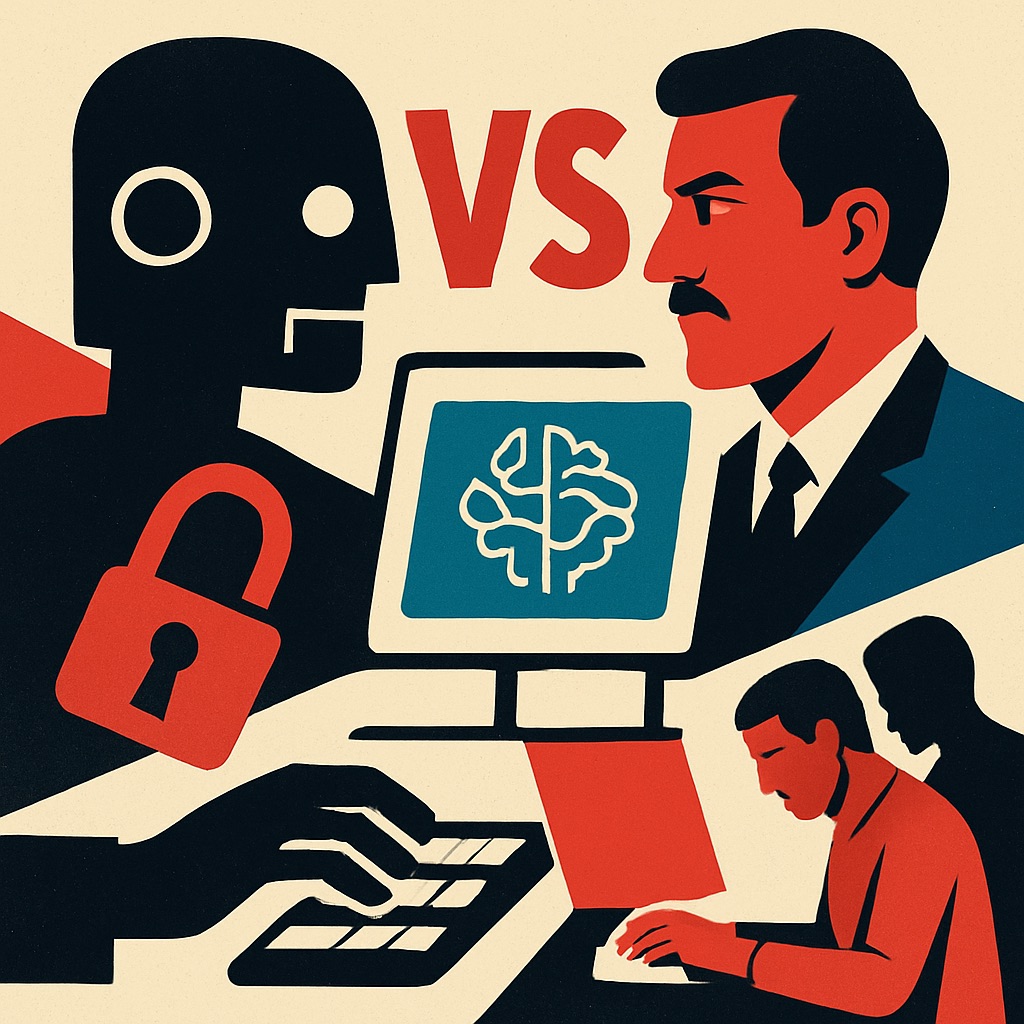
In today’s fast-evolving digital landscape, the titanic technology corporations are locked in a merciless struggle for AI dominance. Their competitive advantage is fuelled by the ability to access vast quantities of data. Yet this race holds profound implications for privacy, ethics, and the overlooked human labour that quietly powers it.

Originally published in Substack: https://substack.com/home/post/p-172413535

Large technology conglomerates are engaged in a cutthroat contest for AI supremacy, a competition shaped in large part by the free availability of data. Chinese rivals may be narrowing the gap in this contest, where the free flow of data reigns supreme. In contrast, in Western nations, personal data remains, at least for now, considered the property of the individual; its use requires the individual’s awareness and consent. Nevertheless, people freely share their data—opinions, consumption habits, images, location—when signing up for platforms or interacting online. The freer companies can exploit this user data, the quicker their AI systems learn. Machine learning is often applauded because it promises better services and more accurately targeted advertisements.

Hidden Human Labour

Yet, behind these learning systems are human workers—micro‑workers—who teach data to AI algorithms. Often subcontracted by the tech giants, they are paid meagrely yet exposed to humanity’s darkest content, and they must keep what they see secret. In principle, anyone can post almost anything on social media. Platforms may block or “lock” content that violates their policies—only to have the original poster appeal, rerouting the content to micro‑workers for review.

These shadow workers toil from home, performing tasks such as identifying forbidden sexual content, violence, or categorising products for companies like Walmart and Amazon. For example, they may have to distinguish whether two similar items are the same or retag products into different categories. Despite the rise of advanced AI, these micro‑tasks remain foundational—and are compensated only by the cent.

The relentless gathering of data is crucial for deep‑learning AI systems. In the United States, the tension between user privacy and corporate surveillance remains unresolved—largely stemming from the Facebook–Cambridge Analytica scandal. In autumn 2021, Frances Haugen, a data scientist and whistleblower, exposed how Facebook prioritised maximising user time on the platform over public safety Wikipedia+1.

Meanwhile, the roots of persuasive design trace back to Stanford University’s Persuasive Technology Lab (now known as the Behavior Design Lab), under founder B. J. Fogg, where concepts to hook and retain users—regardless of the consequences—were born. On face value, social media seems benign—connecting people, facilitating ideas, promoting second‑hand sales. Yet beneath the surface lie algorithms designed to keep users engaged, often by feeding content tailored to their interests. The more platforms learn, the more they serve users exactly what they want—drawing them deeper into addictive cycles.

Renowned psychologists from a PNAS study found that algorithms—based on just a few likes—could know users better than even their closest friends. About 90 likes enabled better personality predictions than an average friend, while 270 likes made AI more accurate than a spouse.

The Cambridge Analytica scandal revealed how personal data can be weaponised to influence political outcomes in events like Brexit and the 2016 US Presidential Election. All that was needed was to identify and target individuals with undecided votes based on their location and psychological profiles.

Frances Haugen’s whistleblowing further confirmed that Facebook exacerbates political hostility and supports authoritarian messaging especially in countries like Brazil, Hungary, the Philippines, India, Sri Lanka, Myanmar, and the USA.

As critics note, these platforms never intended to serve as central political channels—they were optimized to maximise engagement and advertising revenue. One research group led by Laura Edelson found that misinformation posts received six times more likes than posts from trusted sources like CNN or the World Health Organization The Guardian.

In theory, platforms could offer news feeds filled exclusively with content that made users feel confident, loved, safe—but such feeds don’t hold attention long enough for profit. Instead, platforms profit more from cultivating anxiety, insecurity, and outrage. The algorithm knows us so deeply that we often don’t even realise when we’re entirely consumed by our feelings, fighting unseen ideological battles. Hence, ad-based revenue models prove extremely harmful. Providers could instead charge a few euros a month—but the real drive is harvesting user data for long‑term strategic advantage.

Conclusion

The race for AI supremacy is not just a competition of algorithms—it’s a battle over data, attention, design, and ethics. The tech giants are playing with our sense of dissatisfasction, and we have no psychological tools to avoid it. While tech giants vie for the edge, a hidden workforce labours in obscurity, and persuasive systems steer human behaviour toward addiction and division. Awareness, regulation, and ethical models—potentially subscription‑based or artist‑friendly—are needed to reshape the future of AI for human benefit.


References

B. J. Fogg. (n.d.). B. J. Fogg. Wikipedia. Retrieved from https://en.wikipedia.org/wiki/B._J._Fogg
Behavior Design Lab. (n.d.). Stanford Behavior Design Lab. Wikipedia. Retrieved from https://en.wikipedia.org/wiki/Stanford_Behavior_Design_Lab
Captology. (n.d.). Captology. Wikipedia. Retrieved from https://en.wikipedia.org/wiki/Captology
Frances Haugen. (n.d.). Frances Haugen. Wikipedia. Retrieved from https://en.wikipedia.org/wiki/Frances_Haugen
2021 Facebook leak. (n.d.). 2021 Facebook leak. Wikipedia. Retrieved from https://en.wikipedia.org/wiki/2021_Facebook_leak

Zen and the Art of Dissatisfaction – 23

Bullshit Jobs and Smart Machines

This post explores how many of today’s high‑paid professions depend on collecting and analysing data, and on decisions made on the basis of that process. Drawing on thinkers such as Hannah ArendtGerd Gigerenzer, and others, I examine the paradoxes of complex versus simple algorithms, the ethical dilemmas arising from algorithmic decision‑making, and how automation threatens not only unskilled but increasingly highly skilled work. I also situate these issues in historical context, from the Fordist assembly line to modern AI’s reach into law and medicine.

Originally published in Substack: https://substack.com/inbox/post/170023572

Many contemporary highly paid professions rely on data gathering, its analysis, and decisions based on that process. According to Hannah Arendt (2017 [original 1963]), such a threat already existed in the 1950s when she wrote:

“The explosive population growth of today has coincided frighteningly with technological progress that makes vast segments of the population unnecessary—indeed superfluous as a workforce—due to automation.”

In the words of David Ferrucci, the leader of Watson’s Jeopardy! team, the next phase in AI’s development will evaluate data and causality in parallel. The way data is currently used will change significantly when algorithms can construct data‑based hypotheses, theories and mental models answering the question “why?”

The paradox of complexity: simple versus black‑box algorithms

Paradoxically, one of the biggest problems with complex algorithms such as Watson and Google Flu Trends is their very complexity. Gerd Gigerenzer (2022) argues that simple, transparent algorithms often outperform complex ones. He criticises secret machine‑learning “black‑box” systems that search vast proprietary datasets for hidden correlations without understanding the physical or psychological principles of the world. Such systems can make bizarre errors—mistaking correlation for causation, for instance between Swiss chocolate consumption and number of Nobel Prize winners, or between drowning deaths in American pools and the number of films starring Nicolas Cage. A stronger correlation exists between the age of Miss America and rates of murder: when Miss America is aged twenty or younger, murders committed by hot steam or weapons are fewer. Gigerenzer advocates for open, simple algorithms; for example, the 1981 model The Keys to the White House, developed by historian Allan Lichtman and geophysicist Vladimir Keilis‑Borok, which has correctly predicted every US presidential election since 1984, with the single exception of the result in the Al Gore vs. George W. Bush contest.

Examples where individuals have received long prison sentences illustrate how secret, proprietary algorithms such as COMPAS (“Correctional Offender Management Profiling for Alternative Sanctions”) produce risk assessments that can label defendants as high‑risk recidivists. Such black‑box systems, which may determine citizens’ liberty, pose enormous risks to individual freedom. Similar hidden algorithms are used in credit scoring and insurance. Citizens are unknowingly categorised and subject to prejudices that constrain their opportunities in society.

The industrial revolution, automation, and the meaning of work

Even if transformative technologies like Watson may fail to deliver on all the bold promises made by IBM’s marketing, algorithms are steadily doing tasks once carried out by humans. Just as industrial machines displaced heavy manual labour and beasts of burden—especially in agriculture—today’s algorithms are increasingly supplanting cognitive roles.

Since the Great Depression of the 1930s, warnings have circulated that automation would render millions unemployed. British economist John Maynard Keynes (1883–1946) coined the term “technological unemployment” to describe this risk. As David Graeber (2018) notes, automation did indeed trigger mass unemployment. Political forces on both the right and left share a deep belief that paid employment is essential for moral citizenship; they agree that unemployment in wealthy countries should never exceed around 8 percent. Graeber nonetheless argues that the Great Depression produced a collapse in real need for work—and much contemporary work is “bullshit jobs”. If 37–40 percent of jobs are such meaningless roles, more than 50–60 percent of the population are effectively unemployed.

Karl Marx warned of industrial alienation, where people are uprooted from their villages and placed into factories or mines to do simple, repetitive work requiring no skill, knowledge or training, and easily replaceable. Global corporations have shifted assembly lines and mines to places where workers have few rights, as seen in electronics assembly in Chinese factory towns, garment workshops in Bangladesh, and mineral extraction by enslaved children—all under appalling conditions.

Henry Ford’s Western egalitarian idea of the assembly line—that all workers are equal—became a system where anybody can be replaced. In Charles Chaplin’s 1936 film Modern Times, inspired by his encounter in 1931 with Mahatma Gandhi, he highlighted our dependence on machines. Gandhi argued that Britain had enslaved Indians through its machines; he sought non‑violent resistance and self‑sufficiency to show that Indians did not need British machines or Britain itself.

From industrial jobs to algorithmic threat to professional work

At its origin in Ford’s factory in 1913, the T‑model moved through 45 fixed stations and was completed in 93 minutes, borrowing the idea from Chicago slaughterhouses where carcasses moved past stationary cutters. Though just 8 percent of the American workforce was engaged in manufacturing by the 1940s, automation created jobs in transport, repair, and administration—though these often required only low-skilled labour.

Today, AI algorithms threaten not only blue‑collar but also white‑collar roles. Professions requiring long training—lawyers and doctors, for example—are now at risk. AI systems can assess precedent for legal cases more accurately than humans. While such systems promise reliability, they also bring profound ethical risks. Human judges are fallible: one Israeli study suggested that judges issue harsher sentences before lunch than after—but that finding has been contested due to case‑severity ordering. Yet such results are still invoked to support AI’s superiority.

Summary

This blog post has considered how our economy is increasingly structured around data collection, analysis, and decision‑making by both complex and simple algorithms. It has explored the paradox that simple, transparent systems can outperform opaque ones, and highlighted the grave risks posed by black‑box algorithms in criminal justice and financial systems. Tracing the legacy from Fordist automation to modern AI, I have outlined the existential threats posed to human work and purpose—not only for low‑skilled labour but for highly skilled professions. The text argues that while automation may deliver productivity, it also risks alienation, injustice, and meaninglessness unless we critically examine the design, application, and social framing of these systems.


References

Arendt, H. (2017). The Human Condition (Original work published 1963). University of Chicago Press.
Ferrucci, D. (n.d.). [Various works on IBM Watson]. IBM Research.
Gigerenzer, G. (2022). How to Stay Smart in a Smart World: Why Human Intelligence Still Beats Algorithms. MIT Press.
Graeber, D. (2018). Bullshit Jobs: A Theory. Simon & Schuster.
Keynes, J. M. (1930). Economic Possibilities for our Grandchildren. Macmillan.
Lee, C. J. (2018). The misinterpretation of the Israeli parole study. Nature Human Behaviour, 2(5), 303–304.
Lichtman, A., & Keilis-Borok, V. (1981). The Keys to the White House. Rowman & Littlefield.

Zen and the Art of Dissatisfaction  – Part 22

Big Data, Deep Context

In this post, we explore what artificial intelligence (AI) algorithms, or rather – large language models – are, how they learn, and their growing impact on sectors such as medicine, marketing and digital infrastructure. We look into some prominent real‑world examples from the recent past—IBM’s Watson, Google Flu Trends, and the Hadoop ecosystem—and discuss how human involvement remains vital even as machine learning accelerates. Finally, we reflect on both the promise and the risks of entrusting complex decision‑making to algorithms.

Originally published in Substack: https://substack.com/inbox/post/168617753

Artificial intelligence algorithms function by ingesting training data, which guides their learning. How this data is acquired and labelled marks the key differences between various types of AI algorithms. An AI algorithm receives training data and uses it to learn. Once trained, the algorithm performs new tasks using that data as the basis for its future decisions.

AI in Healthcare: From Watson to Robot Doctors

Some algorithms are capable of learning autonomously, continuously integrating new information to adjust and refine their future actions. Others require a programmer’s intervention from time to time. AI algorithms fall into three main categories: supervised learning, unsupervised learning and reinforcement learning. The primary differences between these approaches lie in how they are trained and how they operate.

Algorithms learn to identify patterns in data streams and make assumptions about correct and incorrect choices. They become more effective and accurate the more data they receive—a process known as deep learning, based on artificial neural networks that distinguish between right and wrong answers, enabling them to draw better and faster conclusions. Deep learning is widely used in speech, image and text recognition and processing.

Modern AI and machine learning algorithms have empowered practitioners to notice things they might otherwise have missed. Herbert Chase, a professor of clinical medicine at Columbia University in New York, observed that doctors sometimes have to rely on luck to uncover underlying issues in a patient’s symptoms. Chase served as a medical adviser to IBM during the development of Watson, the AI diagnostic assistant.

IBM’s concept involved a doctor inputting, for example, three patient‑described symptoms into Watson; the diagnostic assistant would then suggest a list of possible diagnoses, ranked from most to least likely. Despite the impressive hype surrounding Watson, it proved inadequate at diagnosing actual patients. IBM therefore announced that Watson would be phased out by the end of 2023 and its clients encouraged to transition to its newer services.

One genuine advantage of AI lies in the absence of a dopamine response. A human doctor, operating via biological algorithms, experiences a rush of dopamine when they arrive at what feels like a correct diagnosis—but that diagnosis can be wrong. When doubts arise, the dopamine fades and frustration sets in. In discouragement, the doctor may choose a plausible but uncertain diagnosis and send the patient home.

An AI‑algorithm‑based “robot‑doctor” does not experience dopamine. All of its hypotheses are treated equally. A robot‑doctor would be just as enthused about a novel idea as about its billionth suggestion. It is likely that doctors will initially work alongside AI‑based robot doctors. The human doctor can review AI‑generated possibilities and make their own judgement. But how long will it be before human doctors become obsolete?

AI in Action: Data, Marketing, and Everyday Decisions

Currently, AI algorithms trained on large datasets drive actions and decision‑making across multiple fields. Robot‑doctors assisting human physicians and the self‑driving cars under development by Google or Tesla are two visible examples of near‑future possibilities—assuming the corporate marketing stays honest.

AI continues to evolve. Targeted online marketing, driven by social media data, is an example of a seemingly trivial yet powerful application that contributes to algorithmic improvement. Users may tolerate mismatched adverts on Facebook, but may become upset if a robot‑doctor recommends an incorrect, potentially expensive or risky test. The outcome is all about data—its quantity, how it is evaluated and whether quantity outweighs quality.

According to MIT economists Erik Brynjolfsson and Andrew McAfee (2014), in the 1990s only about one‑fifth of a company’s activities left a digital trace. Today, almost all corporate activities are digitised, and companies have begun to produce reports in language intelligible to algorithms. It is now more important that a company’s operations are understood by AI algorithms than by its human employees.

Nevertheless, vast amounts of data are still analysed using tools built by humans. Facebook is perhaps the most well‑known example of how our personal data is structured, collected, analysed and used to influence and manipulate opinions and behaviour.

Big Data Infrastructure

Jeff Hammerbacher—in a 2015 interview with Steve Lohr—helped introduce Hadoop in 2008 to manage the ever‑growing volume of data. Hadoop, developed by Mike Cafarella and Doug Cutting, is an open‑source variant of Google’s own distributed computing system. Initially named after Cutting’s child’s yellow toy elephant, Hadoop could process two terabits of data in two days. Two years later it could perform the same task in mere minutes.

At Facebook, Hammerbacher and his team constructed Hive, an application running on Hadoop. Now available as Apache Hive, it allows users without a computer science degree to query large processed datasets. During the writing of this post, generative AI applications such as ChatGPT (by OpenAI), Claude (Anthropic), Gemini (Google DeepMind), Mistral & Mixtral (Mistral AI), and LLaMA (Meta) have become available for casual users on ordinary computers.

A widely cited example of public‑benefit predictive data analysis is Google Flu Trends (GFT). Launched in 2008, GFT aimed to predict flu outbreaks faster than official healthcare systems by analysing popular Google search terms related to flu.

GFT successfully detected the H1N1 virus before official bodies in 2009, marking a major achievement. However, in the winter of 2012–2013, media coverage of flu induced a massive spike in related searches, causing GFT’s estimates to be almost twice the real figures. The Science article “The Parable of Google Flu” (Lazer et al., 2014) accused Google of “big‑data hubris”, although it conceded that GFT was never intended as a standalone forecasting tool, but rather as a supplementary warning signal (Raising the bar, Wikipedia).

Google’s miscalculation lay in its failure to interpret context. Steve Lohr (2015) emphasises that context involves understanding associations—a shift from raw data to meaningful information. IBM’s Watson was touted as capable of such contextual understanding, capable of linking words to appropriate contexts .

Watson: From TV champion to Clinical Tool, and sold for scraps!

David Ferrucci, a leading AI researcher at IBM, headed the DeepQA team responsible for Watson . Named after IBM’s founder Thomas J. Watson, Watson gained prominence after winning £1 million on Jeopardy! in 2011, defeating champions Brad Rutter and Ken Jennings.

Jennifer Chu‑Carroll, one of Watson’s Jeopardy! coaches, told Steve Lohr (2015) that Watson sometimes made comical errors. When asked “Who was the first female astronaut?”, Watson repeatedly answered “Wonder Woman,” failing to distinguish between fiction and reality.

Ken Jennings reflected that:

“Just as manufacturing jobs were removed in the 20th century by assembly‑line robots, Brad and I were among the first knowledge‑industry workers laid off by the new generation of ‘thinking’ machines… The Jeopardy! contestant profession may be the first Watson‑displaced profession, but I’m sure it won’t be the last.”

In February 2013, IBM announced that Watson’s first commercial application would focus on lung cancer treatment and other medical diagnoses—a real‑world “Dr Watson”—with 90% of oncology nurses reportedly following its recommendations at the time. The venture ultimately collapsed under the weight of unmet expectations and financial losses. In January 2022, IBM quietly sold the core assets of Watson Health to private equity firm Francisco Partners—reportedly for about $1 billion, a fraction of the estimated $4 billion it had invested—effectively signalling the death knell of its healthcare ambitions. The sale marked the end of Watson’s chapter as a medical innovator; the remaining assets were later rebranded under the name Merative, a standalone company focusing on data and analytics rather than AI‑powered diagnosis. Slate described the move as “sold for scraps,” characterising the downfall as a cautionary tale of over‑hyped technology failing to deliver on bold promises in complex fields like oncology.

Conclusion

Artificial intelligence algorithms are evolving rapidly, and while they offer significant benefits in fields like medicine, marketing, and data analysis, they also bring challenges. Data is not neutral: volume must be balanced with quality and contextual understanding. Tools such as Watson, Hadoop and Google Flu Trends underscore that human oversight remains indispensable. Ultimately, AI should augment human decision‑making rather than replace it—at least for now.


References

Brynjolfsson, E., & McAfee, A. (2014). The Second Machine Age: Work, Progress, and Prosperity in a Time of Brilliant Technologies. W. W. Norton & Company.

Ferrucci, D. A., Brown, E., Chu‑Carroll, J., Fan, J., Gondek, D., Kalyanpur, A. A., … Welty, C. (2011). Building Watson: An overview of the DeepQA project. AI Magazine, 31(3), 59–79. (IBM Research)

Lazer, D., Kennedy, R., King, G., & Vespignani, A. (2014). The parable of Google Flu: traps in big data analysis. Science, 343(6176), 1203–1205. (Wikipedia)

Lohr, S. (2015). Data‑ism. HarperBusiness.

Mintz‑Oron, O. (2010). Smart Machines: IBM’s Watson and the Era of Cognitive Computing. Columbia Business School Publishing. [Referenced via IBM Watson bibliography] (TIME, Wikipedia)