Zen and the Art of Dissatisfaction – Part 17

From Mammoth Graves to Aurochs Temples

The archaeological record offers profound insights into the lives, beliefs, and practices of our prehistoric ancestors. From elaborate burials in Russia to monumental structures in Finland, and from intricate cave paintings in France to the extinction of megafauna across continents, these remnants challenge modern perceptions of early human societies. This article delves into various significant prehistoric sites and phenomena, shedding light on the complexity and richness of early human culture.

Originally published in Substack: https://substack.com/@mikkoijas

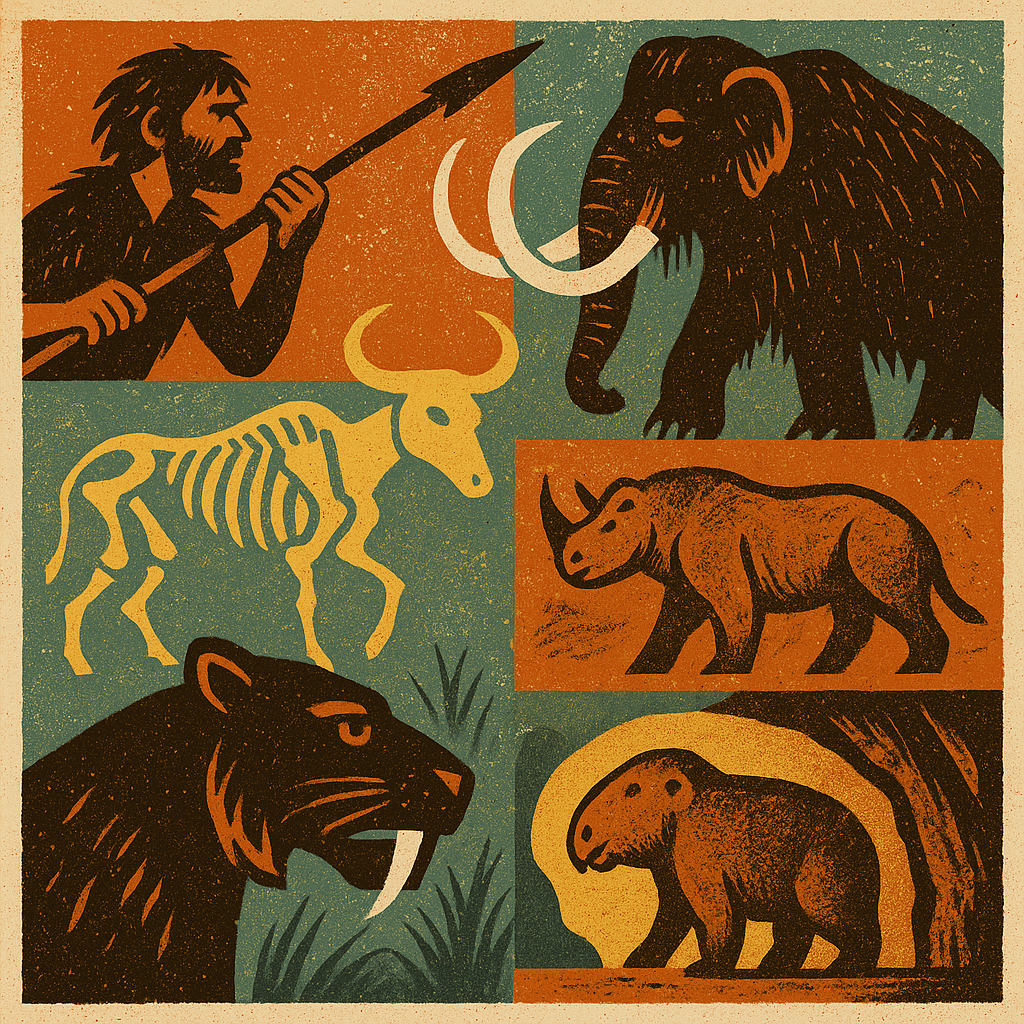
On the territory of present-day Russia, in Sungir some 34,000 years ago, Upper Palaeolithic humans left behind something truly extraordinary. In Sungir, an ancient grave has been discovered where two physically disabled children were buried together with precious treasures. The children of Sungir were adorned with beads carved from mammoth ivory—over 10,000 of them in total. Also found in the grave were 20 bracelets, 300 perforated fox teeth, 16 spears made from mammoth tusks, reindeer antlers, and other ornamental objects.

Unique Traces of Ancient Peoples and Lost Giants of the Ice Age

A common misconception suggests that ancient hunter-gatherers were nomadic wanderers trailing game animals, leaving behind little of note. This, however, is a misconception. We know that hunter-gatherer cultures constructed massive monuments even here in Finland. The 4,500-year-old “Giant’s Church” or Kastelli in Pattijoki is astonishing by any measure. The stone enclosure covers an area of about 2,200–2,300 square metres, with its walls rising on average 1–1.5 metres above the surrounding ground, and in some places nearly 2 metres.

Teotihuacán, located on the southern part of Mexico’s central plateau, is not necessarily ancient, but it too was built by hunter-gatherers. The city was founded in the 3rd century, and what makes it special is the complete absence of advanced technology. The inhabitants of Teotihuacán did not use sophisticated metal tools, did not practice agriculture, nor did they leave behind any administrative documents. The people who founded this city of around 100,000 inhabitants did not use draft animals or even the wheel in its construction. The city boasts two large pyramids, with the Pyramid of the Sun featuring 215-metre-long sides and a height of 60 metres.

In the Dordogne region of central France lies a particularly fascinating cave. After entering the cave, visitors board an electric train in a vast entrance hall, descending deep into the earth. The cave is, in places, so tall that the beam of a torch does not reach the ceiling. In other areas, it is so low that archaeologists had to crawl with their backs pressed against the ceiling to advance further in. After travelling about a kilometre and a half, the train stops, and the guide points to the cave wall. On the wall is an image of a woolly rhinoceros. A little later, the guide illuminates a beautiful depiction of two mammoths looking into each other’s eyes. Rhinoceroses and mammoths… in France! Like mammoths, woolly rhinoceroses disappeared from France after the end of the Ice Age.

In 1991, French diver Henri Cosquer accidentally discovered a cave sealed by an air pocket off the coast of Marseille in the Mediterranean. Now named Cosquer Cave, it lies 37 metres below sea level. Its walls are adorned with paintings of seals, auks, and lions.

Before the rise of modern humans, the lion was the most widely spread land mammal, present wherever land routes allowed. Upon the arrival of modern humans in Central Europe, large prides of cave lions roamed the mammoth steppe. Such prides are vividly depicted on the walls of Chauvet Cave, dating to around 35,000 years ago. Cave lions, likely dangerous to modern humans much like cave bears, went extinct around the same time as the most beautiful cave paintings were created in the Lascaux cave.

The Lascaux cave paintings are especially famous for their massive ceiling frescoes depicting aurochs. The production of these paintings appears to have taken place on an almost industrial scale. The large ceiling artworks were executed using temporarily erected scaffolding, upon which trained artists, working by the refined light of tallow lamps, painted anatomically precise depictions of wild animals as if floating weightlessly, upside down.

The cave is often compared to the Sistine Chapel. A visit to the replica of the Lascaux cave was an equally moving experience. In the first chamber of the cave, known as the Hall of the Bulls, the aurochs painted on the ceiling seem dreamlike. The bulls, wild horses, and other animals appear to fly in weightless space. This is a considerable achievement, especially for paintings made without any live models. The prehistoric artists were highly skilled. At the rear of the cave is a rock featuring a depiction of a horse floating upside down. Even from this two-dimensional image, one can see the animal has been rendered with flawless anatomical accuracy—an achievement that would be rare even among the finest animal illustrators in art history.

French archaeologist André Leroi-Gourhan (1911–1986) published several studies on French cave paintings, the most famous of which entered public discourse, especially in the 1960s, once translated into English. Leroi-Gourhan’s great achievement was his detailed mapping of caves and the precise counting of depicted motifs. Aurochs appear 137 times in the 72 caves he studied. However, the aurochs were less common than horses, which appear 610 times, bison 510 times, woolly mammoths 205 times, and the easily recognisable ibex with its majestic horns 176 times (Leroi-Gourhan 1967).

The aurochs held particular symbolic significance for Ice Age modern humans. South African archaeologist David Lewis-Williams, an expert on rock art, along with his colleague David Pearce (2011), have proposed that the depiction of aurochs in Central European caves may have led to the first organised religions, as modern humans settled into agricultural life. In southern Turkey, Çatalhöyük was, about 7,000 years ago, one of the first cities where people lived settled lives, farming the land and consuming domesticated animals. Lewis-Williams and Pearce suggest that the locals practised a form of religion centred on the aurochs.

At Çatalhöyük, there are rooms that appear to have been entered by crawling, with sculptures on the walls resembling the heads and horns of aurochs. According to Lewis-Williams and Pearce, at the core of this aurochs cult was a priesthood responsible for the domestication of sacrificial animals. Therefore, we can only speculate: did humans settle due to practical agricultural needs or because of religious practices? These rooms might also simply be domestic spaces with decorative aurochs heads.

Ritual, Settlement, and the Mystery of Agriculture

Today, we know that the people of Çatalhöyük did not consume domesticated aurochs. They had been domesticated a thousand years earlier in the Fertile Crescent. The inhabitants of Çatalhöyük continued to hunt wild aurochs but also farmed and raised sheep and goats.

Cities like Çatalhöyük—or even older archaeological sites in Turkey such as Göbekli Tepe—may have served as important religious gathering places, prompting the emergence of agricultural and pastoral lifestyles. But there is no certainty about which came first. Did people first settle and then begin farming? Hunter-gatherer societies may have gathered for seasonal ceremonies yet continued living in smaller, dispersed groups for parts of the year. Alternatively, such gatherings might have led to more permanent settlement—though other, likely very complex, factors were surely also involved.

Modern humans did not start farming universally because it was the best option. Plants have been cultivated in different parts of the world for a long time, but some cultures abandoned agriculture and returned to hunting, fishing, and gathering. Large civilisations have also been built in the Americas without agriculture. In these societies, the land and environment were sometimes altered to support certain plants and animals, and rivers were dammed to enhance fishing.

The Fall of the Aurochs and the Great Auk’s Last Stand

The last aurochs lived in the Jaktorów Forest near Warsaw in Poland as late as 1627. The habitat of the aurochs gradually shrank everywhere, and its meat was especially prized. The largest aurochs were bigger than modern cattle. Later aurochs living in Denmark and Germany reached around 180 centimetres in height and weighed about 700 kilograms, but Ice Age aurochs were even larger. The aurochs immortalised on the ceiling of Lascaux Cave may have weighed up to 1,500 kilograms.

Aurochs, woolly mammoths, woolly rhinoceroses, lions, and cave bears have disappeared from Europe. The great auk (possibly the flightless Pinguinus impennis)depicted on the walls of Cosquer Cave survived in places in great numbers until the 1800s, even though its use as game is evident from Stone Age excavations wherever it once lived.

Elisabeth Kolbert (2016) movingly recounts thestory of the flightless great auk. Before human interference, the auk lived along the eastern Atlantic coast from Norway to Italy, and across the western Atlantic from Canada to Florida. Iceland’s first settlers dined on the easily caught bird. The auk was unafraid of humans and could be caught simply by walking up and tapping it with a stick. With the rise of cod fishing, European fishermen in the 1500s began visiting islands off Newfoundland in northeast Canada.

Funk Island, north of Newfoundland, was known for its auks. An estimated 100,000 auk pairs lived there, potentially producing 100,000 eggs. Early European sailors easily filled their ships with these birds. People found many imaginative uses for the defenceless auk: as fish bait, for mattress stuffing with their feathers, and oil from their bodies was burned for fuel on the treeless, remote Atlantic islands. By the early 1800s, no auks remained on the North American coast. As Kolbert put it, the last American auk had been plucked, salted, and deep-fried.

Afterwards, the auks were confined to Geirfuglasker, an island off Iceland and their last significant habitat. A volcanic eruption destroyed the island in 1830, after which the remaining auks lived on the islet of Eldey. As they became rarer, wealthy European gentlemen competed for specimens and their eggs. The last two auks on Eldey were killed in 1844. A dozen Icelanders rowed to the islet. There they found two auks and a single egg. Sigurður Iselfsson, Ketil Ketilsson, and Jón Brandsson caught and strangled the birds. The last auk egg was broken during the struggle. The birds were sold to a private collector, and one of them is now part of the collection at the Natural History Museum of Los Angeles.

Giants Lost Across Continents

Large land-dwelling animals have also been forced out by humans outside of Europe. One of the best-known examples is Australia. Over 85 percent of Australian terrestrial species weighing more than 44 kilograms went extinct shortly after the arrival of modern humans around 50,000 years ago. Diprotodon, the largest known marsupial and a relative of the modern wombat, disappeared around 44,000 years ago. Diprotodon was about three metres long, two metres tall, and weighed up to three tonnes—a giant wombat. The same genus included Zygomaturus, weighing about 300–500 kilograms, which may have survived until about 35,000 years ago.

Around the same time, Palorchestes also vanished from Australia. This “ancient dancer” weighed about a tonne and may have been related to the ground sloths (Megalonychidae) that lived in North and South America, and which likewise went extinct after the Ice Age and the arrival of humans—although some individuals lived until the 1550s on the islands of Haiti and Cuba. The giant Megatherium, a ground sloth, lived mainly in South and Central America but became extinct around 12,000 years ago with the arrival of modern humans. Megatherium measured about six metres in length and weighed four tonnes.

Almost all land animals in the Americas weighing over 44 kilograms disappeared after the arrival of humans—giant armadillos weighing around a tonne, giant beavers over 100 kilograms, woolly mammoths, and nearly tonne-sized, cold-adapted camel relatives. Around the same time, Smilodon, the 400-kilogram, lion-height but far more robust sabre-toothed cat, also became extinct in both North and South America.

Conclusion

The archaeological and paleontological records underscore the complexity, adaptability, and impact of early human societies. From constructing monumental architecture and creating intricate art to influencing the extinction of megafauna, our ancestors demonstrated remarkable ingenuity and left enduring legacies that continue to inform our understanding of human history.


References

Kolbert, E. (2016). The Sixth Extinction: An Unnatural History. Bloomsbury Publishing.

Leroi-Gourhan, A. (1967). The Dawn of European Art: An Introduction to Palaeolithic Cave Painting. Cambridge University Press.

Lewis-Williams, D., & Pearce, D. (2011). Inside the Neolithic Mind: Consciousness, Cosmos and the Realm of the Gods. Thames & Hudson.

Roberts, R. G., Flannery, T. F., Ayliffe, L. K., et al. (2001). New Ages for the Last Australian Megafauna: Continent-Wide Extinction About 46,000 Years Ago. Science, 292(5523), 1888–1892. https://doi.org/10.1126/science.1060264

Zen and the Art of Dissatisfaction – Part 15

The Climate Story, The End of Holocene Stability 

Throughout human history, never before has the capital of states been as urgently needed as it is today. Canadian journalist, author, professor, and activist Naomi Klein, in her book On Fire (2020), argues that the accumulated wealth of the fossil fuel industry should be redirected as soon as possible to support the development of new, greener infrastructure. This process would also create new jobs. Similarly, Klein proposes a novel state-supported project whereby citizens help restore natural habitats to their original condition.

Originally published in Substack https://substack.com/history/post/164484451

In my public talks on climate, I often present a chart illustrating climate development in relation to the evolution of our species. The climate has warmed and cooled several times during the existence of Homo sapiens. Those who justify their privileged business-as-usual lifestyles often wrongly exploit this detail, because the rapid changes and fluctuations have always been deadly. 

From the Miocene Epoch to the Rise of Humans

The chart begins in the Miocene epoch, shortly before the Pliocene, a geological period lasting from about 5.3 to 2.6 million years ago. Around the boundary of the Miocene and Pliocene, approximately six million years ago, the evolutionary paths of modern humans and chimpanzees diverged. During the Pliocene, the Earth’s average temperature gradually decreased. Around the middle of the Pliocene, the global temperature was roughly 2–3 degrees Celsius warmer than today, causing sea levels to be about 25 metres higher.

The temperature target of the Paris Agreement is to keep warming below +1.5 degrees Celsius. However, the countries that ratified the agreement have failed to meet this goal, and we are now headed back toward Miocene-era temperatures. Bill Gates (2021) reminds us that the last time the Earth’s average temperature was over four degrees warmer than today, crocodiles lived north of the Arctic Circle.

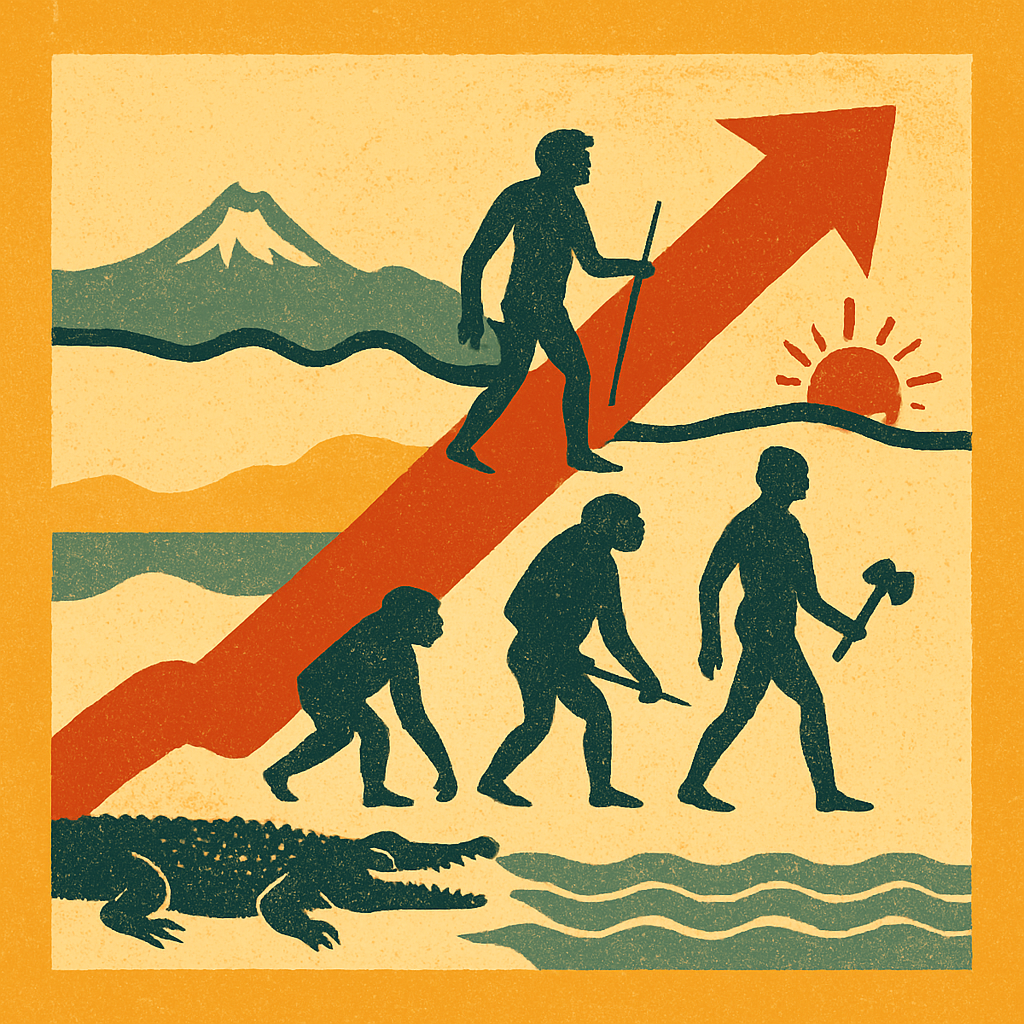
As the climate cooled and Africa’s rainforest areas shrank, a group of distant ancestors of modern humans adapted to life in woodlands and deserts, searching for food underground in the form of roots and tubers instead of relying on rainforest fruits. By the end of the Pliocene, the Homo erectus, or upright humans, appear in the archaeological record. Homo erectus is the most successful of all past human species, surviving in various parts of the world for nearly two million years. The oldest Homo erectus remains date back about two million years from Kenya, and the most recent ones are around 110,000 years old from the Indonesian island of Java.

Homo erectus travelled far from their African birthplace, reaching as far as Indonesia, adapting to diverse natural conditions. They likely tracked animals in various terrains, exhausting large antelopes and other prey by running them down until they could be suffocated or killed with stones. The animals were then butchered using stone tools made on site for specific purposes.

The Pleistocene and the Emergence of Modern Humans

About one million years ago, the Pliocene gave way to the Pleistocene epoch, a colder period marked by significant fluctuations in the Earth’s average temperature. The Pleistocene lasted from around one million to roughly 11,500 years ago. It is best known for the Earth’s most recent ice ages, when the Northern Hemisphere was covered by thick ice sheets.

Modern humans appear in the archaeological record from the Pleistocene in present-day Ethiopia approximately 200,000 years ago. More recent, somewhat surprising discoveries near Marrakech in Morocco suggest modern humans may have lived there as far back as 285,000 years ago. This indicates that the origin of modern humans could be more diverse than previously thought, with different groups of people of varying sizes and appearances living across Africa. While symbolic culture is not evident from this early period (285,000–100,000 years ago), it is reasonable to assume these humans were physically and behaviourally similar to us today. They had their own cultural traditions and histories and were aware political actors capable of consciously addressing challenges related to their lifestyles and societies.

Modern humans arrived in Europe about 45,000 years ago, towards the end of the last ice age. Their arrival coincided with the extinction of Neanderthals, our closest evolutionary relatives. Archaeological dates vary slightly, but Neanderthals disappeared either 4,000 or up to 20,000 years after modern humans arrived. There are multiple theories for their disappearance. In any case, modern humans interbred with Neanderthals, as evidenced by the fact that around 2% of the DNA of present-day humans outside Africa derives from Neanderthals.

The Holocene: An Era of Stability and Agricultural Beginnings

The Pleistocene ended with the conclusion of the last ice age and the beginning of the Holocene, around 11,500 years ago. The transition between these epochs is crucial to our discussion. The Pliocene was a period of steady cooling, while the Pleistocene featured dramatic temperature swings and ice ages. The Holocene ushered in a stable, warmer climate that allowed humans to begin experimenting with agriculture globally.

The steady temperatures of the Holocene provided predictable seasons and a climate suitable for domesticating and cultivating crops. I ask you to pay particular attention to the Holocene’s relatively stable temperatures—a unique period in the last six million years. Until the Holocene, our ancestors had lived as nomadic hunter-gatherers, moving to wherever food was available. Once a resource was depleted, they moved on.

This cultural pattern partly explains why modern humans travelled such great distances and settled vast parts of the planet during the last ice age. Only lions had previously spread as widely, but unlike lions, humans crossed vast bodies of water without fear. History has occasionally been marked by young reckless individuals, brimming with hormones and a desire to prove themselves (let’s call them “The Dudeson” types), who undertake risky ventures that ultimately benefit all humanity—such as crossing seas.

The stable Holocene climate also meant reliable rainfall and forest growth. Paleontologist and geologist R. Dale Guthrie (2005), who has studied Alaskan fossil records, describes the last ice age’s mammoth steppe. During that period, much of the Earth’s freshwater was locked in northern glaciers, leaving little moisture for clouds or rain. The mammoth steppe stretched from what is now northern Spain to Alaska, experiencing cold winters but sunny, relatively long summers. Humans, originating from African savannahs, thrived in this environment. Guthrie notes that ice age humans did not suffer from the common cold, which only emerged during the Holocene with domesticated animals.

The Anthropocene: Human Impact on Climate

The world as we know it exists within the context of Holocene. It is difficult to even imagine the conditions of the Pleistocene world. It is quite impossible for humans to even imagine what would the world be after the Holocene – and this moment is right now! Looking at the chart of global temperature history, we see that at the end of the Holocene, the temperature curve rises sharply. Since the Industrial Revolution in the 1800s, global temperatures have steadily increased. Because this warming is undoubtedly caused by humans, some suggest naming the period following the Holocene the Anthropocene—an era defined by human impact.

There is no consensus on how the Anthropocene will unfold, but atmospheric chemical changes and ice core records show that rising carbon dioxide (CO2) levels are a serious concern. Before industrialisation in the 1700s, atmospheric CO2 was about 278 parts per million (ppm). CO2 levels have steadily risen, especially since the 1970s, when it was 326 ppm. Based on the annual analysis from NOAA’s Global Monitoring Lab (Mauna Loa Observatory in Hawaii), global average atmospheric carbon dioxide was 422.8 ppm in 2024, a new record high. Other dangerous greenhouse gases produced by industry and agriculture include methane and nitrous oxide.

Greenhouse gases like CO2, methane, and nitrous oxide act like the glass roof of a greenhouse. They trap heat that would otherwise escape into space, reflecting warmth back to Earth’s surface. Industrial and agricultural emissions have altered atmospheric chemistry, causing global warming. This excess heat triggers dangerous feedback loops, such as increased water vapour in the atmosphere, which further amplifies warming by trapping more heat.

Monitoring atmospheric changes is essential for understanding our future. Because of climate system lags behind, temperatures are expected to continue rising for decades as ocean currents release stored heat. Eventually, temperatures will stabilise as excess heat radiates into space.

Climate Change, Food Security, and Global Uncertainty

A peer-reviewed article published in Nature Communications by Kornhuber et al. (2023) explores how climate change affects global food security. Changes in the atmosphere’s high-altitude jet streams, known as Rossby waves, directly impact crop production in the Northern Hemisphere. Climate change can cause these jet streams to become stuck or behave unpredictably, but current crop and climate models often fail to account for such irregularities.

The disruption of wind patterns due to ongoing warming could simultaneously expose major agricultural regions—such as North America, Europe, India, and East Asia—to extreme weather events. Global food production currently relies on balancing yields across regions. If one area experiences crop failure, others compensate. However, the risk of multiple simultaneous crop failures increases vulnerability. Since 2015, hunger in the Global South has grown alarmingly, with no clear solutions to climate-induced risks.

The greatest threat to humanity’s future may not be warming itself or extreme weather, but the uncertainty and unpredictability it brings. The Holocene was an era of safety and predictability, much like the Nile’s reliable flooding assured stability for ancient Egyptians. This stability provided a secure framework within which humanity thrived. Although crop failures have occurred throughout history, nothing compares to the potential loss of Holocene-era climatic reliability–nothing.

Conclusion

The climatic history of our planet and our species shows that we have lived through dramatic shifts—from the warm Miocene, through ice age Pleistocene swings, to the uniquely stable Holocene. It is this stability that enabled the rise of agriculture, settled societies, and civilisation. Today, human activity is destabilising this balance, pushing us into the uncertain Anthropocene.

Understanding this deep history is crucial for grasping the scale of the challenge we face. Climate change threatens the predictability that has underpinned human survival and food security for millennia. The future depends on our capacity to respond to these changes with informed, collective action, such as those Naomi Klein advocates: redirecting wealth and effort toward sustainable, green infrastructure and restoration projects.


References

Gates, B. (2021). How to avoid a climate disaster: The solutions we have and the breakthroughs we need. Penguin Random House.

Guthrie, R. D. (2005). The nature of Paleolithic art. University of Chicago Press.

Klein, N. (2020). On fire: The (burning) case for a green new deal. Simon & Schuster.

Kornhuber, K., O’Gorman, P. A., Coumou, D., Petoukhov, V., Rahmstorf, S., & Hoerling, M. (2023). Amplified Rossby wave activity and its impact on food production stability. Nature Communications, 14(1), 1234. https://doi.org/10.1038/s41467-023-XXX