Data: The Oil of the Digital Age
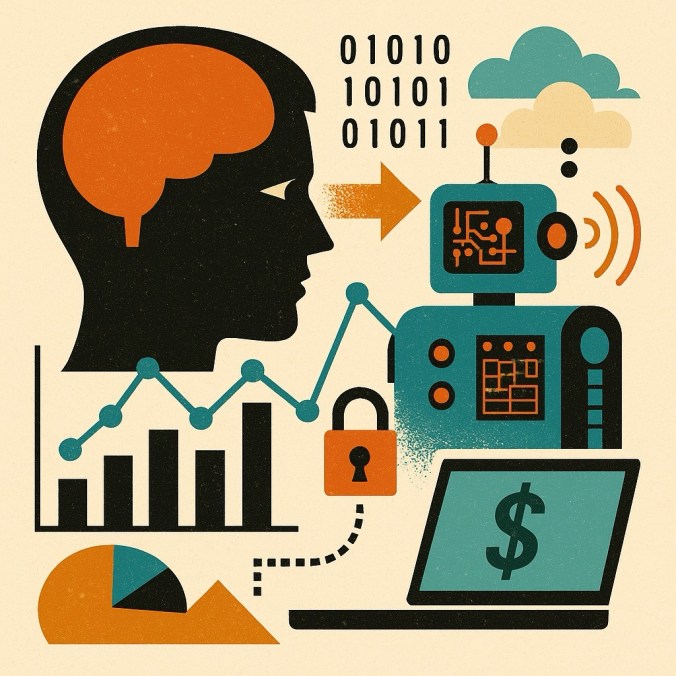
Data applications rely fundamentally on data—its extraction, collection, storage, interpretation, and monetisation—making them arguably the most significant feature of our contemporary world. Often referred to as ”the new oil,” data is, from the perspective of persistent capitalists, a valuable resource capable of sustaining economic growth even after conventional natural reserves have been exhausted. This new form of capitalism has been titled Surveillance Capitalism (Zuboff 2019).
Originally published in Substack: https://substack.com/@mikkoijas
Data matters more than opinions. For developers of data applications, the key goal is that we browse online, click “like,” follow links, spend time on their platforms, and accept cookies. What we think or do does not matter; what matters is the digital behavioural surplus, a trace we leave and our consent to tracking. That footprint has become immensely valuable—companies are willing to pay for it, and sometimes break laws to get it.
Cookies and Consumer Privacy in Europe
European legislation like the General Data Protection Regulation (GDPR) ensures some personal protection, but we still leave traces even if we refuse to share personal data. Websites are legally obligated to request our cookie consent, making privacy violations more visible. Rejecting cookies and clearing them out later becomes a time-consuming and frustrating chore.
In stark contrast, China’s data laws are much more relaxed, granting companies broader operational freedom. The more data a company gathers, the more fine-tuned its predictive algorithms can be. It’s much like environmental regulation: European firms are restricted from drilling for oil in protected areas, which reduces profit but protects nature. Chinese firms, unrestrained by such limits, may harm ecosystems while driving profits. In the data realm, restrictive laws narrow the available datasets. Whereas Chinese firms harvest freely, they might gain a major competitive edge that could help them lead the global AI market.
Data for Good: Jeff Hammerbacher’s Vision
American data scientist Jeff Hammerbacher is one of the field’s most influential figures. As journalist Steve Lohr (2015) reports, Hammerbacher started on Wall Street and later helped build Facebook’s data infrastructure. Today, he curates data collection and interpretation for the purpose of improving human lives—a fundamental ethos across the data industry. According to Hammerbacher, we must understand the current data landscape to predict the future. Practically, this means equipping everything we care about with sensors that collect data. His current focus? Transforming medicine by centring it on data. Data science is one of the most promising fields, where evidence trumps intuition.
Hammerbacher has been particularly interested in mental health and how data can improve psychological wellbeing. His close friend and former classmate, Steven Snyder, tragically died by suicide after struggling with bipolar disorder. This event, combined with Hammerbacher’s own breakdown at age 27—after being diagnosed with bipolar disorder and generalised anxiety disorder—led him to rethink his life. He notes that mental illness is a major cause of workforce dropout and ranks third among causes of early death. Researchers are now collecting neurobiological data from those with mental health conditions. Hammerbacher calls this “one of the most necessary and challenging data problems of our time.”
Pharmaceuticals haven’t solved the issue. Selective serotonin reuptake inhibitors(SSRIs), introduced in the 1980s, have failed to deliver a breakthrough for mood disorders. These remain a leading cause of death; roughly 90% of suicides involve untreated or poorly treated mood disorders, and about 50% of Western populations are affected at some point. The greater challenge lies in defining mental wellness—should people simply adapt to lives that feel unfit?
“Bullshit Jobs” and Social Systems
Investigative anthropologist David Graeber (2018) reported that 37–40% of Western workers view their jobs as “bullshit”—work they see as socially pointless. Thus, the problem isn’t merely psychological; our entire social structure normalises employment that values output over wellbeing.
Data should guide smarter decisions. Yet as our world digitises, data accumulates faster than our ability to interpret it. As Steve Lohr (2015) notes, a 20-bed intensive care unit can generate around 160,000 data points per second—a torrent demanding constant vigilance. Still, this data deluge offers positive outcomes: continuous patient monitoring enables proactive, personalised care.
Data-driven forecasting is set to reshape society, concentrating power and wealth. Not long ago, anyone could found a company; now a single corporation could dominate an entire sector with superior data. A case in point is the partnership between McKesson and IBM. In 2009, Kaan Katircioglu (IBM researcher) sought data for predictive modelling. He found it at McKesson—clean datasets recording medication inventory, prices, and logistics. IBM used this to build a predictive model, enabling McKesson to optimise its warehouse near Memphis and improve delivery accuracy from 90% to 99%.
At present, data-mining algorithms behave as clever tools. An algorithm is simply a set of steps for solving problems—think cooking recipes or coffee machine programming. Even novices can produce impressive outcomes by following a good set of instructions.
Historian Yuval Noah Harari (2015) provocatively suggests we are ourselves algorithms. Unlike machines, our algorithms run through emotions, perceptions, and thoughts—biological processes shaped by evolution, environment, and culture.
Summary
Personal data is the new source of extraction and exploitation—vital for technological progress yet governed by uneven regulations that determine competitive advantage. Pioneers like Jeff Hammerbacher highlight its potential for social good, especially in mental health, while revealing our complex psychology. We collect data abundantly, yet face the challenge of interpreting it effectively. Predictive systems can drive efficiency, but they can also foster monopolies. Ultimately, whether data serves or subsumes us depends on navigating its ethical, legal, and societal implications.
References
Graeber, D. (2018). Bullshit Jobs: A Theory. New York: Simon & Schuster.
Hammerbacher, J. (n.d.). [Interview in Lohr 2015].
Harari, Y. N. (2015). Homo Deus: A History of Tomorrow. New York: Harper.
Lohr, S. (2015). Data-ism: The Revolution Transforming Decision Making, Consumer Behavior, and Almost Everything Else. New York: Harper Business.
Zuboff, Shoshana (2019). The Age of Surveillance Capitalism: The Fight for a Human Future at the New Frontier of Power. PublicAffairs.
 Helsinki Zen - Peacemakers Finland