Written by Kikka Rytkönen
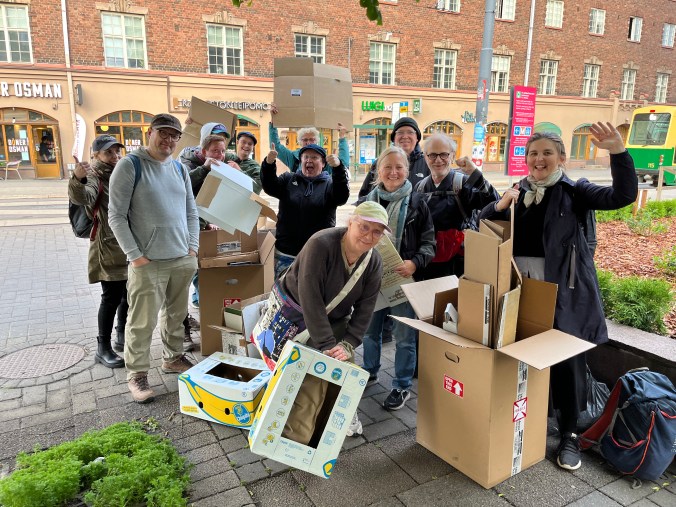
I thought the whole retreat was very good and interesting. Some of the topics that looked boring on paper turned out to be surprisingly engaging. For example, when we visited a Pentecostal church, I initially thought it would be unpleasant for me. But it turned out to be more like a performance, through which I came to understand why people are involved in the movement. It was a good experience.
I also learned how important it is to enter situations without labeling, prejudging, or defining them in advance. Just go in and listen. Everything related to religion was interesting. Lutheran Christianity was the most familiar to me, and perhaps that’s why it didn’t spark quite the same interest. I left the church when I was 16.
I had been to a mosque before, but this time I gained new insight—for instance, I understood why the Tatars haven’t faced discrimination in Finland. They said: “We’ve already been a minority in Russia.” That stayed with me.
Other organizations and begging
The D-station felt cozy. Waiting out the rain together always creates a sense of connection.
VEPA was an amazing place, and the people too. I will definitely return to that place.
Begging was hard. Asking for money felt impossible. People don’t really carry cash anymore. The experience made me feel a bit… submissive, or maybe inadequate. (Please find a better word than “submissive.”)
I ended up chatting with a man around my age standing outside a Euro store. I went inside, and when I came out, he—who turned out to be the shopkeeper—came up to me with a heavy bag full of sausages and chocolate. I thanked him with a handshake. It was a touching moment.
Since then, I’ve given a few euros to people in Piritori who ask for money specifically to buy food. I wonder: is it helpful to give money to someone I suspect is a drug addict? Is it really my place to decide?
Afterthoughts
I also want to mention what happened at the sleeping place. After Maika’s singing and mantra session, others started singing too—it created a beautiful sense of togetherness.
The ceremonies were extremely important and touching for me. On the island, the number of people amplified the experience, and the part of Mikko’s dharma transmission that involved the fire was particularly powerful. Both the content and the ritual form felt somehow purifying. Hard to explain—but I felt very connected.
In the group sharings, it felt like we were family.
Sleeping together so close to others—especially on cardboard and without a pillow—was quite challenging. I tried to learn to enjoy the sounds around me, from birds to some loud noise that made me think, “okay, now the war has started.”When I woke up, I felt congested and hadn’t gotten enough sleep. A sort of regression took over—people started to seem distant, even dismissive of me. I told myself: “Just get through this.” I guess some separation anxiety was already kicking in, knowing it would all end soon.
Back at Elokolo, I fixated on the idea that I needed to eat certain colors at specific intervals, and porridge became my central focus. I probably babbled some nonsense to people there too.
All in all, walking for a day and a half and spending a night without any belongings or a phone was incredibly liberating. It felt good not to have to fuss over stuff, money, or especially a phone.
At the farewell and the restaurant, I clung to Mikko Sensei and Maija—people I knew and felt safe with. I no longer knew how to be with anyone else, even though I could see people having conversations at other tables.
A big THANK YOU for the experience!
Did we become a sangha?
Peace-love,
Kikka
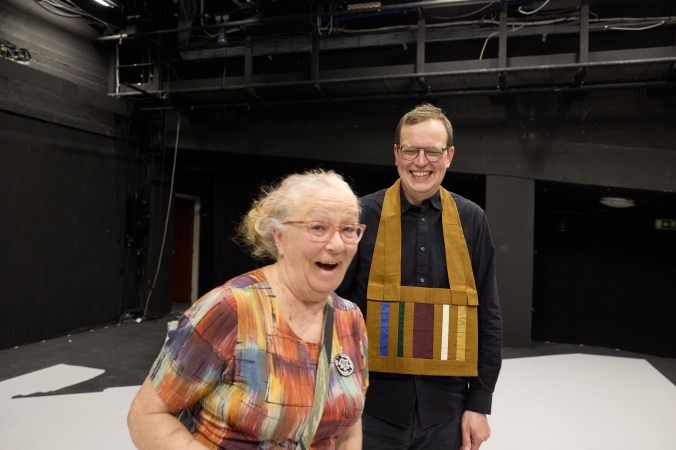
Kikka with Sensei Mikko
Photo by Laura Malmivaara
 Helsinki Zen - Peacemakers Finland
Paluuviite: Kohtaamisia ilman ennakkoluuloja | Helsinki Zen – Peacemakers Finland