Can Money Buy Happiness?
Originally published in 17 March 2025 on Substack: https://substack.com/home/post/p-159249876
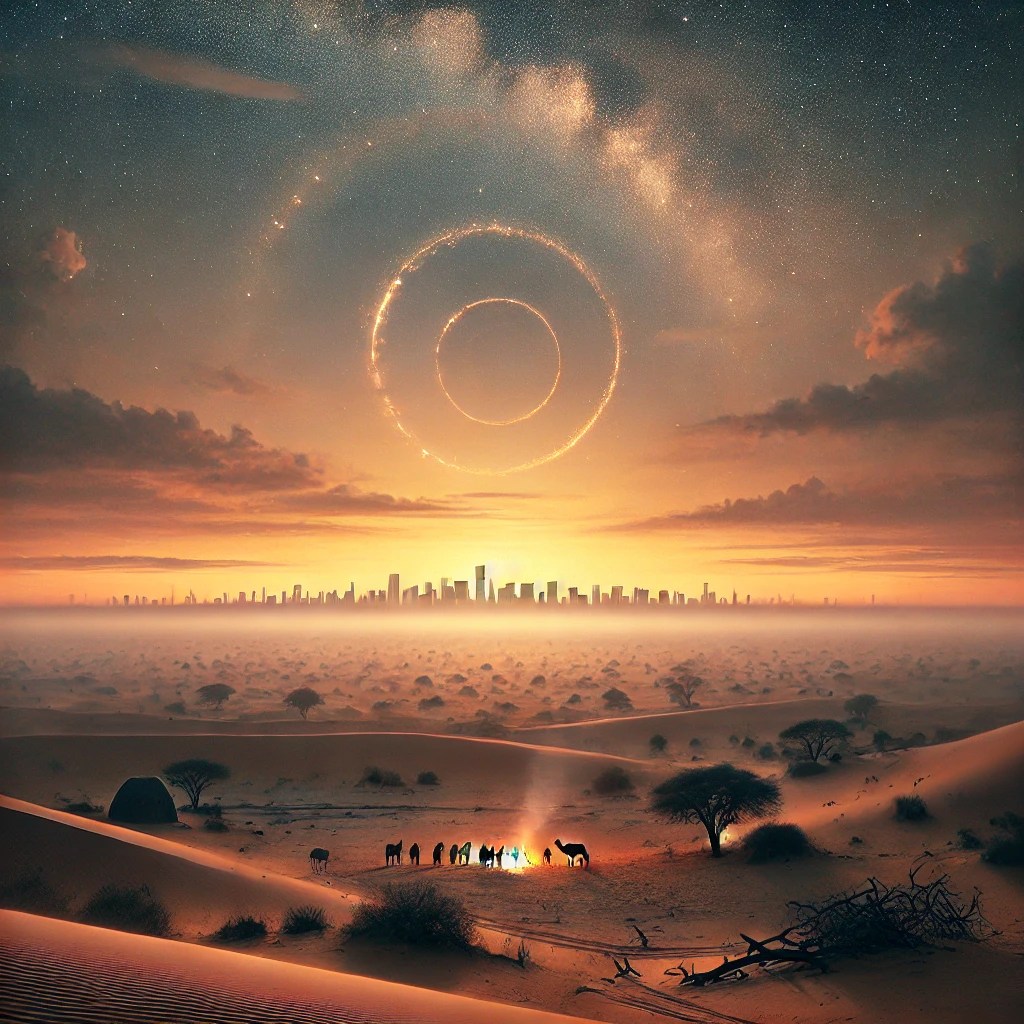
I traveled to the Kalahari Desert in northeastern Namibia, to the Nyae Nyae Conservancy on the border of Botswana, in November 2014 for two reasons. First, to collect ethnographic data for my doctoral dissertation. Second, to produce the accompanying documentary film The Origins (Ijäs & Kaunismaa 2018). My wife Maija and I lived in a tent on the roof of our 4WD vehicle, and sometimes we slept under the stars alongside local hunters, with nothing but our sleeping bags for shelter. Maija sang Brahms’ lullaby for us, and we explained to the hunters what angels were.
I had imagined (and hoped) that the Kalahari hunter-gatherers would be quite satisfied with their life, far from the psychological trappings of civilisation. This romanticised Rousseauian view had formed through reading books and research papers about the San people, especially since the Marshall family began visiting them in the 1950s. The San culture is often cited as one of the most thoroughly studied human groups in the world. There’s even a joke that every tribe has at least one white anthropologist. It was my time to be that guy.
Overall, the San do appear content with their lives, but they too have grievances and deep sources of dissatisfaction. They often wish for more wild animals to support their hunting culture. To compensate for the scarcity of game, they acquired a few goats and chickens in the spring of 2018. They also regularly bought milk from a nearby village outside the conservation area, where cattle farming is permitted. They were concerned about cattle herders crossing into their land from Botswana.
The San are happy to appear in traditional leather attire when cameras are rolling, but their culture has been changing quickly since the 1950s, as in everywhere. In fact, the group I studied had returned to a hunting culture only in the 1990s, partly as a response to the negative effects of Western influence, such as alcoholism and social challenges. Yet, thanks to Western aid, the Nyae Nyae Conservancy remains a viable area for groups that still practice hunting and gathering, at least in part.
For the purposes of this ongoing Substack series, Zen and the Art of Dissatisfaction, it is important that even the last indigenous peoples living in hunting cultures are not fully satisfied with their circumstances. They wish for more liberties, better education, and a more varied diet. One of our guides dreamed of working in the film industry. This is understandable as many of their visitors carry film equipment.
As I’ve previously noted, the deep profound dissatisfaction exists even among Kalahari hunter-gatherers. But the question is, do these hunter-gatherers want something they don’t have simply because of an internal dissatisfaction, or because they have glimpsed Western wealth and been enchanted by the promise of material satisfaction? The answer is likely a bit of both, because as long as our species Homo sapiens has existed, our actions have been marked by constant change, curiosity, and exploration.
Even when human cultures have settled in various parts of the world for extended periods, a closer look reveals that their cultures have been in constant dynamic motion. Their social structures, customs, art, food, clothing, tools, religions, and music have all evolved over time. Some indigenous peoples have changed their societal organisation, religions, property rights, and names with the seasons. Because of this dynamism, idealising indigenous cultures as somehow different than ours is a romanticised view. Seeing a foreign culture as superior is just the flip side of seeing it as inferior. Therefore, I try to be very cautious with such perspectives.
Swedish linguist, author and film maker Helena Norberg-Hodge is the founder and director of Local Futures, a non-profit dedicated to revitalising cultural and biological diversity and strengthening local communities and economies worldwide. In her book Ancient Futures (1991), she discusses cultural changes in Ladakh, a remote region in northern India bordering Pakistan and China. While politically part of India, culturally it is closer to Tibet. Ladakh remained largely isolated until 1962, when the first road was built over high mountain passes. In 1975, the Indian government opened Ladakh to tourism and Western development. Norberg-Hodge was one of the first Westerners to visit.
Norberg-Hodge describes Ladakh as a near paradise of social and ecological well-being that rapidly collapsed under external economic pressures. In the capital Leh, then with about 5,000 residents, cows were the main traffic hazard, and the air was crystal clear. Barley fields and farmhouses surrounded the city. Over the next 20 years, Norberg-Hodge witnessed Leh’s transformation. Streets filled with traffic and diesel fumes polluted the air. Soulless concrete housing projects sprawled into the distance. Water became undrinkable. Increased economic pressure led to unemployment and competition, sparking conflict between communities. Many changes were psychological.
On Norberg-Hodge’s first visit, all local houses in Ladakh were three-storied and beautifully painted. When she asked a young man to show her the poorest house in the village, he was puzzled—they had no concept of wealth inequality. Eight years later, that same man lamented their poverty, having seen images in the media of Westerners with fast cars and wealth. Suddenly, from his perspective, Ladakhi culture had morphed into primitive and poor.
Crime, depression, and suicide were rare in 1970s Ladakh. But in a short time, Western competition culture took root, and suicides became more common, even among schoolchildren. Until the 1970s, success and failure were communal experiences tied to tangible aspects of life like farming and family. Western consumer culture and market economy brought its hamster wheel to Ladakh, dividing people into winners and losers and turning personal success into everyone’s individual mission, and purpose of life.
Extreme individualism and the glorification of wealth have become so central to Western lifestyle that they seem quite natural or irrefutable. In the Western competitive mindset, happiness is always just around the corner, and we spend our lives trying to reach it. We imagine we need to succeed, and that success will lead us to more wealth. Financial security seems to be the ultimate state of happiness, but money itself doesn’t bring happiness. Money is a medium of exchange, based on trust, and it has value only because we agree it does. It is a means to an end, not an end in itself. Yet we see it as both, and that duality is worth exploring.
One might think that rich people would be happy in a world where wealth is the ultimate goal. But paradoxically, as they try to escape their own inner dissatisfaction, the world’s wealthiest people use the alcoholic drinks as the society’s poorest and most desperate. Studies show money does not bring happiness—but neither does poverty.
Poverty brings depression, but it is not only the lack of money that brings depression, it is the lack of freedom, which poverty brings along. Widespread depression among modern humans is largely due to lack of control over one’s circumstances. Depression is more common in poverty, where people feel trapped and unable to improve their circumstances. Wealth allows freer decision-making without worrying about consequences. Wealth also enables better planning for the future. Wealthy people can enrol to universities, and spend several years studying. The poor do not have this luxury. But even the rich suffer from the same existential emptiness and dissatisfaction. They seek meaning in luxury, exclusive holidays, fancy dinners, bespoke clothes, cars, watches—yet something is always missing. The inner void remains.
Did ancient hunter-gatherers have similar problems? Was their life freer in this sense? We might imagine they were fully capable of surviving in their environment, as long as they could find food, build shelter, and secure basic conditions for their family and offspring. After that, things were probably pretty good.
Ancient hunter-gatherers had no mortgages, insurance bills, electricity bills, credit card debt, or student loans. No college funds or extracurricular expenses for their children. Today, many people are up to their ears in debt. This abstract dependency on lenders causes various forms of undefined complicated anxiety. Humans have a natural need for at least some freedom and control over their lives; otherwise, they fall into despair. The Western debt-based system of dependency on power structures fosters further dissatisfaction.
Has our civilised Western lifestyle become a trap? Could we do something about it? Could we escape somewhere to be free? David Graeber and archaeologist David Wengrow (2021) remind us that in colonial North and South America, captured indigenous people often chose to return to their own communities rather than remain in ”civilisation”. The same applied to children captured by indigenous groups, who often preferred to remain with their indigenous captors. The main reasons might have been the intense social bonds among indigenous people: care, love, and above all, happiness—qualities impossible to replicate upon returning to civilisation. Graeber and Wengrow remind us that the concept of safety takes many forms. It’s one thing to know you statistically have a lower chance of being shot by an arrow. It’s another to know that around you are surrounded by who deeply care if that were to happen.
Depression has been found to be more common in impoverished conditions (Brown & Harris 1978). However, freedom or money does not ultimately save us from dissatisfaction. Andrew T. Jebb (2018), a researcher at Purdue University in Indiana, USA, studied with his colleagues whether money brings happiness. The study shows that money brings happiness up to a certain point, but not beyond a certain threshold. In Western Europe and here in Scandinavia, this threshold is around 50,000–100,000 euros in annual income, which is considerably higher than the average income. According to 2021 tax data, only 10.2% of the population reached this magical happiness threshold here in Finland, and 2% of the population surpassed this threshold. In other words, 87.8% of the population remained below that threshold. The situation is even more challenging because about 13% of the population with low incomes (below 60% of median income). The low-income threshold for a single-person household in 2021 was approximately 16,200 euros per year. No wonder we are not satisfied.
This post is the fifth part of my ongoing Substack series, Zen and the Art of Dissatisfaction, exploring the roots of human dissatisfaction, the paradox of progress, and the question of whether a meaningful life is possible in a world designed for endless desire.
Resources:
Brown, G. W., & Harris, T. (1978). Social Origins of Depression: A Study of Psychiatric Disorder in Women. Tavistock: London. LINK
Graeber, David & Wengrow, David. (2021). The Dawn of Everything: A New History of Humanity. London: Allen Lane. LINK
Ijäs, M. R. (2020). Fragments of the hunt: Persistence hunting approach to rock art. Hunter Gatherer Research, 6(3–4). LINK
Ijäs, M. (2017). Fragments of the Hunt: Persistence Hunting, Tracking and Prehistoric Art. Helsinki: Aalto University. LINK
Ijäs, M. & Kaunismaa, M. (2018). The Origins: Fragments of the Hunt. Documentary Film. LINK
Jebb, A.T., Tay, L., Diener, E., & Oishi, S. (2018). Happiness, income satiation and turning points around the world. Nature Human Behaviour. LINK
Norberg-Hodge, Helena (1991). Ancient Futures: Learning from Ladakh. San Francisco: Sierra Club Books. LINK
 Helsinki Zen - Peacemakers Finland