The Origin of Dissatisfaction
”He who is not content with what he has,
would not be content with what he would like to have.”
— Socrates
Originally published in 2 March 2025 on Substack https://substack.com/inbox/post/158235271
Are our closest relatives, such as chimpanzees or bonobos, dissatisfied? Research indicates that they experience feelings of unfairness when human researchers reward one individual with a cucumber and another with a grape for completing the same task. Is dissatisfaction something that has always existed? What drives us to always desire for more—consumer goods, exotic travels, romantic relationships, fancy clothes, flamboyant drinks—more of everything? We are like hungry ghosts, wanting everything, yet nothing quenches our thirst.
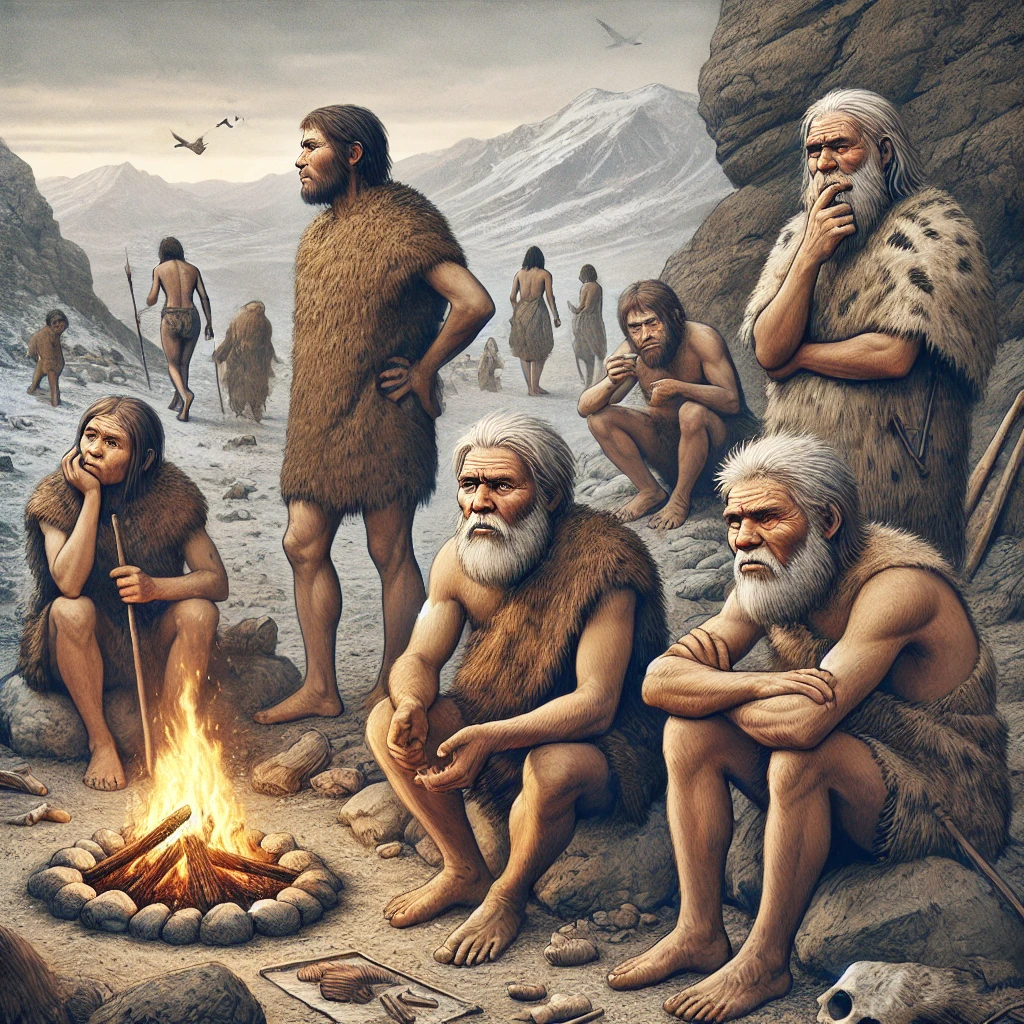
In principle, any stage in human history where cultural and technological evolution took a step toward greater complexity could be considered a potential source of origins of dissatisfaction. One such early step was taken around 70,000 years ago, marking the beginning of the Upper Palaeolithic. The culture of Middle Palaeolithic humans differed significantly from that of modern humans. Middle Palaeolithic people used hand axes similar to those that had been in use for hundreds of thousands of years. These people were biologically identical to us, yet this cultural ”contentment” with old ways feels foreign to us today.
However, we must approach such transitions cautiously. Although the shift to the Upper Palaeolithic is sometimes referred to as the ”Upper Palaeolithic explosion,” it was a slow process that took thousands of years and did not occur simultaneously in one place. Moreover, in this Substack series, we are discussing an internal dissatisfaction that other animals also seem to struggle with.
According to the Swedish geneticist, Nobel laureate Svante Pääbo, Neanderthals diverged from the same lineage as modern humans approximately 550,000–690,000 years ago. Earlier fossil-based estimates suggested that the split between modern humans and Neanderthals occurred around 250,000–300,000 years ago, while archaeological data estimates the separation at around 300,000 years.
Neanderthals inherited a similar method of making simple stone tools, and changes in tool evolution were relatively slow between 200,000 and 50,000 years ago. Meanwhile, modern humans in Africa gradually began engaging in extensive trade with other human groups. Archaeological evidence suggests that such behaviour was already occurring at least 80,000 years ago, though it is likely that it began even earlier, when modern humans had already existed for 300,000–200,000 years. The American anthropologist David Graeber and the British archaeologist David Wengrow remind us in their book The Dawn of Everything that Africa may have resembled something akin to J.R.R. Tolkien’s Middle-earth, populated by humans of various shapes and sizes.
The evidence for early interaction networks is scattered, but the tools used by early modern humans remained largely unchanged for long periods. Around 100,000 years ago, however, new types of tools and objects began to appear. For instance, very small and sophisticated arrowheads were made in southern Africa around 65,000–60,000 years ago, only to disappear from the archaeological record for some time before reappearing later.
Excavations reveal that Middle Palaeolithic people used the same tools and weapons for generations, which appear to have remained relatively unchanged. People did not move as frequently as they did later, nor do they seem to have had a rich symbolic culture involving body adornments or cave paintings.
By about 70,000 years ago, the transition to Upper Palaeolithic culture was well underway. It introduced cultural features that we still recognise as ”human.” However, there is no reason to assume that a major cognitive leap occurred at this point. British archaeologist Colin Renfrew coined the term sapient paradox to describe the illusion that we fail to recognise earlier human behaviour as human-like. The clearest archaeological evidence of the Upper Palaeolithic transition is the emergence of entirely new tools. Instead of heavy stone axes, modern humans began crafting refined stone blades that were sharp, lightweight, and required knowledge of the stone material. These blades were more portable and easier to attach to wooden shafts. Examples of this new technology include prismatic blades and sophisticated burins.
Some of the most recognisable Upper Palaeolithic achievements from Ice Age Europe include tools made from animal bones and tusks. Easily worked materials like bone were used to craft sewing needles, fishing hooks, harpoon tips, flutes, and small portable sculptures. The Upper Palaeolithic period also brought dietary changes. Previously, during the Middle Palaeolithic, humans primarily relied on large game, but Upper Palaeolithic humans expanded their diet to include snails, fish, shellfish, birds, smaller mammals, and terrestrial turtles.
Evidence of a plant-based diet during the Upper Palaeolithic has only emerged in recent years due to improved analysis methods. It now appears that humans consumed a variety of wild plants, herbs, tubers, roots, fungi, and nuts. These foods were processed by grinding, mashing, boiling, and roasting. Some researchers suggest that the Upper Palaeolithic era involved a broader participation of women and children in food gathering, though this may be a sexist assumption by male researchers. Studies of contemporary hunter-gatherer societies indicate that female hunting is quite common. Researchers from the University of Seattle, led by Abigail Anderson, found evidence that in 90% of the 50 analysed groups, women engaged in hunting. In over a third of these cases, women hunted all types of game, including large animals.
The Rise of Homo Non Satiatæ
The Upper Palaeolithic transition has been linked to advances in tools, diet, and cooperation, which in turn facilitated population growth and the rapid spread of humans across the Ice Age world, including Australia. It has also been suggested that this transition marked the end of earlier forms of cannibalism. While this is difficult to prove, it may have at least reduced such practices. Humans have occasionally engaged in cannibalism for various reasons, but in Upper Palaeolithic, they began burying their dead with respect and likely with ritual significance, as evidenced by grave goods found in burials.
Alongside these seemingly positive adaptations, something significant (for the lack of a better expression: modern) appears to have occurred in the human mind. Some have speculated that language and symbolic thought took a leap forward at this time. While this evolution was likely gradual, the archaeological record gives the impression of a sudden transformation. Natural selection favours those who are most reproductively successful, and new social and technological skills likely facilitated this process. However, natural selection does not consider whether the reproducing organism is healthy or happy. Humans at the dawn of the Upper Palaeolithic were likely neither always healthy nor necessarily happy—and perhaps this still applies. With the beginning of the Upper Palaeolithic, our species may have taken a step toward dissatisfaction. Perhaps the last 70,000—or at least 50,000—years of our evolution could be playfully described as the rise of Homo Non Satiatæ, the dissatisfied human.
From this perspective, we could frame the discussion as follows: one distinguishing feature of Upper Palaeolithic humans, compared to their predecessors, may have been the emergence of psychological dissatisfaction. I do not claim that people were content and happy before this transition, nor that it was the result of a sudden shift. Rather, it was likely a long, tens-of-thousands-of-years-long process during which humans lived in diverse communities, experimented with different ways of organising their societies, and adapted as best they could.
This trait had many enriching dimensions. Dissatisfaction made humans curious travellers, constantly searching for better hunting grounds. It also made them possessive, as evidenced by the extinction of large predators, megafauna, and competing species worldwide. Dissatisfaction also drove innovation—nothing old seemed to serve its purpose anymore, creating an urgent need for new tools, clothing, customs, and weapons.
Resources
Anderson, A., Chilczuk, S., Nelson, K., Ruther, R., & Wall-Scheffler, C. (2023). The Myth of Man the Hunter: Women’s Contribution to the Hunt Across Ethnographic Contexts. PLoS ONE, 18(6), e0287101.
Graeber, D., & Wengrow, D. (2021). The Dawn of Everything: A New History of Humanity. Farrar, Straus and Giroux.
Pääbo, S., et al. (1997). Neandertal DNA Sequences and the Origin of Modern Humans. Cell, 90(1), 19-30.
Renfrew, C. (2008). Neuroscience, Evolution and the Sapient Paradox / The Factuality of Value and of the Sacred. Philosophical Transactions of the Royal Society B: Biological Sciences, 363(1499), 2041-2047.
 Helsinki Zen - Peacemakers Finland